
On Wednesday morning (26 November), the Security Council and the General Assembly will adopt substantively identical resolutions on the 2025 Peacebuilding Architecture Review (PBAR). The Council president for November (Sierra Leone) is expected to put the agreed draft resolution to a vote at a Council meeting scheduled for 10 am. At the same time, the President of the General Assembly (PGA), Annalena Baerbock, is expected to table the corresponding draft resolution for adoption without a vote during a plenary meeting of the General Assembly, at which member states will have the option of delivering explanations of position.
This year’s PBAR was the fourth review since the creation of the UN Peacebuilding Architecture in 2005. (For background and more information, see the In Hindsight in our February 2025 Monthly Forecast.) The formal, intergovernmental review process began on 13 January with the appointment of co-facilitators Ambassador Osama Mahmoud Abdelkhalek Mahmoud (Egypt) for the General Assembly and Ambassador Samuel Žbogar (Slovenia) for the Security Council.
The adoption of twin resolutions on peacebuilding by the General Assembly and the Council is an innovative practice that dates to 20 December 2005, when the two organs adopted matching substantive and operative texts establishing the Peacebuilding Commission (PBC) and the Peacebuilding Support Office (PBSO), and requesting the Secretary-General to establish a Peacebuilding Fund (PBF). This dual-track approach enables the General Assembly and the Council to articulate and commit to a common framework for supporting peacebuilding efforts across the development, human rights, and peace and security pillars of the UN.
Twin Draft Resolutions
The 2025 twin draft resolutions affirm that the latest PBAR aims to enhance the implementation and impact of UN peacebuilding activities at the field level. They also restate the UN’s long-standing commitment to conflict prevention, peacebuilding, and sustaining peace, emphasising that these efforts rely on the mutually reinforcing contributions of development, human rights, and peace and security initiatives. They also emphasise the enduring importance of national ownership and inclusive governance, as well as the primary responsibility of member states in preventing conflict and addressing its root causes.
In the operative paragraphs of the resolutions, the General Assembly and the Security Council, among other things:
Task the PBC with developing a predictable, detailed annual programme of work, tying its activities more closely to those of the General Assembly, the Security Council, and the Economic and Social Council (ECOSOC).
Reaffirm that the PBC serves as a platform for assistance to member states, requesting it to support national prevention and peacebuilding strategies, undertake capacity-building, share good practices, and mobilise resources.
Request that the PBC strengthen its impact through regular follow-up, monitoring, and assessment of its activities; enhance the visibility of its work; and help global efforts to address peacebuilding financing gaps—especially to facilitate the participation of women and youth in peacebuilding efforts—including through increased coordination with international financial institutions and strategic dialogue with the PBF.
Encourage member states to strengthen the PBSO’s capacities—within existing resources or through voluntary funding—and call for better coordination and improved integration of peacebuilding considerations across UN reforms and UN field missions.
Encourage the Secretary-General to include more systematic data and analysis in his relevant reports to the Security Council, drawing on the PBSO’s expertise and system-wide capacities to track country and regional peacebuilding impact, within existing resources.
Decide to establish, within existing resources, an annual “peacebuilding week” in June to promote dialogue, exchange of good practices, and public awareness about the UN’s peacebuilding and sustaining peace efforts.
Call for a further comprehensive review of UN Peacebuilding in 2030.
The Negotiation Process
As shown in figure 1 below, the negotiations were a lengthy, consultative process. Between January and April, the co-facilitators encouraged member states to share views that informed an initial “elements paper”, which was circulated on 2 May and subsequently served as input to a joint General Assembly–Security Council informal interactive dialogue (IID) on the PBAR held on 8 May. (For more information, see our 6 May What’s in Blue story.) From that point, the drafting process advanced through successive revisions and rounds of consultations, with the co-facilitators issuing the initial draft of the text in June, followed by revised drafts in July, October, and November. An innovative feature of the process was the co-facilitators’ encouragement of issue-specific groups to voluntarily bring together member states with differing positions to informally work through contentious questions. The co-facilitators allowed sufficient time to enable constructive engagement during these informal consultations, which helped build consensus.
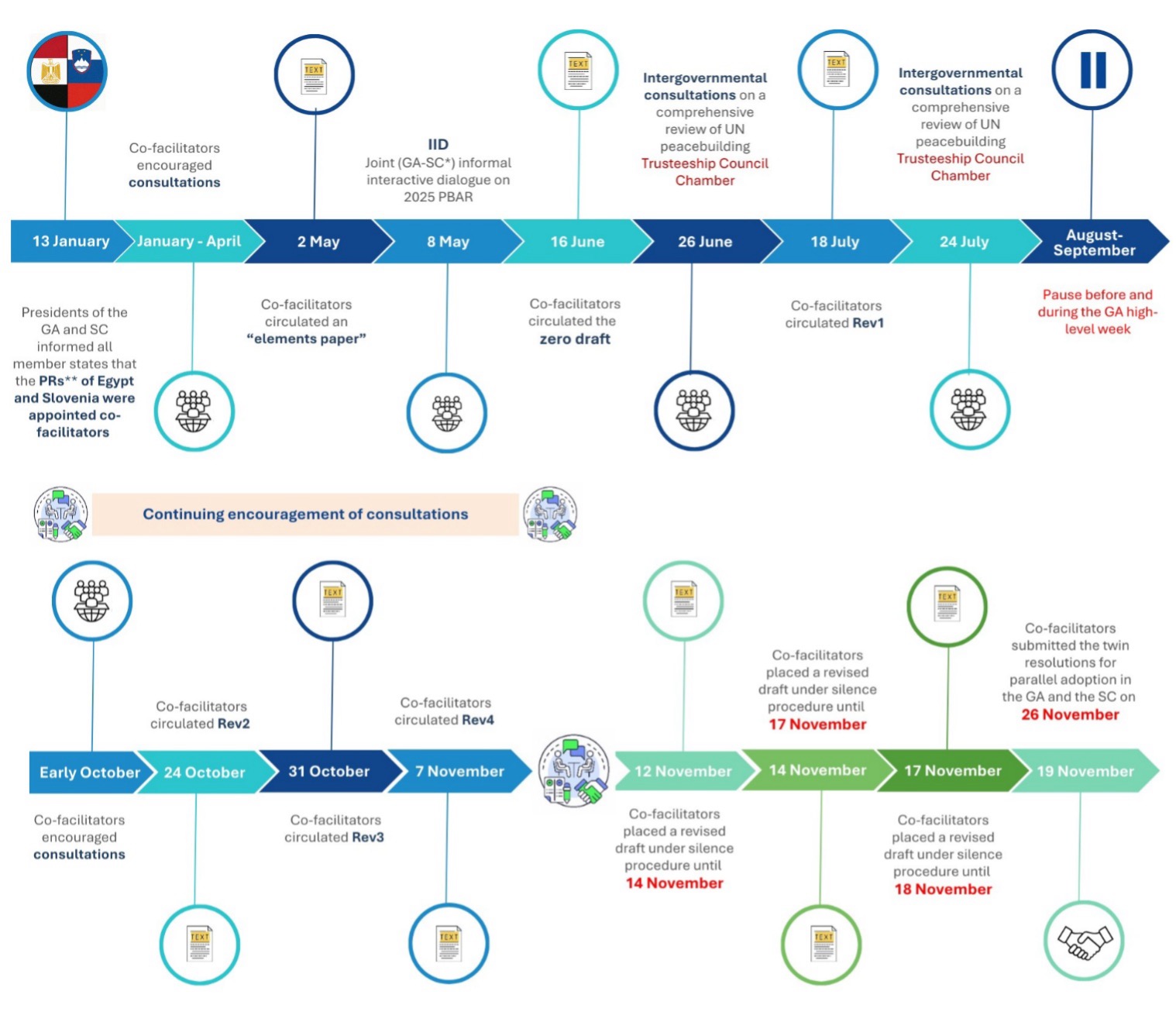
Figure 1:
Timeline of the Intergovernmental Phase of the 2025 Peacebuilding Architecture Review
*GA: General Assembly, SC: Security Council; **PRs: Permanent Representatives
On 12 November, the co-facilitators circulated a revised draft and put it under a silence procedure, which Algeria, Iran, Russia, and the US broke. The co-facilitators then circulated a further revised draft text on 14 November and put it under a silence procedure, which was broken by Algeria; Australia on behalf of a group of like-minded member states comprising Brazil, Canada, Colombia, Guatemala, Japan, Norway, the Republic of Korea (ROK), Switzerland, and the UK; China; the European Union (EU); Iran; and Russia. The co-facilitators circulated a further revised draft on 17 November and put it under silence until the following day. Algeria broke silence, requesting the addition of a reference to a presidential statement welcoming the start of the PBAR process that it initiated during its Council presidency in January. The co-facilitators convened an ambassadorial-level meeting on 18 November to consider this request. Although the meeting did not yield a conclusion, consensus was subsequently reached on a text without reference to the presidential statement. Subsequently, on 19 November, the co-facilitators submitted the twin resolutions to the General Assembly and the Security Council for adoption on 26 November.
Issues Raised during the Negotiations
The negotiations were challenging, as positions diverged among member states on several issues. In the initial draft text, the opening preambular paragraphs attempted to anchor the 2025 PBAR in a renewed commitment to multilateralism by, for example, referencing the Pact for the Future, the outcome document of the Summit of the Future. That language was contested, with the US deleting the word “multilateralism” and only agreeing on a weaker reaffirmation of international cooperation. China and the US also opposed referencing the Pact but eventually agreed to mentioning the relevant provisions adopted at the Summit of the Future.
Diverging views among member states on the meaning and scope of national ownership also caused divisions. Those prioritising sovereignty pressed for language affirming that conflict prevention and peacebuilding are nationally led and owned, that governments hold primary responsibility for setting priorities for such efforts, and that engagement with the UN and international financial institutions occurs voluntarily and strictly upon request. Meanwhile, proponents of an inclusive, participatory interpretation succeeded in embedding provisions related to women, peace and security (WPS) and youth, peace and security (YPS) in the text; maintaining explicit references to civil society, local peacebuilders, and women- and youth-led organisations; and securing language on financing for their participation in peacebuilding efforts.
Consistent with its recent approach across negotiated UN documents, the US removed references to gender throughout the text. As a result, language requesting the PBC to continue monitoring the implementation of its Gender Strategy and Youth Action Plan was replaced with a more generic request to monitor the implementation of its existing strategies and action plans.
The negotiations revealed deep divisions over the scope of the PBC’s preventive role. Proposals to link conflict prevention efforts to broader thematic drivers—such as climate change or environmental degradation—and to emphasise the value of early warning and implementing the UN’s 2030 Agenda and the Sustainable Development Goals in this respect, met sustained resistance until they were all removed. Language that positioned the PBC as a knowledge hub on some thematic issues relating to peacebuilding and sustaining peace, such as development and human rights, was similarly pared back. The final text of the draft resolutions converged on a demand-driven role, tasking the PBC and the PBF to support member states, upon request, in advancing nationally-owned prevention and peacebuilding strategies.
While early drafts of the twin texts sought a commitment to adequate, predictable, and sustained financing, this language was steadily diluted. Proposed language recalling the General Assembly’s 2023 decision to provide $50 million per year in assessed contributions to the PBF was not included in the final draft. An earlier preambular proposal to express concern about the impact of rising global military expenditures on peacebuilding investments was also not taken on board. Objections—particularly from the EU, Türkiye, and the US—overrode attempts of several delegations to reflect this concern in the text. Several member states interpreted the outcome of the negotiations on financing language as reflective of broader geopolitical dynamics, with cuts envisaged across multilateral cooperation budgets as military spending continues to rise.
Tags: Insights on Peacebuilding, Peacebuilding (including the PBC)
Sign up for What’s In Blue emails