
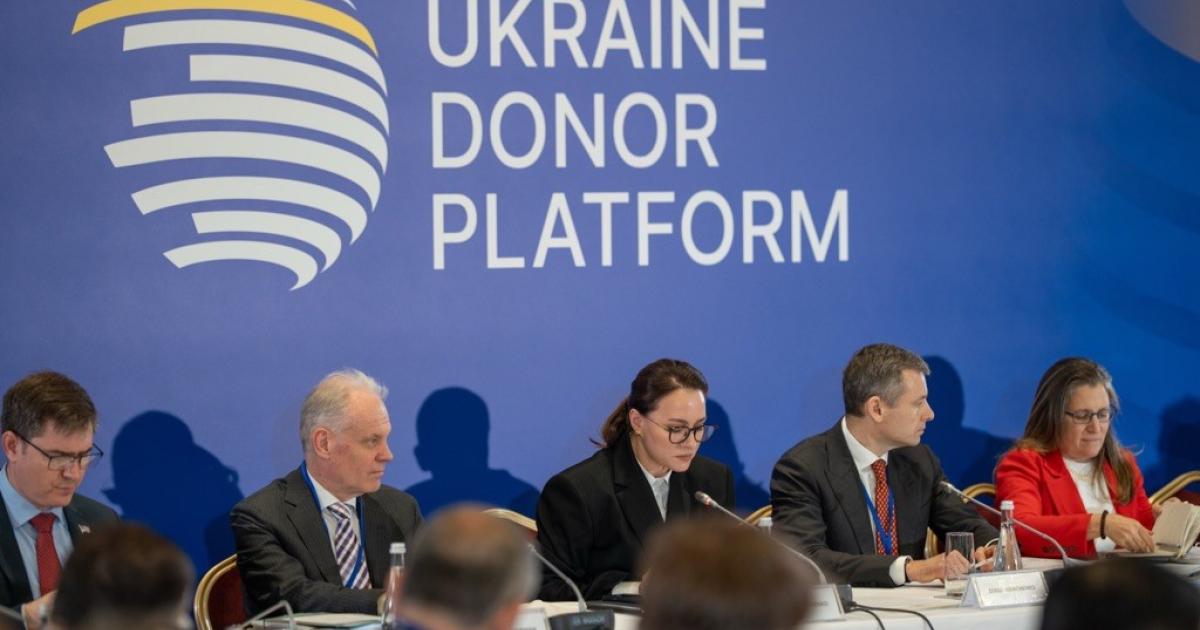
The Ukraine Donor Platform held its 15th Steering Committee in Kyiv today, bringing together senior representatives of its member countries and international financial institutions. This was the second meeting of the Platform’s governing body in Ukraine’s capital in 2025. The Steering Committee was opened by Yuliia Svyrydenko, Prime Minister of Ukraine, and chaired by Minister of Finance Sergii Marchenko.
The European Commission briefed the Steering Committee on the findings of the 2025 Enlargement Report for Ukraine, published earlier this month, which noted continued reform progress in all areas over the past year. The Steering Committee welcomed Ukraine’s reform efforts, delivered against a backdrop of ongoing war. Members stressed the need to proceed at pace with reform adoption, accompanied by rigorous implementation. They underlined the fundamental importance of further strengthening the rule-of-law and the fight against corruption. The effectiveness and independence of State anti-corruption bodies must be ensured, including in the context of the EU accession process and to support foreign direct investment, and there must be no backsliding. Ukraine stressed its strong commitment to pursue this agenda.
The Steering Committee reiterated the importance of the ongoing public investment management (PIM) reform and its further reinforcement through the introduction of the 2026 Single Project Pipeline, which consolidates all state investment programmes and projects eligible for budgetary, international or other financing, and integrates municipalities into the PIM framework.
The Steering Committee received updates from the Minister of Finance, the International Monetary Fund and the Canadian G7 Presidency on Ukraine’s budgetary situation and external financing needs. Members welcomed the Government’s efforts on domestic revenue mobilisation and reiterated their strong commitment to continue supporting Ukraine in addressing its financing needs, both in 2026 and beyond. Members acknowledged the ongoing discussions on a wide range of financing options, including further leveraging immobilised Russian Sovereign Assets in their jurisdictions in a coordinated way to support Ukraine.
Ukraine updated the Platform on its priorities for the reconstruction of areas heavily affected by the war, in particular frontline regions, based on a comprehensive approach addressing all future needs of the settlements in question. With the winter season approaching, those communities are vulnerable amid ongoing Russian attacks on infrastructure. The Steering Committee noted the Government’s initiatives to provide financial support for those regions, with cross-sectoral programmes intended to provide social assistance, to ensure the stability of healthcare, housing, educational, civil security and other crucial sectors. Ways were discussed to ensure the fast and efficient reconstruction of the most affected territories. Members welcomed Ukraine’s recent achievements in the comprehensive restoration of settlements, a new holistic approach set for further expansion.
The Steering Committee held an extensive discussion on how to support the resilience of Ukraine and its people as winter sets in. In this context, members strongly condemned Russia’s direct attacks on civilian and energy infrastructure and reaffirmed their support for Ukraine’s energy security. The Steering Committee called for work to be taken forward as a matter of urgency on a comprehensive approach to support Ukraine’s energy resilience in both the short and medium term.
The Steering Committee reiterated the importance of efforts to boost private sector engagement in Ukraine’s recovery and reconstruction. Members welcomed the updated work plan of the Business Advisory Council, which was established in June 2024 to provide expertise, insights and problem solving to improve Ukraine’s investment climate and help to attract private investment. A dedicated meeting between Steering Committee members and the Business Advisory Council will be organised in the coming weeks to exchange views on the priority areas of focus to be pursued in 2026.
For the first time, Ukraine briefed the Steering Committee on the needs of war veterans, underlining that a support system for veterans should be an integral component of Ukraine’s recovery initiatives. The Steering Committee agreed that this important issue should be further discussed in forthcoming meetings of the Platform.
Following the Steering Committee, members took part in a series of roundtable discussions with civil society organisations active in six regions of Ukraine that are particularly affected by the ongoing war: Chernihiv, Kharkiv, Mykolaiv, Odesa, Sumy and Zaporizhzhia, along with representatives of the authorities from the oblasts in question. The discussions deepened members’ understanding of the priorities and challenges facing these regions and of the level of civic engagement in the planning, delivery and monitoring of recovery and reconstruction activities. Today’s exchanges further reaffirmed the Platform’s strong commitment to engagement with Ukrainian civil society, which will be pursued in the coming year.
The Steering Committee welcomed the work done at the Ukraine Recovery Conference (URC) 2025 held in Rome, in particular regarding insurance and credit instruments and new funds, notably the European Flagship Fund for the Reconstruction of Ukraine, which is set to become operational in 2026.
The Platform’s next Steering Committee meeting is expected to take place in early 2026.