
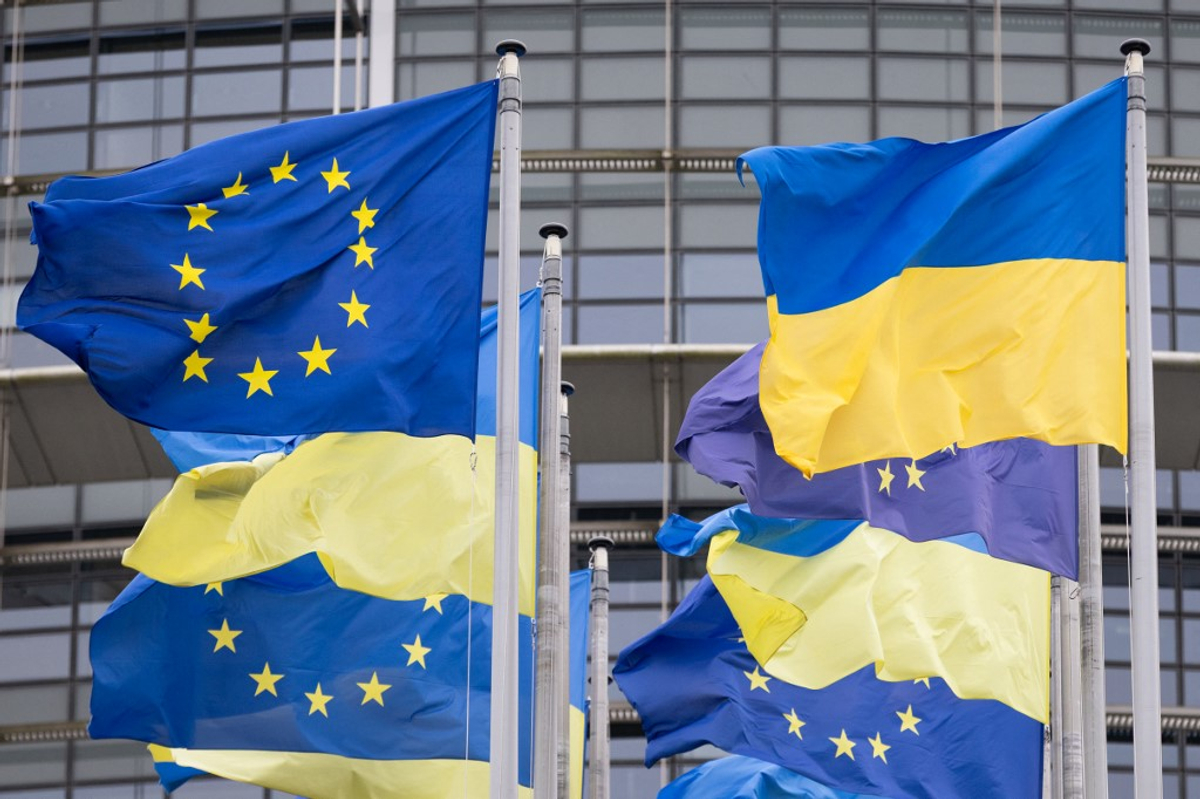
Europe’s E3 powers – Britain, France and Germany – have drafted a counter-proposal to the controversial US peace plan for Ukraine, offering a point-by-point revision of the leaked document.
Reuters has released the text of a European counter-proposal, which the agency reviewed on Sunday. Kyiv Post has compared it with the original US draft on a point-by-point basis.
JOIN US ON TELEGRAM
Follow our coverage of the war on the @Kyivpost_official.
While the EU uses the American plan as its foundation, it rewrites, deletes, or reframes multiple elements that critics noted would reward Moscow or compromise Kyiv’s sovereignty.
1. Sovereignty of Ukraine
EU: Reconfirms Ukraine’s sovereignty.
US: Says Ukraine’s sovereignty will be confirmed.
The wording is nearly identical; both establish sovereignty as the baseline.
2. Non-aggression agreement
EU: A total and complete non-aggression pact involving Ukraine, Russia, and NATO, resolving “all ambiguities of the last 30 years.”
US: A comprehensive non-aggression agreement between Russia, Ukraine, and Europe.
EU explicitly includes NATO, not “Europe,” stresses “total and complete.” However, both aim to close decades of disputes, but the EU’s framing is more expansive and institutional.
3. Deleted clause (NATO expansion/Russian aggression)
The US plan included a line: “Russia will not invade neighboring countries and NATO will not expand further.”
Other Topics of Interest
Driscoll Meets Russians in Abu Dhabi as Peace Plan Shrinks to 19 Points
Washington slashes its Ukraine peace plan from 28 to 19 points as Army Secretary Dan Driscoll is said to hold secret talks with Russian officials in Abu Dhabi.
The EU deletes the point entirely and proposes no replacement. Thereby, the EU rejects any language restricting NATO enlargement or implicitly legitimizing Russia’s regional veto.
4. Russia-NATO dialogue
EU: Calls for post-agreement Russia-NATO dialogue to address security concerns, reduce tensions, and enable “future economic opportunity.”
US: A Russia-NATO dialogue mediated by the United States.
Obviously, the EU removes US mediation and restores NATO-Russia direct engagement. The EU emphasizes economic connectivity, while the US wording is more political/strategic.
5. Security guarantees for Ukraine
EU: Ukraine will receive robust security guarantees.
US: Ukraine will receive reliable security guarantees.
The EU’s term “robust” implies stronger commitments, though both remain vague.
6. Size of Ukrainian Armed Forces (AFU)
EU: Peacetime cap at 800,000 troops.
US: Cap at 600,000 troops.
EU allows a significantly larger Ukrainian army – a clear pushback against the restrictive US proposal.
7. NATO membership
The EU states the obvious: Ukraine’s NATO accession “depends on consensus,” which currently does not exist.
US: Ukraine must constitutionally renounce NATO membership; NATO must legally bar Ukraine from ever joining.
So, the EU removes the prohibition entirely. The US proposes a permanent veto on Ukraine’s NATO future.
8. Stationing of NATO troops in Ukraine
EU: NATO will not station permanent troops in Ukraine during peacetime.
US: NATO will not station troops in Ukraine at all.
EU preserves flexibility for temporary or crisis deployments while the US imposes a blanket ban.
9. Fighter jets
EU: NATO fighter jets will be stationed in Poland.
US: European fighter jets will be stationed in Poland.
EU emphasizes NATO command; meanwhile the US frames it as a Europe-only measure.
10. US security guarantee (Article 5-like)
Both propose a US security guarantee, but the EU version is slightly narrower.
The EU includes:
US receives compensation. Ukraine loses guarantee if it invades Russia. Full sanctions snapback and coordinated response if Russia invades Ukraine.
US includes all the above plus a clause stating Ukraine loses the guarantee if it launches an unprovoked missile strike on Moscow or St. Petersburg.
Obviously, the EU softens the conditionality by removing the “missile strike” provision, seen as ambiguous and easily manipulable by Russia.
11. EU membership
EU: Eligible for EU accession + temporary market access.
US: Same formula.
12. Reconstruction and development package
The two drafts are nearly identical, outlining:
A Ukraine Development Fund Joint US-Ukraine energy infrastructure management Reconstruction of war-damaged regions Infrastructure, tech, AI, mineral extraction World Bank financing package
There are minor linguistic changes but no substantive policy divergence.
13. Russia’s reintegration into the global economy
The sections are nearly identical, including phased sanctions relief, long-term US-Russia economic cooperation, joint projects (energy, resources, data, AI, Arctic, etc.), and return to the G8. So, no difference beyond wording.
14. Frozen Russian assets
EU: Russia must compensate Ukraine, including through sovereign assets, which remain frozen until reparations are paid.
US: $100bn of Russian assets go to US-led Ukrainian reconstruction, US retains 50% of profits while EU contributes another $100bn. Remaining frozen funds placed into a US-Russia investment vehicle.
The EU proposes straightforward reparations – Russia pays before assets are unfrozen. US proposes a highly complex asset-management system that partially benefits Washington and creates joint Russian-American investment structures.
15. Enforcement mechanism
EU: A joint security taskforce including the US, Ukraine, Russia, and Europeans.
US: A US-Russia working group on security issues.
Apparently, the EU wants a multilateral system including Ukraine; the US proposes a bilateral US-Russia structure, largely excluding Kyiv and Europe.
16. Russia’s Non-Aggression Law
EU & US: Russia to codify non-aggression toward Europe and Ukraine.
17. Nuclear Treaties
EU: Extend nuclear treaties including “Fair Start.”
US: Extend treaties including START I.
The only difference is naming; intent is the same.
18. Ukraine’s Nuclear Status
EU & US: Ukraine reaffirms its status as a non-nuclear NPT state.
19. Zaporizhzhia Nuclear Plant
EU & US: The Zaporizhzhia NPP will be restarted under International Atomic Energy Agency (IAEA) supervision, with electricity split 50/50 between Russia and Ukraine.
20. Cultural, Linguistic and Media Rights
EU draft: Ukraine will adopt EU rules on religious tolerance and protection of linguistic minorities.
US draft:
Both countries will implement education programs promoting cultural understanding. Ukraine will adopt EU rules on religious tolerance and protection of linguistic minorities. Both countries will abolish discriminatory measures and guarantee media and education rights for both languages. All Nazi ideology and activities will be banned.
The US draft is broader, imposing obligations on both sides and adding “denazification” language.
21. Territorial Issues
EU: Ukraine commits not to restore its occupied territories by military means. Negotiations on territorial swaps will begin from the current Line of Contact.
US: Crimea, Luhansk and Donetsk will be recognized as de facto Russian, including by the US. Kherson and Zaporizhzhia will be frozen along the line of contact, implying de facto recognition. Russia will give up some other unspecified territories it controls.
Ukraine will withdraw from parts of the Donetsk region it currently holds; this zone will become a demilitarized buffer internationally recognized as Russian territory, with Russia not entering the zone.
The US version contains explicit territorial concessions to Russia; the EU version avoids recognizing any Russian claims and frames everything as future negotiations.
22. Territorial Changes by Force
EU & US: Future territorial arrangements cannot be changed by force; violations void security guarantees.
23. Dnipro & Grain Corridor
EU & US: Russia must not obstruct Ukraine’s commercial use of the Dnipro; grain must move freely via the Black Sea.
24. Humanitarian Issues
EU & US:
“All-for-all” POW and body exchanges Return of all civilian hostages and abducted children Family reunification Support for victims
Differences are negligeable.
25. Elections
EU: Elections “as soon as possible.”
US: Elections within 100 days.
Obviously, the EU leaves timing flexible while US imposes a strict 100-day deadline.
26. Accountability/Amnesty
EU: Provides measures to address the suffering of victims.
US: Grants full amnesty to all parties and bans future claims or complaints.
The two provisions fundamentally diverge – EU focuses on victims, US proposes blanket amnesty.
27. Enforcement Body
EU & US:
Legally binding agreement Oversight by a body chaired by Donald Trump (Board of Peace / Peace Council) Penalties or sanctions for violations
So, only terminology differs.
28. Ceasefire Modalities
EU: Ceasefire begins once both sides withdraw; monitoring arrangements still to be negotiated under US supervision.
US: Ceasefire begins immediately after withdrawal.
EU stresses the need to negotiate monitoring procedures.
Main divergences
The EU counter-proposal significantly softens or rewrites the most contentious elements of the US plan.
Brussels removes explicit territorial concessions, rejects any limits on NATO enlargement, and avoids binding Ukraine to renounce NATO membership.
It allows a larger Ukrainian army, weakens conditionality on US security guarantees, and drops US-proposed restrictions like “no missile strikes on Moscow.”
On sanctions and frozen assets, the EU favors straightforward reparations, not the complex US asset-management scheme.
It also blocks blanket amnesty, protects victim-focused accountability, and resists bilateral US-Russia mechanisms, instead pushing multilateral structures that include Ukraine and Europe.
Essentially, the EU preserves flexibility, tries to avoid rewarding Moscow, and strips out provisions critics viewed as undermining Kyiv’s sovereignty.