
Russia has signalled it could reject a modified US peace plan to end the war in Ukraine if it fails to satisfy Moscow’s long-standing demands, even as Kyiv indicated it had agreed a framework with Washington.
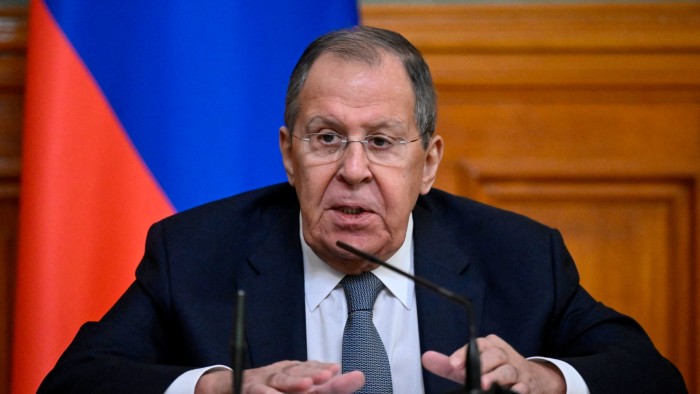
Foreign minister Sergei Lavrov said on Tuesday that if the plan “erased . . . key understandings” that Russian President Vladimir Putin thought he had reached with US President Donald Trump at an Alaska summit, the “situation will be fundamentally different”.
But he made his comments as the White House hailed what it said was “tremendous progress towards a peace deal by bringing both Ukraine and Russia to the table” over the past week.
Lavrov was referring to Moscow’s concerns about a revised 19-point peace plan agreed with Ukrainian and European officials in Geneva, which followed a 28-point US proposal drawn up with Russian input and presented to Ukrainian President Volodymyr Zelenskyy on Thursday.
The first version of the plan, which Lavrov said Russia had “welcomed”, called for Ukraine to give up territory it has yet to lose in combat, as well as imposing other restrictions on Kyiv.
But the latest draft is less favourable to Moscow, leaving the most sensitive issues to be decided by Trump and Zelenskyy.
Senior Ukrainian officials close to the president told the FT on Tuesday that those included territorial issues and US security guarantees, but added that Kyiv had agreed to cap its army at 800,000.
Lavrov sought to contrast the latest text with the discussion between Trump and Putin at the August summit in Anchorage, Alaska, a meeting that alarmed both Kyiv and European capitals.
“After Anchorage, when we thought these understandings had already been formalised, there was a long pause. And now the pause has been broken by the introduction of this document . . . A whole series of issues there, of course, require clarification,” Lavrov said.
In Alaska, Trump said the US was willing to recognise Russia’s 2014 annexation of Crimea and push Ukraine to pull back from some frontline positions in the Donbas region in the east of the country if Russia stopped the fighting.
Recommended

Putin insisted that no deal would be possible if it did not address what he called the “root causes” of the conflict, his shorthand for regime change in Kyiv, an end to Nato expansion and western arms supplies for Ukraine.
On Tuesday, Lavrov said that “if the spirit and letter of Anchorage are erased from the key understandings we have documented, then, of course, the situation will be fundamentally different”. But he added that, to date, “no one has officially handed us anything”.
As Washington continues its push to end the war, US army secretary Dan Driscoll held negotiations in Abu Dhabi with Ukraine’s military intelligence chief and a Russian delegation.
Driscoll, an ally of US vice-president JD Vance, began talks with the Russians on Monday night, according to a US official and two people familiar with the meeting.
The composition of Russia’s delegation was not immediately clear and it remained unclear whether the three sides in Abu Dhabi were meeting together or talking separately.
In remarks posted on X on Tuesday, White House press secretary Karoline Leavitt added: “There are a few delicate, but not insurmountable, details that must be sorted out and will require further talks between Ukraine, Russia, and the United States.”
One prominent member of the Ukrainian delegation held out the prospect of an imminent White House meeting between Trump and Zelenskyy and said that Ukraine had largely agreed to the proposal.
“Our delegations reached a common understanding on the core terms of the agreement discussed in Geneva,” said Rustem Umerov, secretary of the country’s national security and defence council.
“We now count on the support of our European partners in our further steps,” he added, referring to remaining questions over the use Russian frozen assets and Ukraine’s Nato aspirations.
“We look forward to organising a visit of Ukraine’s president to the US at the earliest suitable date in November to complete final steps and make a deal with President Trump,” he said.
In his evening address on Monday, Zelenskyy said he now believed the “necessary steps to end the war can become doable”.
“After Geneva, there are fewer points — no longer 28 — and many of the right elements have been taken into account in this framework,” he said.
The talks in the UAE came as Moscow targeted energy infrastructure and hit residential buildings in an overnight attack on Kyiv, killing at least six people and injuring 13 others, according to city officials.
The leaders of the UK, France and other European countries are also holding a call on Tuesday to discuss security guarantees to Ukraine in a potential ceasefire.
Since being blindsided by the emergence of the 28-point plan last week, Kyiv’s European allies have raced to support Zelenskyy and pushed back on some of its most contentious points.
French President Emmanuel Macron on Tuesday warned against a deal that amounted to “capitulation” for Ukraine, and emboldened Russia “to go further towards other Europeans and puts all of our security in danger”.
Speaking to radio station RTL, Macron added that only Kyiv should decide on territorial concessions, while the use of Russian frozen assets held in Europe should be decided by Europe.
France, the UK, Turkey and other countries would also be prepared to provide a “reassurance force” far from the frontline to provide training and security, he said.
Additional reporting by Ian Johnston in Paris and Henry Foy in Brussels