
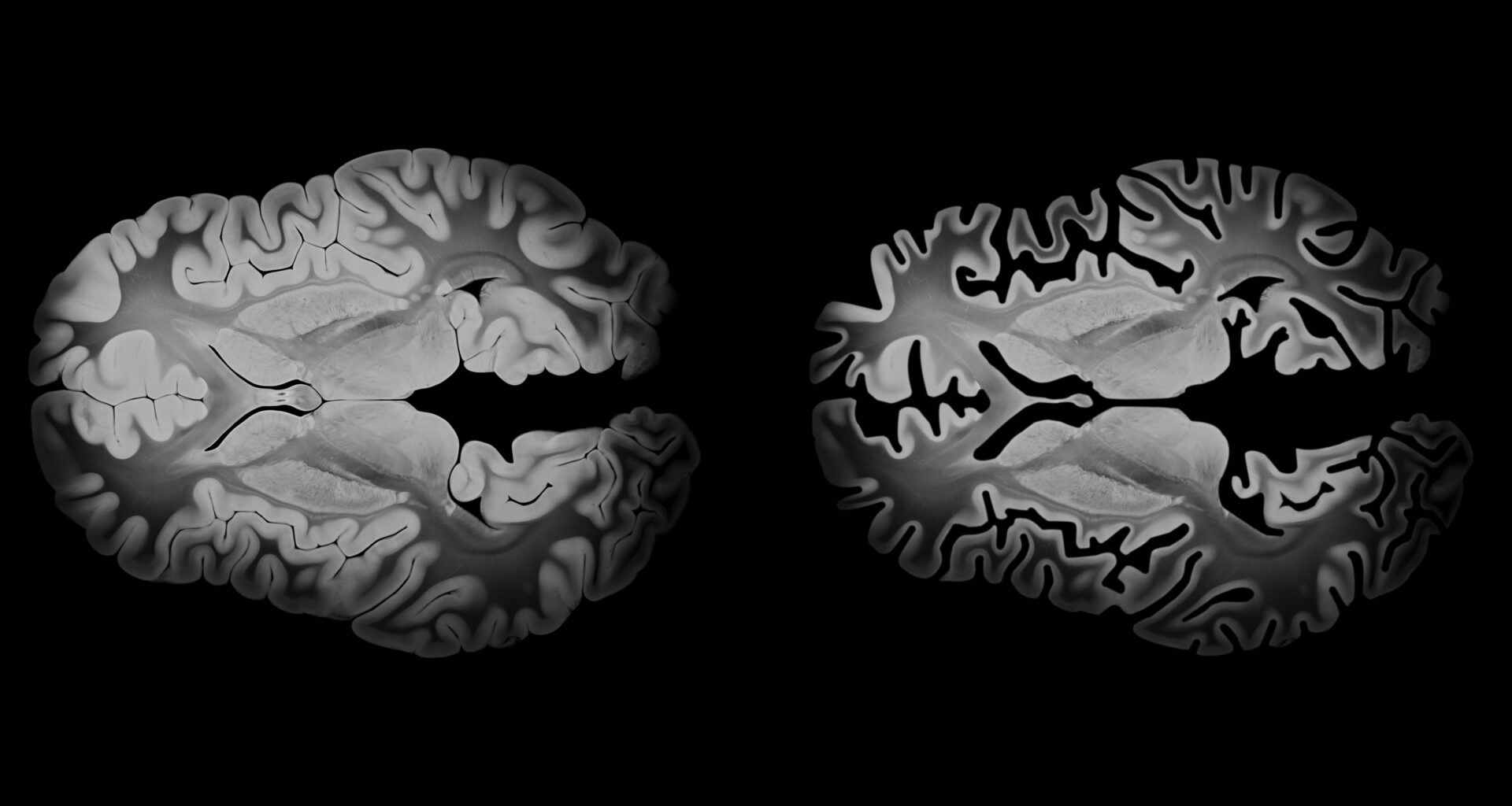
New research has shown that the enzyme OTULIN regulates tau at the gene-expression level rather than through protein degradation.
Researchers have discovered that brain enzyme, OTULIN, controls the production of tau – the protein that forms toxic tangles in Alzheimer’s disease. The study highlights how OTULIN plays a far greater role in the brain than previously thought, acting as a powerful regulator of gene expression and RNA metabolism.
The research, led by Dr Kiran Bhaskar of the University of New Mexico Health Sciences Center and Dr Francesca-Fang Liao at the University of Tennessee Health Science Center, could lead to new therapeutic approaches to Alzheimer’s and other dementias.
“We set out to test whether stabilising a specific type of ubiquitin chain would help clear toxic tau from neurons,” explained Dr Bhaskar. “Instead, we discovered something completely unexpected – that OTULIN acts as a master switch controlling whether tau is even produced in the first place.”
A paradigm-shifting discovery
The team initially theorised that blocking OTULIN’s known enzyme activity would enhance the clearance of abnormal tau. But when researchers removed the OTULIN gene entirely from neurons, they found that tau did not just degrade faster – it disappeared because cells had stopped producing it.
We found that OTULIN deficiency causes tau mRNA to vanish, along with massive changes in how the cell processes RNA and controls gene expression.
“This was a paradigm shift in our thinking,” said Dr Liao. “We found that OTULIN deficiency causes tau mRNA to vanish, along with massive changes in how the cell processes RNA and controls gene expression.”
Neurons derived from a patient with late-onset Alzheimer’s showed elevated OTULIN protein and phosphorylated tau, prompting the investigation into whether OTULIN contributes to the disease’s progression.
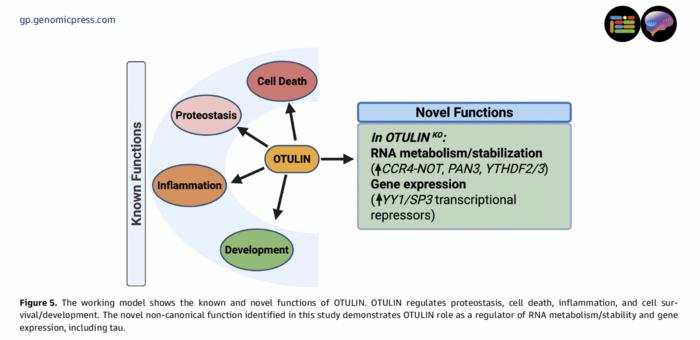
The working model shows the known and novel functions of OTULIN. OTULIN regulates proteostasis, cell death, inflammation, and cell survival/development. The novel non-canonical function identified in this study demonstrates OTULIN role as a regulator of RNA metabolism/stability and gene expression, including tau. Credit: Kiran Bhaskar
Key findings
RNA sequencing revealed that removing OTULIN triggered several cellular changes: more than 13,000 genes were downregulated and nearly 800 upregulated, alongside many effects on RNA transcripts. Comparisons between patient neurons and healthy controls showed thousands of genes altered in Alzheimer’s disease.
Further experiments using a new small-molecule OTULIN inhibitor, UC495, reduced harmful phosphorylated tau without eliminating tau entirely, pointing toward a possible therapeutic opportunity.
The absence of OTULIN also increased activity in genes involved in RNA degradation and stability. Bulk sequencing data also showed reduced expression of OTULIN long noncoding RNA and MAGE family genes, which help regulate protein quality control.
Therapeutic potential
The findings could significantly develop our approaches to treating tau-driven neurodegenerative diseases.
OTULIN could serve as a novel drug target, but our findings suggest we need to modulate its activity carefully rather than eliminate it completely.
“OTULIN could serve as a novel drug target, but our findings suggest we need to modulate its activity carefully rather than eliminate it completely,” Dr Bhaskar said. “Complete loss causes widespread changes in cellular RNA metabolism that could have unintended consequences.”
Partial inhibition reduced pathological tau without harming neurons, while OTULIN deficiency also dampened inflammatory pathways. This gave the scientists real insight into the mechanisms of the disease.
Broader implications for brain disorders
The study outlines the key role that OTULIN plays in RNA biology, affecting both transcriptional repressors and RNA-binding ubiquitin ligases. Its connections to RNA-binding proteins linked to neurodegenerative diseases – such as TDP-43, FMR1, ATXN2 and MSI1 – indicate that OTULIN’s impact could extend well beyond Alzheimer’s.
“We’re essentially looking at a previously unknown checkpoint in gene expression,” explained Dr Liao. “OTULIN appears to influence which genes get expressed and how long their RNA messages survive in cells.”