
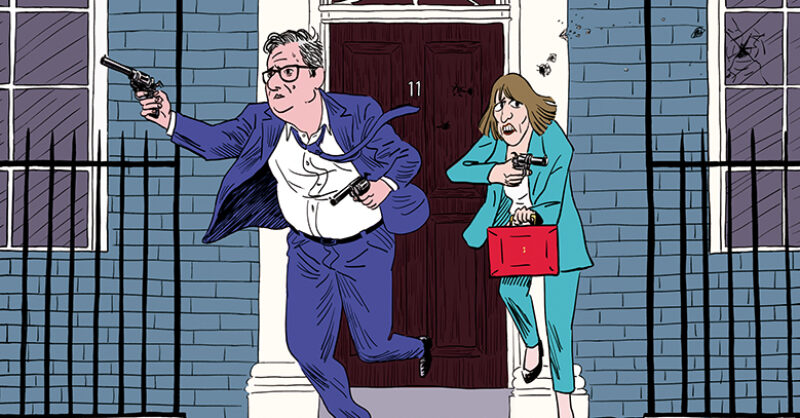
When Rachel Reeves entered the Treasury as Britain’s first female Chancellor only 18 months ago, there were tears of joy in her eyes. It was the image of a woman who had spent her life dreaming of serving in a Labour government. The last time I interviewed her for this magazine, in 2021, she became tearful describing her grandparents, who worked in shoe factories in Kettering. “The Labour Party was formed by people like them and for people like them,” she told me. “It’s got to be the voice for those people.” Her dream was not just to be chancellor, but to be a Labour chancellor.
She achieved that dream. Now she is reckoning with the reality. Today, she is the least popular minister in the least popular government in postwar Britain. Her approval rating in one recent poll – minus 71 per cent – would make her the least popular Chancellor in history. As such, she has had to get used to being mocked and blamed by her own side. A couple of weeks ago, at a black-tie awards ceremony for the business community, she was roundly booed when her face appeared on the big screen.
In her short time at the Treasury, she has faced market turbulence, constant media speculation about her position and a rebellion of her own MPs. Tears of joy turned to tears of something sadder, when she wept live on television during Prime Minister’s Questions, in front of her opponents, colleagues and the world, shortly after reportedly telling a colleague: “I’m just under so much pressure.”
That pressure has been building all year and culminates in Wednesday’s Budget. Boxed in by her own promises as well as an invidious economic inheritance, she is nevertheless determined to be the kind of Labour chancellor she once dreamed of. She hopes to win back voters, please her own party and make the sorts of decisions that history will judge kindly. She needs to keep the markets on side, too. As she raises taxes from a position of unparalleled unpopularity, it may be too much to ask.
Keir Starmer, whose own position is in doubt after briefings fuelled by his own allies, knows his political fate is intertwined with hers. He has been closely involved in preparations for this big moment. They both know there is widespread speculation that Reeves’ second Budget could be the last for her and the Prime Minister. They go into it together, fighting for their political lives.
Rachel Reeves’ trouble began in the happier times before the election, when Labour was riding high in the polls and focused solely on winning. When she decided to rule out increasing income tax, VAT and National Insurance in the party’s election manifesto, colleagues warned her that she was at risk of boxing herself in terribly for government. “That would be a nice problem to have,” she replied. Ever since, it has been a problem she has had.

Treat yourself or a friend this Christmas to a New Statesman subscription from £1 per month
Reeves had seen the Labour Party snatch defeat from the jaws of victory too many times before. She is one of the traumatised veterans of Ed Miliband’s campaign in 2015, who thought they were on course to win – and even saw polling on election day that led them to believe they had done so – only to be stunned and heartbroken when the exit poll was announced on the night. This time, she determined, she wouldn’t risk history repeating itself.
In their more candid moments, some Labour advisers and politicians acknowledge that it was a promise they would struggle to keep. “We had to win the election,” one shrugs. “I think unfortunately there is a question as to whether you can win an election while being honest with people,” another reflects. Many of them expected the election campaign to be tougher. Instead, they sailed through, the polls barely moving. It was only after their election win that the trouble began.
The Institute for Fiscal Studies had warned during the 2024 campaign that there was “a conspiracy of silence” on tax between the two main parties. The spending plans the Conservatives had pencilled in for after the election “weren’t credible” – nor, it said, were Labour’s plans to match them without making cuts nor raising “taxes on working people”. Labour had insisted they would find a third way, by attracting private investment into the country and spurring economic growth. On one campaign visit, I asked Keir Starmer if he would get in to Downing Street, announce things were worse than they’d thought, and then put up taxes. “No,” he replied, looking me dead in the eye.
Weeks later, as Prime Minister, Starmer took to a lectern in the No 10 rose garden, described the discovery of an “economic black hole” and warned of a “painful” Budget ahead. Reeves, meanwhile, took the defining first big decision of their Labour government: to means test the winter fuel allowance. It has become commonplace to blame a combination of civil servants’ penny-pinching and Reeves’ inexperience for the decision. Many in the Labour Party and a number of external commentators reported that Reeves had been presented with a list of the civil servants’ favoured cuts, and she became the first chancellor shown their recommendations who was foolish enough to agree to them. But some close to the decision-making process dispute that version of events. It wasn’t an accident, several have said, but a deliberate political choice from advisers to reassure markets.
It would soon become the government’s best known and least popular policy. Rewarded for being tough in opposition, Reeves was swiftly punished for the same approach in government. She had “confused looking strong with looking a bit mean”, Starmer’s friend and biographer Tom Baldwin would reflect months later, when she was forced to make a U-turn on winter fuel payment eligibility.
In her October Budget last year, Reeves was boxed in by the constraints she set herself during the election campaign. Having promised no tax increases on working people, no return to austerity and “iron-clad” borrowing rules, she nevertheless found herself having to plug what she described as a £22bn black hole. She did it by hiking National Insurance on employers, alongside an array of other taxes that amounted to the biggest tax-raising Budget since 1993. Although the argument that she had breached her manifesto promises did not stick, she faced a fierce and unexpected backlash from businesses. The effect was grim. The gloomy pitch-rolling collapsed consumer confidence. And businesses soon stopped hiring. Since Reeves’ first Budget, unemployment has climbed to a four-year high of 5 per cent.
What is more, she gave herself only the smallest of buffers – just £9.9bn of so called headroom – in case things went wrong. And soon they did. Boxing herself in yet again, Reeves promised that her tax-raising Budget of 2024 would be a “once-in-a-parliament” event. “We are not going to be coming back with more tax increases,” she declared. She had made herself a hostage to fortune.
In January this year, the markets began to wobble. Her headroom was wiped out by the rise in government borrowing costs. Further strain was added by Donald Trump’s announcement of tariffs. As the year went on, Reeves found herself weathering international turbulence, additional spending pressures, and lower-than-expected tax receipts. A steady drumbeat began: tax rises were inevitable.
There was front-page newspaper speculation that Reeves would be replaced as chancellor by Pat McFadden. Voters and Labour MPs, meanwhile, were displaying mounting levels of anger at the cut to winter fuel payments.
Her aides insisted privately that she would stick to her promise not to raise more taxes – instead, they would fill any gap in the finances by making cuts. In March, Liz Kendall, then the work and pensions secretary, announced the cuts Reeves needed, just in time for the Chancellor’s Spring Statement. The savings would be taken from the UK’s main in-work disability benefit. Labour MPs had other ideas.
By the time of the Spending Review in June, Reeves was under fire, isolated, and on the defensive. She had faced yet more hostile media coverage over accusations that she had exaggerated her CV, and “Rachel from accounts”, a moniker she finds misogynistic, was the belittling nickname now given to her by her opponents. Support for the welfare reforms she needed to balance the books was dwindling.
In private, she had heated, bitter disagreements with cabinet colleagues over squeezed budgets for their departments. “Get out of my office,” she told the Mayor of London, Sadiq Khan, as he tried to negotiate more funding for the capital, according to several people familiar with the incident. I’m told she cut short their scheduled meeting before the second half could begin. She told friends she was frustrated by Labour MPs criticising her without suggesting how they would pay for an alternative plan. Those who saw her at this time described a woman clearly struggling under the pressure, raging against all those making her job impossible, while showing no signs of regret over her own decisions and the constraints she had placed on herself.
As the rebellion brewed on the welfare reforms – which Reeves needed to plug the hole in the finances – tensions were running high. The Chancellor rang around colleagues to persuade them to stick with her, only to make things worse. Marie Tidball, one of parliament’s very few visibly disabled MPs, was reduced to tears by a conversation she had with the Chancellor over the phone, and cried again in the House of Commons chamber ahead of the vote.
It all culminated in an extraordinary 11th-hour U-turn. The government was saved from the humiliating spectacle of defeat by its own MPs, but at a cost. The following day, as a visibly exhausted Reeves, her economic plan in tatters, herself cried on the green benches at Prime Minister’s Questions, her colleagues remembered the human being behind the decisions that had so angered them in recent months. “Very hard to see,” Labour MPs texted, only days after they had been privately calling for Reeves to be sacked. The bond market panic, as speculation mounted that she might be replaced, had the effect of solidifying her position.
If things have improved since, Reeves still feels frustrated by a lack of support from colleagues and progressives more widely – including left-leaning media. Following Andy Burnham’s New Statesman interview in September, in which he said the UK shouldn’t be “in hock to the bond markets”, Reeves rang the Mayor of Greater Manchester to complain. She told him that he had cost her billions in borrowing costs and even caused concern at the Bank of England.
“She is incredibly isolated from the rest of the party,” one former adviser observes. But, with mounting frustration and blame directed towards Starmer, she is not being held solely responsible for the problems of the past year. “Any suggestion that she alone is responsible for this is ridiculous,” one insider observes. “Keir was there too, for winter fuel, for welfare. He’s the First Lord of the Treasury.”
Reeves and Starmer have always tried to be as close as David Cameron and George Osborne were in office. Yet theirs is a fundamentally different dynamic. “There’s no warmth there,” one figure who knows them both well observes, although there is “a trust”. “They are not friends – they’re allies.”
The danger the Prime Minister finds himself in is only growing. The contempt I mentioned in these pages two weeks ago has not abated; Labour MPs have referred to Starmer’s trip to South Africa for the G20 summit at the end of November as his “gardening leave”. One quipped that the Prime Minister was “enjoying one last holiday”. Several have joked they won’t vote against the Budget because they want to retain the whip for the looming leadership contest. Starmer’s allies’ briefing against Wes Streeting earlier in the month has been seen as a “fundamental breach” even by some of the party’s most loyal footsoldiers. “While they might have moved on, the MPs haven’t,” one MP says.
There is still speculation in Westminster that the Prime Minister could yet seek to save himself by throwing his Chancellor under the bus. One adviser reflects: “If you were Rachel, you would have to be stupid not to wonder if Keir will eventually turn on you, given how ruthless he is.”
Nevertheless, Starmer and Reeves go into this Budget as a united front. “It is a joint endeavour between Keir and Rachel,” a Reeves ally says, which is what you would expect from her side. But there is no detectable effort from No 10 to distance the Prime Minister from his Chancellor’s difficult decisions. Instead, a senior Downing Street source agrees that “Keir’s been very closely involved”. They are fighting for their political lives – in it together. You could read that another way, however: having seen the way the past 18 months have gone, this time Starmer and his team want more control.
The two have been in constant, close conversation for months as they have planned this big moment. In September, Starmer and Reeves each brought in additional economic heft and created a “Budget Board” spanning Nos 10 and 11, to underpin the tight cooperation between their respective teams. Darren Jones, previously chief secretary to the Treasury, was moved to No 10. Torsten Bell, a Treasury minister and the former head of the Resolution Foundation think tank, was promoted to co-chair the board, alongside Minouche Shafik, the former vice-chancellor of the London School of Economics, who was brought in as Starmer’s chief economic adviser.
They may not say so explicitly, but Starmer and Reeves have plainly tried to learn the lessons of the past year. From the outset, they were clear that the Budget should not be a “spreadsheet-first exercise”, as one Reeves ally puts it, an apparent nod to the ill-fated winter fuel and welfare cuts, when the need to make a saving compromised the politics. To do that, she resolved to increase her headroom, giving herself a buffer she hopes will insulate her from further market movements and bring down the UK’s borrowing costs.
“When she started thinking about this, she was really clear that it needed to be built around her principles and her vision for the country,” a Reeves ally says. “She was clear it would not be a ‘Treasury orthodoxy’ exercise.” She decided to prioritise “working people” and “doing what is right, not what is politically expedient”. The principles haven’t changed from the start, they insist. But some of the policies certainly have.
On 4 November, Reeves staged an extraordinary takeover of breakfast television and radio. She delivered a speech deliberately timed to be broadcast live as millions ate their cornflakes, so that no one, be they voter, MP or bond trader, would be in any doubt: she was poised to break her manifesto pledge and raise income tax. She couldn’t explicitly say it until the Budget itself, but she came as close as she could. She referenced the difficult economic inheritance of austerity, Brexit, the pandemic, international instability and an unexpected productivity downgrade from the Office for Budget Responsibility. She said it would be “irresponsible” to offer “easy answers” to the economic problems the country faces, and pointedly didn’t rule out an income tax rise when asked about one.
The planned tax hike had already been sent to the forecaster. The public had been alerted in the clearest possible terms. Then, on the very last day to lock in the final Budget measures, in an incredible Sliding Doors moment, Starmer and Reeves changed their minds. They were informed by the forecaster that instead of plugging a £30bn black hole, they only needed to fill £20bn. They were offered an off-ramp, and they took it. It is not a coincidence that the decision was taken as a row raged between Starmer’s allies and Wes Streeting about allegations of a planned leadership coup. Despite suggestions it was Starmer who got cold feet and forced the change, Nos 10 and 11 insist that the Prime Minister and Chancellor took the decision together. Many in the Labour Party are convinced they pulled back from the brink of electoral suicide in the nick of time.
The U-turn was planned as good news for Budget day. Instead, it leaked to the Financial Times. Markets wobbled and Labour MPs despaired as the Budget appeared to unravel before it had even been announced. Several Labour figures have described it as their worst week in government. There is frustration and embarrassment in Downing Street at how the news unfolded – and suspicion between Nos 10 and 11 about how it leaked. “If you were to ask me, ‘Are you pleased? Has it gone how you planned, like that income tax leak?’ No. That isn’t how we would have wanted it to go. But it is the reality,” one Reeves ally says.
The Budget that never was will haunt the one Reeves delivers on Wednesday. A broad-based tax increase would have been seen as more credible by markets, less damaging to economic growth, and better for building a war chest for the election. She wasn’t able to do it because of her own decision to rule it out in Labour’s manifesto. She missed earlier opportunities, too, to change course – such as the announcement of Trump’s tariffs. Many sympathetic colleagues are frustrated by political missteps that have limited their economic options.
Tax increases are still on the table, but now as a “smorgasbord” of many different levies. Many in the disheartened Labour ranks have such little faith in the political abilities of Downing Street that they fear one tax might blow up spectacularly, prompting vicious blowback from lobbyists and marches on Whitehall. The smorgasbord approach presents “a multi-fronted risk”, one Downing Street insider acknowledges: “There are more opportunities for things to go wrong.”
There has been a concerted effort to bring Labour MPs on side ahead of this high-stakes moment. There have been No 11 receptions, where groups of MPs have been asked to invite local business leaders to meet the Chancellor over warm white wine. There have been presentations showing the distribution impact of the Budget, emphasising that lower earners will be least affected by tax increases, and “those with the broadest shoulders” will contribute most. And there have been “Budget lessons”, aiming to teach MPs how debt interest works and why borrowing more would result in more money going to US hedge funds. “There is nothing progressive about £1 in every ten going on debt interest,” is the line being drilled into them.
Starmer and Reeves hope they have good news to sell to a disenchanted public and a restive parliamentary party. Labour MPs will have one big reason to be cheerful. The Budget will grant their wish and scrap the two-child benefit cap, as so many have been pushing for all year. Starmer has been “very closely involved” in the decision, a senior No 10 source says, and the plan to tackle child poverty “will have his personal stamp on it”. It is his, and Reeves’, last stand – their moment to produce a Labour Budget to save themselves. They face overwhelming odds, but they are determined to fight their way back.
Even that move comes with risk, however. Some are worried that the Labour Party is about to face a reckoning with public opinion on the issue: the two-child cap, when people are polled about it, is seen as fair and the public doesn’t support ditching it. The counter-argument is that polling also shows that voters expect Labour governments to tackle child poverty, and support it doing so – and scrapping the cap is the single most effective lever to pull to do this.
After a long debate within Labour, we’re about to see who is right. Regardless of whether it’s popular, Labour politicians right up to cabinet level will be happy to see it happen, purely because they say it’s the right thing to do. “It’s finally going to happen,” one Labour MP said to me, and burst into tears. It’s impossible to overstate how important this is to the Labour movement.
Reeves is still hoping to be the kind of chancellor she dreamed of being in opposition: a Labour chancellor who lifts millions of children out of poverty, raises the minimum wage and finally uses the power of the state to turn the economy around after years of Tory failure. In their most positive moments, she and Starmer allow themselves to imagine that the Budget will let them go into next May’s Scottish, Welsh and local English elections with a positive message that might just unite the party behind them and turn things around. “We’re using this Budget to show we’re a Labour government doing what we were elected to do,” a Reeves ally says. You get the sense it is Labour MPs, just as much as anyone else, who they are trying to convince.
The dividing line is drawn: investment in public services from Reeves, or “a return to austerity” with Reform or the Conservatives, as a senior No 10 figure puts it. Nevertheless, as another Downing Street insider reflects, “It is fundamentally a difficult, tax-raising Budget.” They fear both the bond market reaction and the political one.
Sometimes, while preparing for this defining political moment, Reeves has escaped Budget preparations in No 11 and gone for a run – blasting the south London R&B singer Raye in her ears. Her first 18 months in office have taken a toll, but Reeves is determined to carry on. “She’s tough,” an ally reflects. “And she’s always been underestimated.”
If the Budget does not turn the government’s fortunes around, it may well prove Reeves’ last. Her room for manoeuvre has all but vanished. Isolated from her friends and surrounded by enemies, she and the Prime Minister face their moment of reckoning, their fates bound together – whether they like it or not.
[Further reading: “Mansion tax” puts off the tougher questions about council tax]
Content from our partners