
European reactions to Ukraine talks stress ‘momentum’ but obvious issues remain — analysis Jakub Krupa
European leaders have emerged from this morning’s discussions on their counterproposal for a peace plan for Ukraine with strikingly positive comments on the process, while reiterating their key points on respecting numerous Ukrainian red lines on territory and sovereignty.
The EU leaders met on the sidelines of the EU-Africa summit in Angola to discuss the progress made over the weekend in Geneva, welcoming “the new momentum,” even as they insisted that some issues still needed to be addressed.
But the sticking points are in no way minor and are absolutely central to discussions on Ukraine’s sovereignty, relating to its territory, its ability to defend itself, or its prospects of joining Nato or the EU.
With some of the European leaders’ rhetoric at times almost inexplicably positive, with leaders that keen to show to the US and Donald Trump that they want to engage with the process, the question of what actual lasting impact these European discussions will have on the actual peace plan remains open.
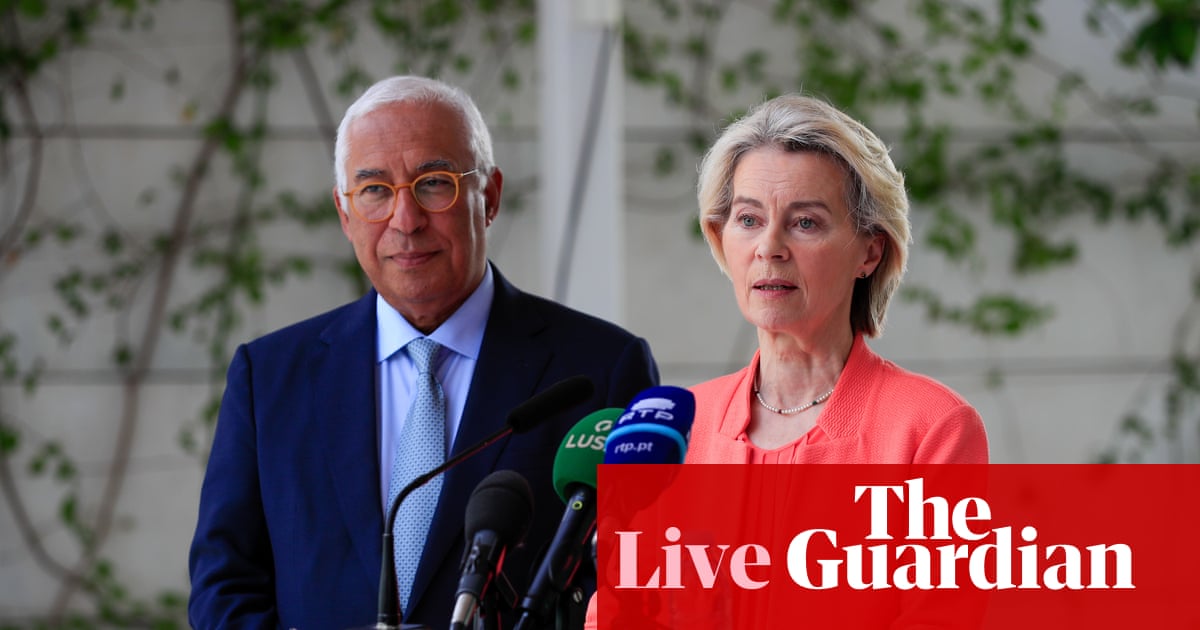
The European Commission president, Ursula von der Leyen, said that “while work remains to be done, there is now a solid basis for moving forward,” with the key principle that “only Ukraine, as a sovereign country, can make decisions regarding” its future (13:03)
The European Council president António Costa said that “while some issues remain to be solved, the direction if positive,” as he reaffirmed that parts of the deal affecting the EU would need to see “full involvement and decision” by the bloc.
But it’s the national leaders’ comments that offered a bit more scepticism and depth to the EU’s view of the deal, highlighting the key areas areas that may require a fair bit more of diplomatic back-and-forth.
Poland’s Donald Tusk stressed that any peace settlement on Ukraine needed to “strengthen, not weaken, our security,” as he openly said that some bits need to be rewritten.
He also strongly pushed for further pressure on Russia, including through the use of its frozen assets in Europe, saying “it cannot be the case that Europe ends up paying for Russia’s actions.” (12:54)
Sweden’s prime minister Ulf Kristersson echoed this sentiment, saying that Russia “must be forced to the negotiating table,” and stressing that it was in Stockholm’s self-interest to send a clear signal to Moscow that “aggression … never pays off.” (15:09)
But for all the generally positive rhetoric, it was Germany’s chancellor Fredrich Merz who conceded that “peace in Ukraine won’t happen overnight,” with the need to get Russia involved more closely in any further talks.
The proposed EU draft – radically overhauling the original proposals, which were thought to be pro-Russian and shifting the balance towards Ukraine – will no doubt prompt a reaction from Moscow, with the Russian administration seeking to push back on some of the proposals.
One key things to watch out for is to see which of the European arguments and counterproposals actually stick in the latest draft after the Geneva talks over the weekend – something we will no doubt find out more about in the coming hours and days.
Updated at 10.00 EST
Key events
1d ago
Summary of the day so far
1d ago
Europe ‘had some key decisions to make’ on Ukraine at December summit, Irish PM says
1d ago
Ukraine peace deal should be anchored in human rights framework, Council of Europe commissioner says
1d ago
Zelenskyy and Trump may meet this week to discuss revised plan for Ukraine, sources say
1d ago
EU counterproposals ‘unconstructive’ and ‘do not work for Russia,’ Kremlin aide says
1d ago
European reactions to Ukraine talks stress ‘momentum’ but obvious issues remain — analysis
1d ago
Russia ‘must be forced to negotiating table,’ Swedish PM says
1d ago
European foreign policy leaders call for ‘united, principled stand’ as they warn peace settlement ‘will shape European security for generations’
1d ago
Russia’s Putin and Turkey’s Erdoğan discussed US proposals on ending Ukraine war
1d ago
Romania scrambles jets in response to drones near its border, defence ministry says
1d ago
Keir Starmer welcomes ‘significant progress’ in Ukraine talks
1d ago
‘Peace in Ukraine won’t happen overnight,’ Germany’s Merz says
1d ago
EU leaders hail ‘new momentum’ in Ukraine talks, but say issues remain to be solved
1d ago
‘Peace settlement on Ukraine needs to strengthen, not weaken, our security,’ Poland’s Tusk says
1d ago
Four killed, 13 injured in overnight Russian attack on Kharkiv, Ukraine
1d ago
‘Lot of work remains to be done,’ EU says after early constructive talks on Ukraine
1d ago
‘Something good just may be happening,’ Trump says on Ukraine talks
1d ago
Poland arrests third suspect after Russian rail sabotage
1d ago
Ukrainian drone downed en route to Moscow, mayor says
1d ago
EU’s Costa spoke with Zelenskyy before EU leaders’ talks on Ukraine
1d ago
No plans for Russia-US meetings this week so far, Kremlin says
1d ago
Ukraine needs to be at table for peace talks to avoid new Munich agreement, Czech Republic’s Pavel says
1d ago
Lithuania’s Budrys welcomes Geneva talks, raises concerns about Belarus
1d ago
Sweden will not recognise Russia’s illegal annexation of Ukrainian territories, Swedish foreign minister says
1d ago
Ukraine ready to move to peace with three key red lines, Ukrainian parliament speaker says
1d ago
Ukraine working with US to look for ‘compromises that strengthen, not weaken us,’ Zelenskyy says
1d ago
Morning opening: Can Europe change the US-Russian plan?
Show key events only
Please turn on JavaScript to use this feature
Summary of the day so farJakub Krupa
We are pausing our coverage of today’s developments on Ukraine here, but will resume it if there are any major news lines emerging later in the day.
Here is our summary of the day so far:
Ukraine has significantly amended the US “peace plan” for Ukraine, removing some of Russia’s maximalist demands, people familiar with the negotiations said, as European leaders warned on Monday that no deal could be reached quickly.
Volodymyr Zelenskyy may meet Donald Trump in the White House later this week, they indicated, amid a flurry of calls between Kyiv and Washington.
US president Donald Trump said earlier today that “something good just may be happening” with “big progress” in the talks on Ukraine (12:01).
Ukraine’s president Volodymyr Zelenskyy said that Ukraine was working with the US to look for “compromises that strengthen, not weaken, us” and “and will continue explaining how dangerous it is to pretend that aggression is something one can simply overlook and move on” (9:49).
Meanwhile, numerous European leaders welcomed “the new momentum” in talks on ending the Russian invasion on Ukraine, but insisted that several issues needed to addressed (15:47), with the next month’s European Council summit billed as a moment to make some “key decisions” (17:01).
In a particularly striking reaction, Swedish prime minister Ulf Kristersson insisted that Russia “must be forced to the negotiating table” (15:09) as he joined Germany’s Friedrich Merz and Poland’s Donald Tusk in calling for more pressure to be put on Moscow (12:54, 13:06).
Meanwhile, Czech president Petr Pavel warned that Ukraine needed to be closely listened to during any peace talks, as it’s exclusion from key decisions would prompt parallels with the 1938 Munich Agreement, saying: “it is their territory, it is their country, their people, their lives” (10:43).
ShareEurope ‘had some key decisions to make’ on Ukraine at December summit, Irish PM says
The Irish prime minister, Micheál Martin, said that the European leaders “had some key decisions to make” at the upcoming EU summit in December when it comes to further support and financing for Ukraine.
Ireland’s prime minister Micheal Martin arrives for the second day of the G20 Leaders’ Summit, in Johannesburg, South Africa. Photograph: Marco Longari/AP
Speaking after today’s EU discussions on the peace plan for Ukraine, Martin said the December meeting “will be a very key moment and important meeting in respect of Europe’s contribution to all of this, particularly in terms of the financing of Ukraine into the future and related issues.”
He said the leaders had “a good discussion” earlier today, but the December meeting will be critical for translating it into action, “and a lot of work has to be done in advance of that meeting.”
“Meanwhile, strong support for President Zelensky emanating from the meeting; important to continue to support him in his negotiations and in his endeavours,” he said.
He also insisted that Europe played a role in the discussions about the peace settlement, saying:
“Clearly, Europe is at the table because of key issues that have been identified, in terms of the future financing of Ukraine, in terms of Ukraine’s membership of the European Union, which we’ve been strong advocates for, and also in terms of, ultimately, the security underpinning of any post war scenario.”
ShareUkraine peace deal should be anchored in human rights framework, Council of Europe commissioner says
The Council of Europe’s human rights commissioner Michael O’Flaherty warned that while it’s “encouraging” to see diplomatic efforts on Ukraine intensify, “a comprehensive, just, and lasting peace can only be achieved if it is anchored in the international human rights framework.”
O’Flaherty said in a statement that any final peace discussions needs to address the key issues on accountability and reparations – including “mechanisms for accountability for perpetrators of gross human rights violations and international crimes and fair reparations for all victims of Russia’s aggression” – as well as on the protection of affected persons, reconstruction and recovery, and inclusion.
“To fortify our security and counter the Russian aggression against Ukraine, we must unequivocally defend the values and human rights that are under fire in this war against Ukraine,” he said.
Earlier this month, O’Flaherty convened a meeting of 35 officials – including from Ukraine – to discuss how some of these issues could be practically advanced, and a report is expected soon.
ShareZelenskyy and Trump may meet this week to discuss revised plan for Ukraine, sources say Luke Harding
in Kyiv
Ukraine has significantly amended the US “peace plan” for Ukraine, removing some of Russia’s maximalist demands, people familiar with the negotiations said, as sources say Volodymyr Zelenskyy may meet Donald Trump in the White House later this week to discuss its contents.
Head of the Office of the President of Ukraine Andriy Yermak, second right, and US Secretary of State Marco Rubio, right, talk to the press as their consultations continue at the US Mission to International Organizations in Geneva, Switzerland. Photograph: Martial Trezzini/AP
The latest developments as European leaders warned on Monday that no deal could be reached quickly, amid a flurry of calls between Kyiv and Washington.
Ukraine is also pressing for Europe to be involved in the talks.
The original 28-point US-Russian plan was drawn up last month by Kirill Dmitriev, Vladimir Putin’s special envoy, and Trump’s representative Steve Witkoff. It calls on Ukraine to withdraw from cities it controls in the eastern Donbas region, limit the size of its army, and not join Nato.
During negotiations on Sunday in Switzerland – led by the US secretary of state, Marco Rubio, and Zelenskyy’s chief of staff, Andriy Yermak – the plan was substantially revised. It now includes only 19 points. Kyiv and its European partners say the existing frontline has to be the starting point for territorial discussions.
The UK and EU were blindsided last week when the original plan was leaked to US media. The army secretary, Dan Driscoll – Vance’s friend and university classmate – was sent to Kyiv with a military delegation to brief Zelenskyy on its contents.
Since then, European governments have sought to revise the document, which appears to have originally been written in Russian. They published their own counter-proposals over the weekend, which called for Ukraine’s sovereignty to be respected.
Updated at 10.20 EST
EU counterproposals ‘unconstructive’ and ‘do not work for Russia,’ Kremlin aide says
And just like that, a senior Kremlin aide Yuri Ushakov said that European counterproposals on Ukraine “seem at the first glance completely unconstructive and do not work for Russia,” Reuters has just reported.
The European plan significantly changes the meaning and significance of key points on Nato and territory, according to a copy circulating in the media, including the one reported by Reuters.
Ushakov was much more optimistic about the original US plan – criticised by Ukraine’s allies as pro-Russian – saying that “not all, but many provisions of this plan seem quite acceptable to us.”
ShareEuropean reactions to Ukraine talks stress ‘momentum’ but obvious issues remain — analysisJakub Krupa
European leaders have emerged from this morning’s discussions on their counterproposal for a peace plan for Ukraine with strikingly positive comments on the process, while reiterating their key points on respecting numerous Ukrainian red lines on territory and sovereignty.
The EU leaders met on the sidelines of the EU-Africa summit in Angola to discuss the progress made over the weekend in Geneva, welcoming “the new momentum,” even as they insisted that some issues still needed to be addressed.
But the sticking points are in no way minor and are absolutely central to discussions on Ukraine’s sovereignty, relating to its territory, its ability to defend itself, or its prospects of joining Nato or the EU.
With some of the European leaders’ rhetoric at times almost inexplicably positive, with leaders that keen to show to the US and Donald Trump that they want to engage with the process, the question of what actual lasting impact these European discussions will have on the actual peace plan remains open.
The European Commission president, Ursula von der Leyen, said that “while work remains to be done, there is now a solid basis for moving forward,” with the key principle that “only Ukraine, as a sovereign country, can make decisions regarding” its future (13:03)
The European Council president António Costa said that “while some issues remain to be solved, the direction if positive,” as he reaffirmed that parts of the deal affecting the EU would need to see “full involvement and decision” by the bloc.
But it’s the national leaders’ comments that offered a bit more scepticism and depth to the EU’s view of the deal, highlighting the key areas areas that may require a fair bit more of diplomatic back-and-forth.
Poland’s Donald Tusk stressed that any peace settlement on Ukraine needed to “strengthen, not weaken, our security,” as he openly said that some bits need to be rewritten.
He also strongly pushed for further pressure on Russia, including through the use of its frozen assets in Europe, saying “it cannot be the case that Europe ends up paying for Russia’s actions.” (12:54)
Sweden’s prime minister Ulf Kristersson echoed this sentiment, saying that Russia “must be forced to the negotiating table,” and stressing that it was in Stockholm’s self-interest to send a clear signal to Moscow that “aggression … never pays off.” (15:09)
But for all the generally positive rhetoric, it was Germany’s chancellor Fredrich Merz who conceded that “peace in Ukraine won’t happen overnight,” with the need to get Russia involved more closely in any further talks.
The proposed EU draft – radically overhauling the original proposals, which were thought to be pro-Russian and shifting the balance towards Ukraine – will no doubt prompt a reaction from Moscow, with the Russian administration seeking to push back on some of the proposals.
One key things to watch out for is to see which of the European arguments and counterproposals actually stick in the latest draft after the Geneva talks over the weekend – something we will no doubt find out more about in the coming hours and days.
Updated at 10.00 EST
Russia ‘must be forced to negotiating table,’ Swedish PM says Miranda Bryant
Nordic correspondent
Ulf Kristersson, the Swedish prime minister, has said that Vladimir Putin “must be forced to the negotiating table”.
After meeting EU leaders about the US peace plan for Ukraine, he said:
“It is in Sweden’s interest that Russia’s aggression against neighbouring countries never pays off. Otherwise, what happens in Ukraine today could affect one of us in the EU tomorrow.”
Swedish prime minister Ulf Kristersson briefs the media in Berlin, Germany last week. Photograph: Ebrahim Noroozi/AP
He added: “It is clear that Putin must be forced to the negotiating table.”
He also called for increased pressure on Russia by seizing Russian assets held by European banks.
“The money will be used to strengthen Ukraine’s defence and to pay for the damage Russia has caused to Ukraine.”
ShareEuropean foreign policy leaders call for ‘united, principled stand’ as they warn peace settlement ‘will shape European security for generations’
The chairs of the parliamentary foreign affairs committees from 20 European countries have issued a rare joint statement supporting “a just and lasting peace that is grounded in international law and fully respects Ukraine’s territorial integrity, independence and sovereignty.”
The statement, signed by representatives of France, Ireland, Poland, Spain and the UK among others, warns that “Russia’s war of aggression against Ukraine — and the peace that follows — will shape European security for generations and affect the existential interests of all Europeans.”
“Such a peace cannot be achieved by yielding to or rewarding the aggressor; it requires sustained pressure on Russia and unwavering support for Ukraine for any solution to succeed,” the statement said.
The parliamentarians called for “urgent meetings of European leaders and the European Council to take a united, principled stand” in support of Ukraine.
“Genuine negotiations cannot begin with Ukraine being asked to pre-emptively accept Russian demands. The era of empires is over, and Europe will never accept as legitimate any notion of Russian ‘security interests’ that extend beyond its borders or presume the right to shape Europe’s security order,” they said.
The statement also stressed the need for “real” and “legally binding” security guarantees for Ukraine, and no limits on its armed forces or constraints on its policies.
“Europe must stand united, principled, and unflinching. Our values, our security, and the future of our continent depend on ensuring that any peace achieved is worthy of the sacrifices made and of Ukraine’s bravery and resilience — a peace rooted in justice, law, and lasting security.”
ShareRussia’s Putin and Turkey’s Erdoğan discussed US proposals on ending Ukraine war
Russian president Vladimir Putin and his Turkish counterpart Recep Tayyip Erdoğan discussed a US proposal to end the war in Ukraine by phone on Monday, the Kremlin said.
In a readout, reported by Reuters, the Kremlin said that “Vladimir Putin noted that these proposals, in the version in which we have reviewed them, are in line with the discussions at the Russian-American summit in Alaska and, in principle, can be used as the basis for a final peaceful settlement.”
“The Russian side’s interest in a political and diplomatic solution to the Ukrainian crisis was reaffirmed,” ithe Kremlin added.
In turn, Erdoğan told Putin he was ready to support the process in every way and offered Istanbul – where the two sides held three rounds of peace talks earlier this year – as a venue for further discussions, the Kremlin said.
Ukraine’s President Volodymyr Zelenskyy has posted on Telegram to say that his country’s delegation is returning home after talks in Geneva.
Zelenskyy says that he is “awaiting a full report” on the progress of negotiations, which should come this evening.
He added:
Based on the results of the reports, we will determine further steps and timing. We will continue to coordinate with Europe and other partners in the world.
Updated at 08.53 EST
Romania scrambles jets in response to drones near its border, defence ministry says
Amid talks to bring about an end to the war, Russia resumed its night-time drone attacks on Ukraine’s civilian and port infrastructure close to Romania’s border, the Nato member’s defence ministry said earlier today.
A statement from the defence ministry read:
Radar monitoring systems detected air targets heading to Ismail, and two German Eurofighter Typhoon aircraft conducting enhanced air policing missions scrambled to monitor the air situation.
The drones disappeared from the radar, shortly after explosions were reported in Ismail.
No incursions of unmanned aerial vehicles into the Romanian airspace were detected, and the Eurofighter Typhoon aircraft returned to the 57th airbase at 01.01.
Romania shares a 650 km (400 mile) border with Ukraine. It has had Russian drone fragments fall on its territory repeatedly as Moscow attacks Ukrainian port infrastructure across the river Danube from Romania.
ShareKeir Starmer welcomes ‘significant progress’ in Ukraine talks
Along with French President Emmanuel Macron, the UK’s prime minister, Keir Starmer, has been leading European diplomatic efforts to try to secure a deal to end the war that (more) fairly accounts for Ukrainian interests and deters future Russian aggression.
We have some fresh quotes from the prime minister’s spokesperson, who said Starmer welcomed “significant progress” in the weekend talks that discussed peace in Ukraine.
“The prime minister obviously welcomes the significant progress made at yesterday’s meetings between the US and Ukraine in Geneva,” the spokesperson said, adding “there are some outstanding issues” which will be discussed in “coming days and weeks”.
Keir Starmer has repeatedly reiterated the UK’s “steadfast support” for Kyiv to Ukrainian President Volodymyr Zelenskyy. Photograph: Anadolu/Getty Images
Asked if the UK would send troops to enforce any deal agreed between Kyiv and Moscow, the Downing Street spokesperson reportedly said they would not “get ahead” of ongoing discussions.
The foreign ministers of several European countries – including Germany, France, Britain and Finland – met Ukraine’s foreign minister, Andrii Sybiha, this morning, a German official was quoted by the Telegraph as having said. It is not clear exactly what was said in the discussions.
Updated at 08.06 EST
‘Peace in Ukraine won’t happen overnight,’ Germany’s Merz says
Meanwhile, German chancellor Friedrich Merz said that while “some issues were clarified” in the Geneva talks, “we also know: peace in Ukraine will not happen overnight.”
Merz also made it clear that Europe must be consulted and agree to any Ukraine peace plan given its consequences for European security, as he called for Russia to come to table and engage with the talks more directly.
“It is important to us that there can be no peace plan for Ukraine if we do not give our consent to issues that affect European interests and European sovereignty,” he said.
ShareEU leaders hail ‘new momentum’ in Ukraine talks, but say issues remain to be solved
European Commission president Ursula von der Leyen and European Council president António Costa are also briefing the media after the EU leaders’ meeting this morning.
Costa welcomed “the new momentum” in peace negotiations, and said that while “some issues remain to be solved, the direction is positive,” as he commended the efforts of the Ukrainian and US teams involved in the talks.
“It is also clear that the issues that concern directly the European Union, such as sanctions enlargement or immobilised assets, require the full involvement and decision by the European Union,” he said.
von der Leyen used similar language, talking about “good progress” in the Geneva talks.
“While work remains to be done, there is now a solid basis for moving forward. As we do, we must remain united and keep placing Ukraine’s best interest at the centre of our efforts,” she said.
She pointedly added that “moving forward, Ukraine’s territory and sovereignty must be respected,” adding that “only Ukraine, as a sovereign country, can make decisions regarding its armed forces.”
“The choice of their destiny is in their own hands. I also want to emphasise Europe’s centrality in the country’s future,” she said.
Updated at 07.18 EST
‘Peace settlement on Ukraine needs to strengthen, not weaken, our security,’ Poland’s Tusk says
Polish prime minister Donald Tusk said the EU leaders attending an informal meeting in Angola had a “serious” discussion on the Ukraine peace talks, agreeing that the 28 points proposed by US and Russia “need reworking” as some of the proposals as “unacceptable.”
Speaking from Luanda, he said that it was particularly important that no agreement would weaken Poland and Europe’s broader security.
Tusk added that the peace settlement must not “favour the aggressor,” and said that the leaders are leaning towards moving forward on what to do with the frozen Russian assets.
“It cannot be the case that Europe ends up paying for Russia’s actions,” he said.
He acknowledged that some countries remain unconvinced, but he thought the leaders were “much, much closer” to an agreement on this issue to use the frozen assets to “help Ukraine now and during reconstruction.”
Tusk also said the EU was clear that it would not agree to limiting the number of soldiers in the Ukrainian armed forces.
The Polish PM said the talks remained “delicate” as European leaders are keen to keep the US on side.
Tusk also stressed that the sanctions imposed on Russia were working and they needed to be kept in place to force Russia into a peace settlement.
“Europe must be united. We will do everything we can so the US is on the same side. We should talk [act towards Russia] as Nato, together, and not as individual states,” he added.
“Any peace settlement on Ukraine needs to strengthen, not weaken, our security,” he said.
Updated at 06.54 EST
Four killed, 13 injured in overnight Russian attack on Kharkiv, Ukraine
Overnight, Ukraine’s second-largest city Kharkiv was hit by what officials said was a massive drone attack that killed four people and injured at least 13, Reuters and AP reported.
Eight residential buildings, an educational facility and power lines were damaged in the attack, according to the head of the regional military administration, Oleh Syniehubov.
Footage showing the aftermath of a Russian attack on Kharkiv, Ukraine
Ukraine’s air force says Russia fired 162 strike and decoy drones over the country overnight, AP noted.
Share‘Lot of work remains to be done,’ EU says after early constructive talks on Ukraine
Over in Brussels, the European Commission is hosting its daily midday press briefing.
Chief spokesperson Paula Pinho said the bloc welcomed the constructive progress made in early Ukraine talks over the weekend, although “a lot of work remains to be done,” which is also being discussed by the EU leaders taking part in further discussions on the margin of the EU-Africa summit in Angola today.
The EU’s three red lines remain unchanged: borders cannot be changed by force, no limitations on Ukrainian armed forces, and return of all Ukrainian children abducted by Russia.
The commission spokesperson also reiterated that “it is critical that the aggressor, Russia, pays for the destruction,” with talks on the use of the Russian frozen assets through a Ukraine reparations loan “even more urgent now.”
It was also revealed that a meeting of the Coalition of the Willing is expected to be convened online, on video, on Tuesday.
Share‘Something good just may be happening,’ Trump says on Ukraine talks
US president Donald Trump responded to the reports coming out of Geneva overnight, posting on his Truth Social account:
“Is it really possible that big progress is being made in Peace Talks between Russia and Ukraine??? Don’t believe it until you see it, but something good just may be happening. GOD BLESS AMERICA!”
SharePoland arrests third suspect after Russian rail sabotage
A Ukrainian man has been arrested by Polish authorities investigating a recent Russian rail sabotage, with prosecutors alleging he was involved in aiding the main two suspects in preparing their attack.
The man, identified only as Volodymyr B. under Polish privacy laws, was detained last Thursday and charged over the weekend, the prosecutor’s office said in a statement this morning.
The prosecutors allege that back in September he drove one of the two suspects to the area of the railway tracks going towards Ukraine, helping him to scout the site ahead of the attack.
The incident, earlier this month, saw an explosion along a section of railway line used for deliveries to Ukraine and another reported attempt to derail trains moving on this route.
Polish authorities have previously identified two Ukrainian men, allegedly working for the Russian intelligence services, as the key suspects in two cases of rail sabotage. They had reportedly arrived in Poland from Belarus and left soon after placing explosive devices on the rail tracks, and so remain beyond the reach of the Polish prosecutors.
Polish leaders condemned the attack at the time as “state terrorism” by Russia, who they allege deliberately recruited Ukrainian men to conduct the attacks to stir up anti-Ukrainian sentiment in the country, which hosts a major Ukrainian community.
Updated at 05.54 EST