
Stay informed with free updates
Simply sign up to the UK tax myFT Digest — delivered directly to your inbox.
The UK’s sugar tax will be extended to more soft drinks as well as milkshakes under plans to fight obesity announced on Tuesday.
Wes Streeting, the health secretary, has said the level at which the sugar tax is imposed is being cut, catching some of Britain’s best-known drinks.
Milkshakes and pre-packaged coffees such as lattes and cappuccinos will also be included as the levy is extended to milk-based drinks for the first time.
The move, which will take effect in January 2028, has been welcomed by health campaigners but criticised by those in the industry for imposing more burdens on business.
Streeting insisted that “this government will not look away as children get unhealthier and our political opponents urge us to leave them behind” as he confirmed the move to MPs.
He said the changes were being introduced because obesity “robs children of the best possible start in life, hits the poorest hardest, sets them up for a lifetime of health problems and costs the NHS billions”.
The sugar tax was introduced by George Osborne in 2016 as a levy on drinks with a sugar content of 5g per 100ml. This has led to numerous brands reformulating products to avoid the tax, widely hailed as a public health success.
However, a policy paper confirming the changes said ministers believed there was “room to go further to reduce sugar consumed from soft drinks”, describing the tax as a “tried and tested method”.
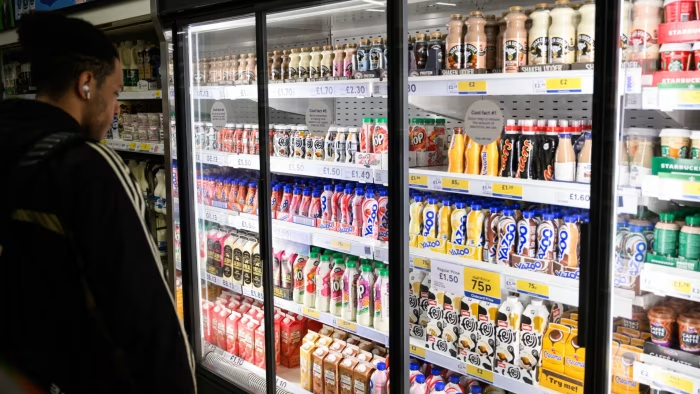
The threshold will be lowered to 4.5g per 100ml, catching drinks such as Pepsi, Fanta and Irn-Bru, which sit at or just above that level.
Milk-based drinks, originally exempted to protect children’s calcium intake, will now be included to end what a consultation described as an “anomaly”. Coffees in cafés and bars will remain exempt.
About 11 per cent of the soft drink market will be affected by the change and the government estimates it will raise an extra £40mn-£45mn a year in tax. It acknowledged that the policy could lead to increased prices for consumers but estimated that two-thirds of drinks affected would cut sugar to avoid the tax, saying there would be a “negligible” impact on inflation.
During a consultation on the changes, industry representatives accused the government of “moving the goalposts” after companies adjusted recipes to avoid the previous threshold.
Ministers dropped plans to reduce the threshold to 4g but said a reduction to 4.5g “strikes the appropriate balance between supporting health objectives and fostering conditions that allow the soft drink industry to continue to grow and invest”, according to the policy paper.
Recommended

The existing sugar levy is estimated by the Department of Health to have reduced hospital admissions for tooth decay in children by 12 per cent.
Health campaigners welcomed the change. Professor Sir Chris Whitty, the chief medical officer, said: “The existing soft drinks industry levy has already substantially reduced the amount of sugar in shop-bought products, helping slow the increase in childhood obesity and bring down hospital admissions for tooth extractions among young children.”
Gavin Partington, director-general of the British Soft Drinks Association, said the move “will create an additional cost burden for industry” but expressed relief that the government had not cut the threshold further.
“We are also reassured that the government has committed to making no further changes to the levy this parliamentary term, as well as deciding against an implementation date of 2027, which would have been damaging for our sector,” he said.