
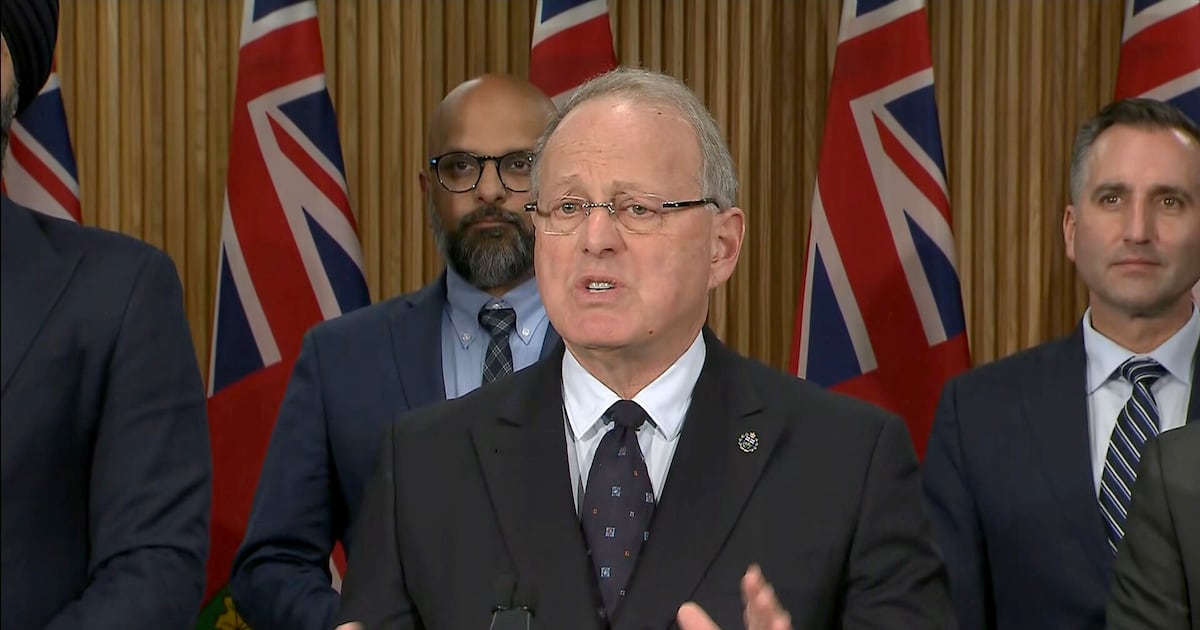
The Ford government unveiled a justice bill at Queen’s Park Tuesday that includes tougher penalties for dangerous and impaired drivers.
The Ford government unveiled a justice bill at Queen’s Park Tuesday that includes tougher penalties for dangerous and impaired drivers, tighter bail rules and a promise to protect cats and dogs from animal testing.
“We are a government that will never stop in making sure dangerous criminals are off our streets, arrested and put back in jail where they belong, and this includes taking a much harder stand on impaired drivers who put people’s lives at risk every time they get behind the wheel,” Solicitor General Michael Kerzner said at a news conference Tuesday.
“The status quo cannot, will not continue, because everyone has the same right, an inherent right to feel safe in their own homes and communities.”
A number of measures included in the bill were previously announced, such as plans to make some information from the Ontario Sex Offender and Sex Trafficker Registry (OSOTR) public, and to make impaired drivers pay child support to surviving dependants if they kill a parent or guardian. Attorney General Doug Downey said Monday the bill would tighten bail requirements by requiring defendants to pay cash security deposits once released from custody.
The government revealed Tuesday that the bill, titled “The Keeping Criminals Behind Bars Act,” also includes a suite of measures aimed at dangerous driving, animal welfare and “enhanced digital tools” to track repeat offenders and those violating bail conditions.
Some of the measures around driving come in response to a petition to create “Andrew’s Law” in tribute to Andrew Cristillo, a father of three from East Gwillimbury who died Aug. 4 after a head-on collision on Highway 48.
 Andrew Cristillo is shown in this handout photo with his family Chloe, left tonight, Leah, Ella and Christina Cristillo. THE CANADIAN PRESS/Handout – Jordan Cristillo (Mandatory Credit) Andrew Cristillo is shown in this handout photo with his family Chloe, left tonight, Leah, Ella and Christina Cristillo. THE CANADIAN PRESS/Handout – Jordan Cristillo (Mandatory Credit) (Jordan Cristillo)
The driver of the other vehicle was charged with dangerous driving causing death, dangerous driving causing bodily harm in connection with injuries sustained by Cristillo’s three daughters, and making a false statement to police. Court documents revealed the same driver had previously been charged with dangerous operation of a motor vehicle in connection with a Highway 401 collision in January involving a car carrying Premier Doug Ford.
Appearing at the news conference to unveil the bill Tuesday, Cristillo’s brother Jordan said the Ford government has stayed in touch with the family since his brother’s death and has been receptive to their recommendations.
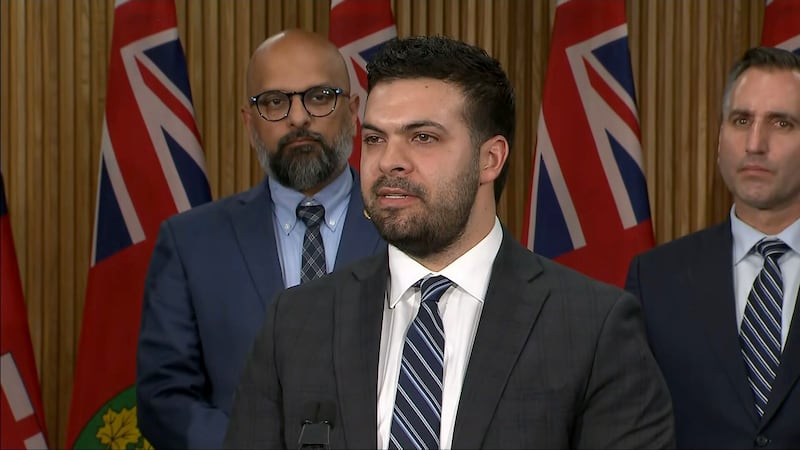 Jordan Cristillo Jordan Cristillo speaks with reporters at a news conference at Queen’s Park Tuesday November 25, 2025.
“Choices need consequences. And what I’m seeing proposed here delivers real consequences,” he said. “You have people that use our roads like a race track, and now they’ll be held accountable, and most importantly, families like mine will be protected.”
The Ford government has recently faced criticism for banning speed cameras – a move some experts have said will make roads less safe.
Asked why the government thinks speed cameras won’t work while higher fines for other violations will, Transportation Minister Prambeet Sarkaria said the province is focused on “prevention” in areas where speed cameras are being removed.
“Our intention is to bring in traffic calming measures that will support measures that won’t allow individuals in those specific zones to go over at such a high speed, especially in school zones and community zones,” Sarkaria said.
Here’s a rundown of some of the proposed measures in the bill.
Dangerous driving
The proposed changes would impose a lifetime driving ban for anyone convicted of dangerous driving causing death.
The bill would also allow police to immediately suspend a driver’s licence for 90 days and impound a vehicle if they have reason to believe a person is driving dangerously.
Careless driving
Police would be able to issue a seven-day roadside licence suspension for careless driving and a 30-day suspension for careless driving causing bodily harm or death.
Those convicted of careless driving would face steeper fines of $1,000 to $5,000. That compares to current fines of $400 to $2,000.
Distracted driving
Those convicted of distracted driving while operating a commercial vehicle would face longer licence suspensions and steeper fines, ranging anywhere from $1,000 for a first offence to $6,000 for a third offence.
Driving with a suspended license
Those who drive with a with a suspended licence would also face increased fines and longer vehicle impoundment periods. A first offence would result in a 14-day impoundment and a fine of anywhere from $2,000 to $10,000. The impoundment period would increase to 30ndays for a second offence, and a fine of $5,000 to $15,000. A third offence would mean an impoundment period of 45 days and a fine of $10,000 to $20,000.
Animal welfare
The bill includes a number of provisions for animal welfare. It would restrict invasive medical research on dogs and cats to “specified purposes,” such as veterinary research.
Penalties will also be increased for those who harm animals that work with peace officers, such as police dogs.
The government also says that it will begin consultations late next year on banning “medically unnecessary procedures that harm dogs and cats.” That would include procedures such as declawing and ear-cropping, the province says.
Faster police record checks
Under the bill, service standards would be developed to help reduce delays in processing police record checks that could affect employment or access to services.
Investigative Genetic Genealogy testing
Investigative Genetic Genealogy (IGG) is a relatively new investigative technique that has been credited with heling to solve a number of cold cases recently. The province wants to establish IGG laboratory testing at Ontario’s Centre of Forensic Sciences instead of having to turn to outside services to do the testing.
Fees and penalties for criminals
The government says it plans to establish a user fee system to charge convicts who are required to be monitored by GPS technology for the use of the devices.
It also plans to explore suspending the driver’s licences of those who default on bail debts, including sureties.
Drug enforcement powers for transit constables
Transit special constables could get drug enforcement authority under the bill, allowing them to direct people to stop using drugs or to leave the public space. They would be able to issue tickets or make arrests for non-compliance. The government says the aim is to reduce drug use on public transit.
Changes to the Coroners Act
The government says it wants to update the act “in response to challenges within the system.” As part of those changes it wants to prohibit “unauthorized recording and broadcasting” of coroner’s inquests.
The government says the change would bring the rules in line with those for the Courts of Justice and protect family privacy.
Using dogs to search prisoners
The bill proposes using canines to perform searches of inmates. The government says this will help prevent contraband from entering correctional facilities.
Changing SIU Act to exclude ARWENs from firearm definition
The bill changes the definition of “firearm” under the Special Investigations Unit Act to exclude Anti-Riot Weapon Enfields (ARWENs), a less-lethal weapon used by officers in law enforcement. The change would mean that firing an ARWEN will not automatically trigger an external SIU investigation. The SIU would still invoke its mandate in cases involving a death or serious injury involving the use of an ARWEN.
The province says the move will free up resources so the SIU can focus on critical incidents.
Municipal fines for fire code violations
Currently, the Fire Protection and Prevention Act is enforced through tickets, inspection orders and court proceedings.
The bill would allow municipalities to implement administrative monetary penalties for Ontario Fire Code violations. The government says the move would encourage compliance and deal with violations more efficiently by not tying up the court system.