
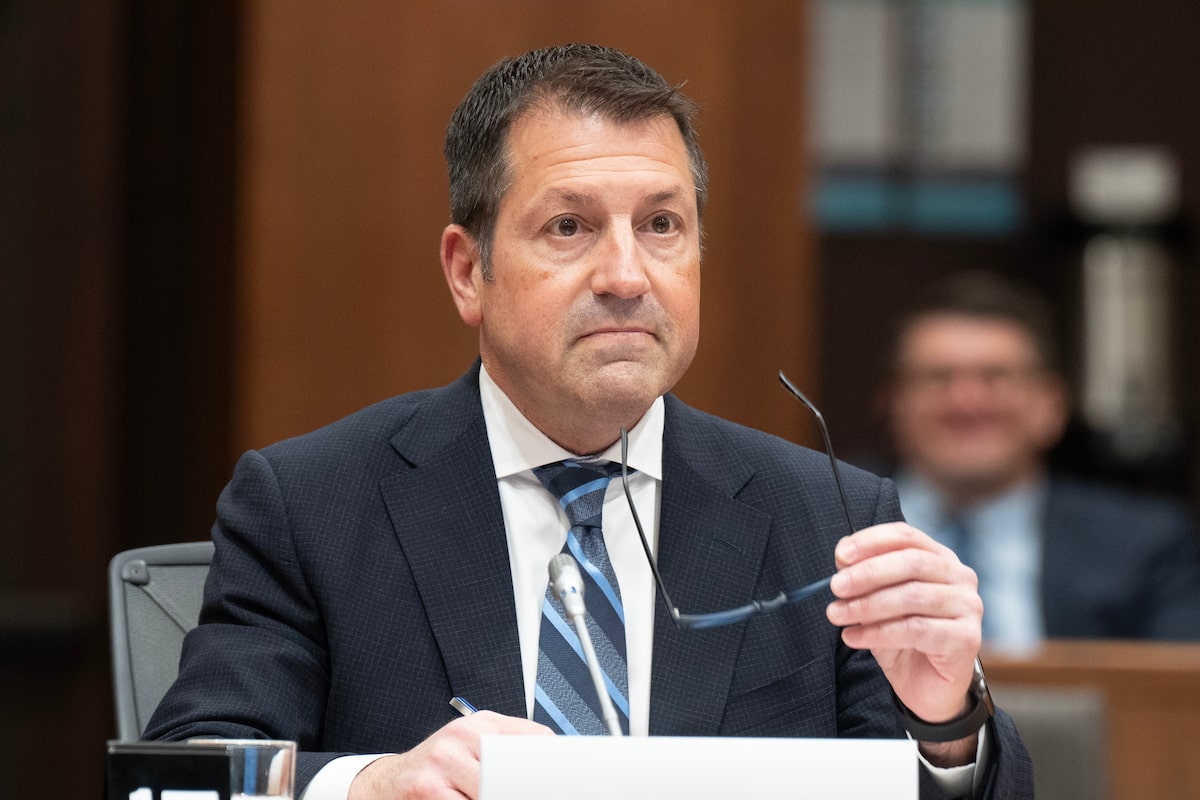
Brookfield Corporation Chief Operating Officer Justin Beber appears before the Standing Committee on Access to Information, Privacy and Ethics on Parliament hill in Ottawa, on Monday.Adrian Wyld/The Canadian Press
No one at Brookfield Corp. has spoken with Prime Minister Mark Carney about company business since he resigned earlier this year to run for the Liberal leadership, according to chief operating officer Justin Beber.
He testified at the House Ethics Committee Monday, which is studying the Conflict of Interest Act. Marc-André Blanchard, Mr. Carney’s chief of staff, and Michael Sabia, the Clerk of the Privy Council, previously appeared before the committee on the same topic. Mr. Carney’s business ties, and potential conflicts, have been in the spotlight since he decided to run for Liberal leader.
At Brookfield, Mr. Carney was head of transition investing. He was also chair of the board of the company’s asset management arm, Brookfield Asset Management Ltd., but not its parent company Brookfield Corp.
Mr. Carney must recuse himself from discussions, debates, decisions or votes specifically related to more than 100 corporate entities, which are largely tied to Brookfield Asset Management Ltd., according to his ethics filing. Mr. Carney has also placed most of his assets into a blind trust, meaning he no longer controls them.
Carney’s ethics filing shows more than 100 entities under conflict-of-interest screen
“Mr. Carney departed Brookfield on January 16th of this year, [the] same day on which he formally announced his candidacy” for the Liberal Party leadership, Mr. Beber said. “Since then, at no point has anyone at Brookfield spoken with the prime minister about Brookfield business.”
Later on, he said he met with Mr. Carney in a personal capacity to discuss “the rise in hate incidents, particularly anti-Semitism across Canada.”
At Brookfield, Mr. Carney spearheaded the design and fundraising for a US$15-billion “transition fund” that made investments in companies and infrastructure aimed at driving a transition to a cleaner global economy. Brookfield has since expanded that strategy by raising billions of dollars for two subsequent funds.
Conservative MPs pressed Mr. Beber to give the committee detailed breakdowns of the first Brookfield Global Transition Fund’s holdings, the clients who put money into it, and even the full range of more than 2,000 companies that Brookfield invests in.
Carney’s chief of staff testifies PM’s ethics screen is at ‘highest level of standards’
All 20 companies held through the first transition fund have been publicly disclosed, he said, and only one of those – the carbon capture and storage venture Entropy Inc. – is Canadian.
Conservative MP Michael Cooper repeatedly questioned Mr. Beber about carried interest payments that Mr. Carney could earn as part of the compensation package that top Brookfield executives receive.
When private equity firms and asset managers such as Brookfield achieve a minimum level of investment gains on a fund they manage, they typically also earn a share of investment profit over and above that threshold, known as carried interest or “carry.”
Mr. Beber said Mr. Carney could be entitled to a share of carried interest on the first fund he helped design and raise for Brookfield.
Mr. Cooper suggested Mr. Carney’s share of carried interest could ultimately be worth millions of dollars, but Mr. Beber said that is “certainly not a fact.”
Carney’s conflict of interest screen has been implemented six times, Privy Council Clerk says
Brookfield won’t know whether the fund performs well enough to earn carried interest or how much money that would be until at least 2032, or possibly as late as 2034, Mr. Beber said.
He declined to disclose what share of carried interest Mr. Carney could earn on the first fund, but said it is “fair” to say it would be in line with industry standards.
He also said Mr. Carney is not eligible for carried interest from two later funds that Brookfield is still raising – a second US$20-billion transition fund, and a smaller fund focused on transition investments in emerging markets. That limits the potential financial gain Mr. Carney could reap if Brookfield’s transition investing strategy is successful over the coming years.
“We had not yet instituted any allocation of carry from those funds,” Mr. Beber said. “Those funds had not yet been raised.”
In 2024, Brookfield and its consolidated businesses paid $750-million in federal tax, Mr. Beber said. When questioned by MPs, he generally noted the company pays all taxes in the jurisdictions it operates in.