
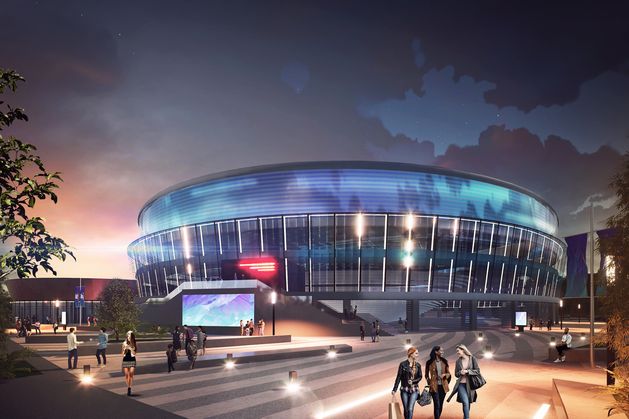
Dermot Rigley, founder and CEO of Prime Arena Holdings, describes his plan for Ireland’s first winter sports arena in Dublin as “a once-in-a-generation project”.
The proposed €190 million facility, set for Cherrywood in south Dublin, promises to reshape winter sports, ice hockey and international events in the capital.
Prime Arena Holdings Limited, the company funding the project, announced it has agreed to acquire the site from US-based real estate firm Hines, which is currently building 1,300 apartments in the Cherrywood Strategic Development Zone.
The potential economic impact of the arena has been independently estimated by Professor Tony Foley of DCU Business School.
According to Professor Foley, the facility could generate €298 million annually for the Irish economy, support more than 2,409 j jobs and produce around 237,000 tourist bed nights each year.
“With the type of events and activity projected at this arena, it would be a significant contributor to the exchequer and to employment,” Mr Rigley said.
He said the genesis of the project was from his background in sport and that’s where it started, with a simple question on whether an ice hockey team could work in Dublin
He began exploring the idea, drawing on his own background and contacts in sport, holding senior roles at RTÉ and Sky and having served on the board of the Pro14 rugby competition expanding the league to South Africa and bringing in private equity.
“Because I worked in sport, I knew there were a lot of good people I could speak with,” he said, citing contacts including Premier Sports founder Mickey O’Rourke and serial entrepreneur Tom Kennedy.
The consortium behind the project includes Dermot Rigley, founder, CEO and investor; Tom Kennedy, co-founder of Hostelworld; music promoter Denis Desmond, chairman of Live Nation UK & Ireland; and Mickey O’Rourke, founder of Setanta and Premier Sports.
Canadian investors Cory Cross, a 12-year NHL veteran, and Kent Simpson, former pro goaltender and coach, are also involved, alongside Irish strategic advisers John Hume and Eoin Brophy of Hume Brophy, and Canada-based financier Helen Work.

Dermot Rigley, founder and CEO of Prime Arena Holdings
Together, they aim to create a private initiative that, according to Mr Rigley, is unusual in Ireland.
“Up until now, you would have the traditional organisations – the GAA, FAI, IRFU – doing grassroots work,” he said.
“It’s rare to have a private consortium trying to create something new for the public and increase participation.”
The arena itself is designed as a national hub for winter sports. It will feature two full-sized Olympic ice rinks, a 5,000-seat arena with a standing capacity of up to 6,000, and a high-performance training centre for elite athletes.
“We’re working closely with the Olympic Federation of Ireland to create the first permanent facility in the country for winter Olympic sports,” Mr Rigley said.
Plans also envisage a professional ice hockey franchise, the first in Dublin, which will compete in the UK Elite Ice Hockey League alongside the Belfast Giants.
Mr Rigley points to the success of Belfast’s SSE Arena as proof that ice hockey can thrive in Ireland.
“Belfast sell out every game, season tickets are through the roof. If it can work there, it can work in Dublin,” he said.
Beyond sport, the arena is being designed to host concerts, exhibitions and conferences, with a projected capacity for 50-70 events annually.
Mr Rigley likens the venue’s potential to a scaled-down Madison Square Garden, offering a “North American entertainment experience” for the capital.
The choice of Cherrywood has been strategic; the eight-acre site sits along the Luas line, adjacent to the M50 and N11, with a Dublin Bus terminus nearby.
“We looked at four locations before settling here. It’s really well served and perfect for what we’re trying to achieve,” Mr Rigley said.
The arena also aims to leave a legacy for Irish sport and community participation.
He described plans to develop grassroots pathways, increase female participation in ice sports and make the facility accessible to all.
“We want to create a space where athletes and the community can access world-class facilities,” Mr Rigley added.
International interest in the project has been strong, with NHL players and investors showing enthusiasm for the project.
There are even plans to explore a potential festival of sport involving NHL and NFL events in Dublin, building on the success of the NFL regular season games staged in Ireland.
With planning permission targeted for submission in the new year, Mr Rigley says the arena could be operational by late 2028 or early 2029.
“There is significant interest in the space on both sides of the Atlantic, because this is a legacy project,” he said.
“Everybody we’ve approached on this has been saying you’re one of the last capital cities in Europe without a facility like this. How can we help you?
“It’s more than an arena, it’s a once-in-a-generation type of project coming to Ireland, which is for sport and for the community,” he added.