
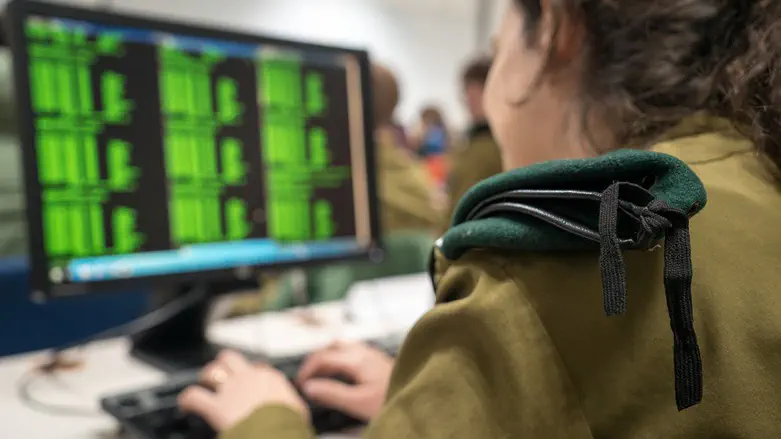
The IDF will begin routinely monitoring the social media accounts of all regular soldiers, as part of renewed preparations to prevent the exposure of sensitive information to the enemy.
According to a report by Galei Tzahal, the new system, called “Morpheus”, is based on artificial intelligence technology and is intended to scan the public accounts of about 170,000 soldiers.
The system will analyze texts, images and videos uploaded to social networks and will alert in cases where there is concern about the disclosure of security-related details.
The IDF says that if a sensitive post is detected, the soldier will receive an automatic notification requiring its deletion, and in serious cases a telephone inquiry will be made with an information security officer.
The “Morpheus” system has two main limitations: it will focus only on open accounts that are not set to private, and it will not monitor reservists, due to legal restrictions concerning citizens’ privacy.
During the past four months a trial version of the system monitored 45,000 soldiers. According to IDF sources, thousands of cases were identified in which soldiers were required to delete sensitive content.
The IDF acknowledges that the new initiative “pushes the boundaries of privacy and restraints on power”, but stresses that it is a necessary step given the damage caused by information leaked to social networks, which allowed Hamas to build a comprehensive intelligence apparatus before the October 7th massacre.
Hamas’ military intelligence network, consisting of roughly 2,500 operatives, spent about five years systematically gathering information in preparation for the October 7 attack.
According to IDF assessments, Hamas began operating in this field as early as 2018, systematically tracking nearly 100,000 soldiers and officers on social media.
According to a report by military correspondent Doron Kadosh on Galai Tzahal (IDF Radio), Hamas did not rely solely on public accounts. It also created “avatar” accounts through sophisticated social engineering and used them to access private accounts and even closed WhatsApp groups – including groups of recruits joining combat units.
Hamas produced daily reports on IDF force deployments, Iron Dome battery locations, and troop movements between sectors. By cross-referencing information from thousands of posts, photos, and videos – from images taken at discharge ceremonies to TikTok clips filmed on bases – the terrorists managed to assemble a precise intelligence puzzle that included the physical layout of IDF posts, rear gate positions, security cameras, readiness rooms, and armories.
This information was then used to build accurate models of IDF posts around the Gaza perimeter, both through 3D simulations and physical replicas constructed in Gaza.
Hamas acquired advanced simulation software and built full-scale 1:1 simulators. Nukhba terrorists trained for base infiltration using virtual reality (VR) headsets, with every detail of IDF soldiers’ behavior serving as raw material for the models.
Israel was aware of some of these models. A senior officer said, “We never imagined how accurate they were,” and an Air Force officer testified: “Hamas knew the base better than I did – even though I served there for many years.”