
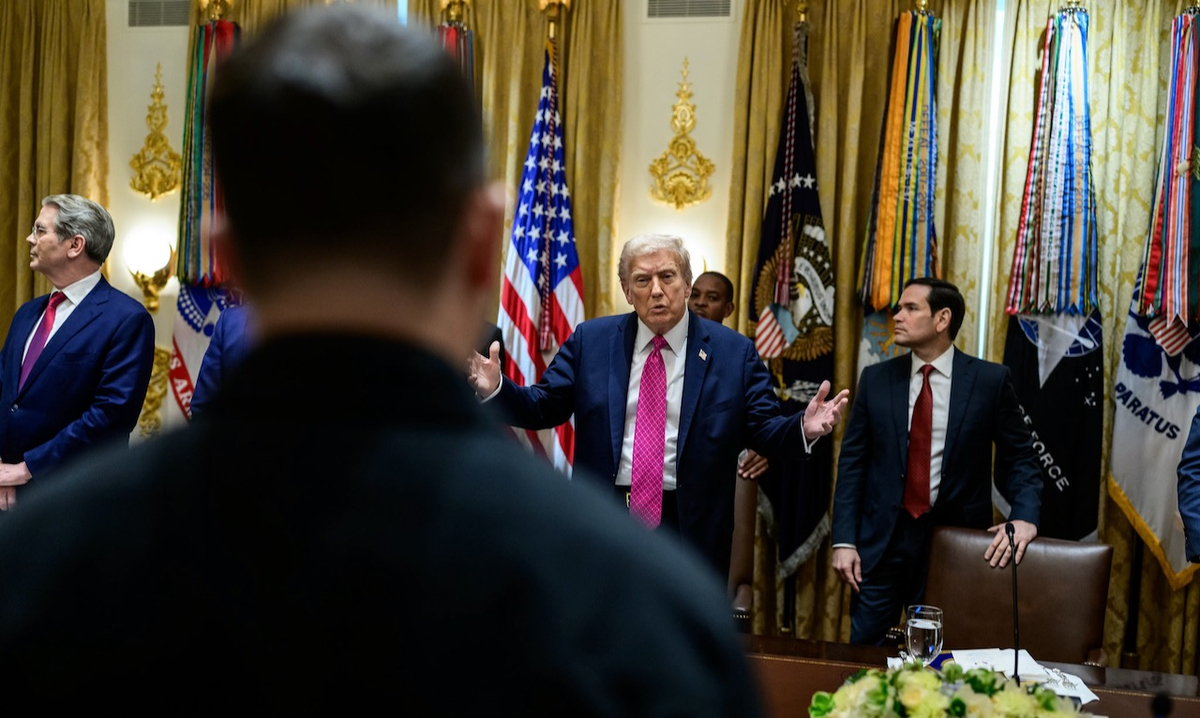
WASHINGTON DC – US President Donald Trump on Tuesday tried to downplay the now-infamous drafted 28-point “peace plan” for Russia and Ukraine – the one that enraged Kyiv, spooked Europe and triggered a revolt on Capitol Hill – insisting it was never more than “a map, a concept” as new questions swirl around the role of his hand-picked fixer Steve Witkoff, a real-estate developer with no diplomatic experience.
The president, who left Washington for Florida after a turbulent set of leaks, denunciations and hurried revisions, repeatedly insisted the draft was “only an original proposal” even as allied capitals and lawmakers demand clarity about the administration’s endgame.
JOIN US ON TELEGRAM
Follow our coverage of the war on the @Kyivpost_official.
“All that was is a map,” Trump told reporters in an impromptu gaggle aboard Air Force One. “That was not a plan. It was a concept… They’ve taken each one of the 28 points, and then you get down to 22 points… A lot of them we solved,” he insisted.
But the White House’s damage-control blitz is running headlong into new revelations – and new skepticism.
Witkoff under fire
A Bloomberg-published transcript of an October call between Trump’s special envoy Steve Witkoff and Putin adviser Yuri Ushakov fueled immediate alarm that Witkoff acted as a conduit for Russian preferences – “laundering” Moscow’s asks before feeding them back into US deliberations, according to one Western diplomat.
Other Topics of Interest
Astana’s tightened border inspections are revealing more than a trade disruption, exposing how deeply Russia’s wartime economy depends on fragile transit routes and political goodwill from neighbors.
In the transcript, Witkoff reportedly floated that Ukraine would “have to give up land,” and discussed how the Kremlin should tailor its pitch to Trump.
Asked about the leak, Trump brushed it off as “a very standard form of negotiation,” adding that Witkoff’s job was to “sell it to Ukraine,” a phrasing critics seized on.
“That’s what a dealmaker does,” Trump said, adding, “You’ve got to say look, they want this… I would imagine he’s saying the same thing to Ukraine.”
Western officials were considerably less forgiving. “If this was an attempt to channel Russian proposals back into the US system, that’s a completely different category of problem,” a senior European diplomat told Kyiv Post Tuesday night adding: “Nothing about this process looks disciplined, coherent, or aligned with NATO security.”
A plan no one wants to own
The originally leaked 28-point framework required Ukraine to surrender additional territory, cap its military and abandon NATO membership – provisions European leaders privately called “a non-starter” that appeared closer to a Kremlin wish list than a US initiative.
The White House was forced into a weekend rewrite, after Secretary of State Marco Rubio personally told allies the plan was “authored by the US” – hours after multiple senators said Rubio had told them it was effectively Russian-drafted.
In Geneva, Ukrainian and American officials “slimmed down” the draft to remove the most explosive elements, including territorial concessions.
But a senior Ukrainian official said the revisions “came only after a full-blown panic among partners.”
Trump, for his part, now says the original draft “was just a concept” – even though he had pushed Ukraine to accept it swiftly only days earlier.
Efforts to contain damage
Despite the uproar, President Volodymyr Zelensky has little choice but to stay in the game.
Zelensky’s chief of staff expects Army Secretary Dan Driscoll – the latest American official to be designated “lead negotiator” in what has become a chaotic, fast-changing process – to arrive in Kyiv this week.
Zelensky himself signaled urgency, saying he hopes to meet Trump “before the end of this month” to resolve “sensitive points,” even as he warned that “the main problem” remains Russia’s demand for legal recognition of its territorial seizures.
Trump insists the parties are making “good progress,” claiming Russia is already offering “big concessions.”
That characterization is not shared in European capitals. French President Emmanuel Macron said he sees “no Russian will for a ceasefire.” British Prime Minister Keir Starmer warned of “a long way to go – a tough road ahead.”
During a joint call of the “coalition of the willing,” European leaders agreed with the US to accelerate work on security guarantees – one of the hardest unresolved issues.
A senior Western official told Kyiv Post privately that improvised personnel shifts, and contradictory messages from Washington have “shaken confidence” in the process. “We are all trying to stabilize something the US keeps destabilizing,” the official said.
Democrats slam White House
In Washington, leading House Democrats issued a blistering joint statement Tuesday accusing the Trump administration of attempting to impose “a pro-Russian, one-sided ‘peace’ deal on Ukraine.”
Rep. Gregory Meeks (D-NY) and five other senior Democrats warned that forcing Ukraine to give up territory and cripple its military is “morally bankrupt,” would “give aid and comfort to Russia,” and would “all but guarantee another Russian invasion.”
“The Putin wing of the administration cannot be allowed to abandon American interests,” they wrote, urging Trump to “abandon [his] initial plan to force Ukraine into capitulation.”
The new, Ukraine-vetted counter-offer – which deletes the territorial clauses – is “vastly closer to what an achievable peace agreement would look like,” the group said.
As of Tuesday night, Russia said it still had not received the new draft – and accused Europe of undermining US efforts.
Meanwhile, Driscoll met Russian officials Monday and Tuesday in Abu Dhabi, even as battlefield strikes continued across Zaporizhzhia.
What next?
Trump told reporters that envoy Witkoff would be traveling to Moscow to meet with Russian President Vladimir Putin next week and that his son-in-law Jared Kushner, who helped negotiate the Gaza deal that brought about an uneasy ceasefire in the Israel-Hamas war, was also involved.
He said it appeared that Russia had the upper hand in the war and that it would be in Ukraine’s best interests to reach an agreement.
Trump added that some Ukrainian territory “might be gotten by Russia anyway” over the next couple of months. He also said security guarantees for Ukraine were being negotiated with Europeans.
In the meantime, while Trump is trying to reposition a plan that sparked a geopolitical firestorm as nothing more than a sketch, the blowback – from Europe, Congress, and even parts of his own administration – has exposed deep doubts about the process, the personnel, and Trump’s strategic intent.
Western officials openly wonder whether the White House is negotiating a ceasefire or simply searching for a face-saving way to hand Russia political wins.
Ukraine is participating, but cautiously. Europe is bracing for more shocks. Capitol Hill is mobilizing against what Democrats call “capitulation.”
And as one NATO official put it: “Talks can’t succeed if no one knows what the US is actually trying to negotiate.”
Where the talks head next – and whether they hold at all – remains unclear now that their starting point is itself in question.