
Berlin, Germany – A Berlin court ruled on Wednesday that authorities in Berlin who shut down a pro-Palestine conference soon after it began acted unlawfully.
Police on April 12, 2024, cracked down on the Palestine Congress, a forum of solidarity activists and human rights experts who were gathering to discuss Israel’s genocide in Gaza and Germany’s alleged complicity, earning a wave of criticism from civil society groups.
Recommended Stories list of 4 itemsend of list
“The dissolution and prohibition of the assembly were deemed disproportionate,” the panel of judges of the Berlin Administrative Court ruled.
The defendant, the State of Berlin, had argued the police were right to act preemptively as they predicted criminal statements would be made at the conference, specifically incitement to hatred, dissemination of propaganda or use of symbols of unconstitutional and “terrorist” organisations.
“The police also found no evidence of any criminal offences related to public expression,” the court ruling read.
The police justified their prediction in part on the basis that in a news conference held prior to the event, organisers allegedly did not distance themselves from the Hamas-led incursion into southern Israel on October 7, 2023.
On the day in question, officers in riot gear descended in their hundreds on the venue usually used for wedding receptions and pulled the plug – cutting off the power to ensure that none of the planned speeches could be heard or broadcast via livestream.
“I’m not aware of any other instance where a conference was shut down without any crime having been committed,” Michael Ploese, the lawyer representing the conference organisers, told Al Jazeera.
He said that German law only allowed restrictions on gatherings in private rooms where there was a high probability that a criminal act would be committed, and that the right to freedom of expression usually took precedence.
‘I wasn’t expecting it all to end an hour later’
Judische Stimme (Jewish Voice) was among the groups organising the conference and filed the legal case.
It is a sister group of the US collective of the same name that organises Jewish peace activists who are critical of Israeli actions regarding Palestine.
“I saw it as a success that we had even been able to begin it at all, but I wasn’t expecting it all to end an hour later,” said Wieland Hoban, the chair of Judische Stimme, who gave opening remarks at the conference.
Adding to the sense of repression, the British Palestinian doctor Ghassan Abu Sittah, one of the main speakers, said officials at the airport in Berlin prevented him from continuing his journey and told him to return to the United Kingdom.
Yanis Varoufakis, the Greek left-wing economist and former minister of finance, posted online the speech he had planned to make. Like Abu Sittah, Varoufakis faced an entry ban after the furore. The Berlin Administrative Court later ruled that the ban on Abu Sittah’s political activity was unlawful.
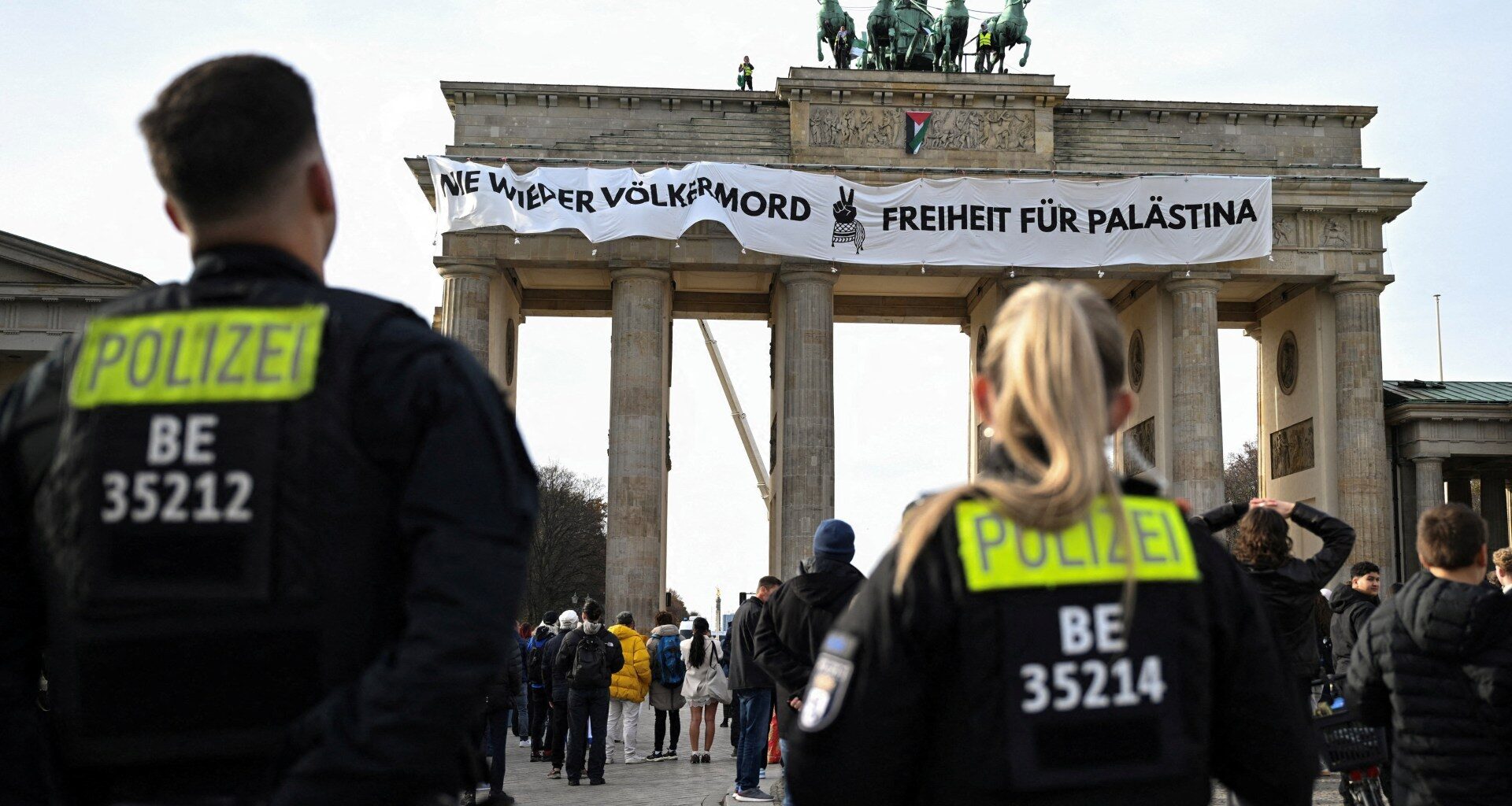
Throughout Israel’s genocidal war against Palestinians in Gaza, German police and security services have repeatedly claimed protests in support of those being bombarded are anti-Semitic or are to be interpreted as revering Hamas. Thousands of individual protesters have been arrested, and many planned demonstrations have been banned outright.
Germany is Israel’s biggest diplomatic supporter in Europe and enforces strict limits on speech that criticises or attacks Israel, with some arguing this is necessary because of Germany’s genocide of six million Jews in the Holocaust.
It is a justification that Wieland Hoban rejects, saying the laws are even used against Jewish people who speak up for Palestine.
“Even if you lost family in the Holocaust, you can still be lectured by some German about what you can say,” said Hoban. “Simply mentioning the Holocaust can get you accused of relativierung” – a word that is used to suggest someone is playing down the Holocaust by drawing comparisons to other, lesser, crimes against humanity.
UN alarmed by German position
Last month, a group of United Nations experts said they were alarmed by the “pattern of police violence and apparent suppression of Palestine solidarity activism by Germany”.
If this week’s case goes in favour of the conference organisers, it will be a blow to Germany’s controversial stance.
Videos of police using force to shut down nonviolent protests for Gaza on the streets of German cities have coursed around the world.
But what marked the state’s intervention in the Palestine Congress apart was that it represented the silencing of an event consisting of talks and debates in an indoor venue – a sphere of political expression that lawyers had previously thought was off-limits for police repression.