

Released: 2025-11-28
Real GDP by expenditure
Third quarter 2025
0.6% 
(quarterly change)
Household disposable income
Third quarter 2025
0.8%
(quarterly change)
Terms of trade
105.4 (2017=100)
Third quarter 2025
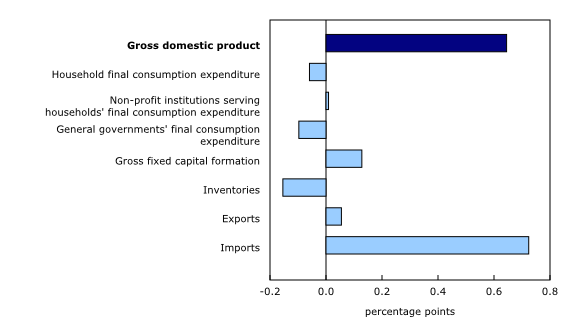
Real gross domestic product (GDP) increased 0.6% in the third quarter of 2025, after falling 0.5% in the second quarter. The rise in the third quarter was driven by a strengthening trade balance, as imports dropped and exports edged up. Increased capital investment was driven by government capital spending, as business investment was flat. Overall growth was dampened by declines in household and government final consumption expenditures as well as a slower accumulation of business inventory.
On a per capita basis, GDP increased 0.5% in the third quarter, after falling 0.5% the previous quarter.
Chart 1

Real gross domestic product and final domestic demand
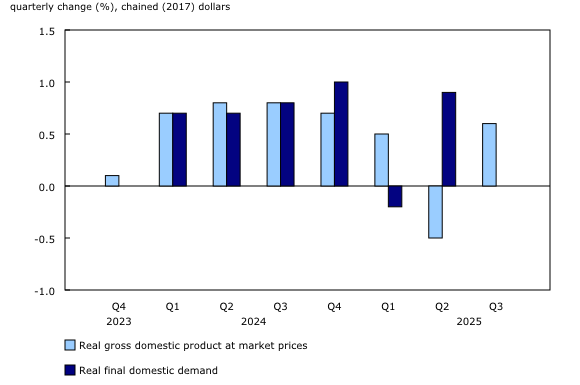
Chart 2
Contributions to percentage change in real gross domestic product, third quarter of 2025
Largest decline in imports since 2022, while exports increase slightly from second quarter drop
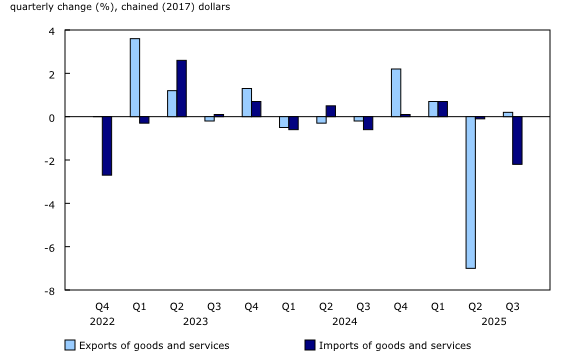
Imports of goods and services fell 2.2% in the third quarter, the largest drop since the fourth quarter of 2022. After recording a significant increase in the second quarter of 2025, imports of unwrought gold, silver and platinum group metals fell in the third quarter. Imports of industrial machinery, equipment and parts also declined in the third quarter, partially the result of a stronger second quarter caused by the import of a large oil and gas platform module.
Exports of goods and services edged up 0.2% in the third quarter, a slight increase from the significant drop in the second quarter (-7.0%). The increase in the third quarter was led by higher exports of crude oil and crude bitumen (+6.7%), followed by commercial services (+1.7%). Decreased exports of unwrought gold, silver and platinum group metals tempered the overall increase in the third quarter.
Chart 3
Volumes of exports and imports
Government invests more in weapon systems, while business capital spending is flat
Capital investment of governments increased 2.9% in the third quarter, led by a significant increase in spending on weapon systems (+82.0%). Governments also invested more in non-residential structures, particularly institutional buildings such as hospitals.
Meanwhile, business capital investment was unchanged in the third quarter, as increased investments in residential structures (+1.6%) and engineering structures (+0.2%) were offset by declines in machinery and equipment (-2.7%), non-residential buildings (-1.5%) and intellectual property products (-0.6%).
Residential investment up on increased resale activity, while new construction falls
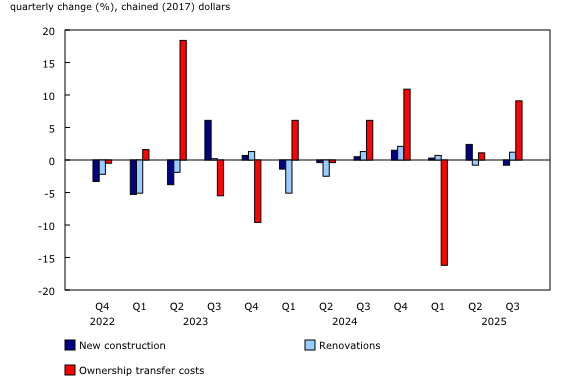
The overall increase in residential investment in the third quarter was due to a rise in ownership transfer costs (+9.1%), a measure of resale market activity, which continued to rise after declining 16.2% in the first quarter. Residential resale activity grew in all provinces in the third quarter, except in Newfoundland and Labrador, Prince Edward Island and Manitoba.
Residential renovations increased 1.2% in the third quarter. However, this rise was largely offset by a decline in new construction (-0.8%), as work put in place for apartments decreased in all provinces and territories, except Nova Scotia and British Columbia.
Chart 4
Housing investment
Slower accumulation of manufacturing inventories dampens overall growth
Businesses accumulated non-farm inventories at a slower pace in the third quarter relative to the second quarter, dampening overall growth in GDP. In the third quarter, the largest slowdowns in business inventory accumulations were in manufacturing, transportation and communication, and utilities. Meanwhile, retail businesses replenished stocks of motor vehicles in the third quarter, after recording withdrawals in the previous three quarters.
Household spending declines due to fewer purchases of vehicles
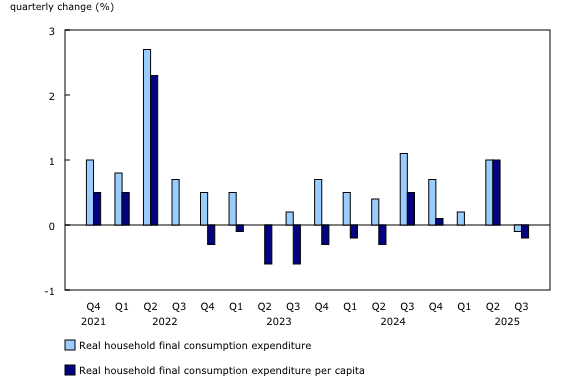
Household final consumption expenditure fell 0.1% in the third quarter, as decreased spending on passenger vehicles (-2.3%) was offset by increased expenditures on rent and financial investment services. Spending by Canadians abroad fell 3.9% in the third quarter, reflecting fewer international trips made by Canadians.
On a per capita basis, household spending fell 0.2% in the third quarter, after rising 1.0% in the second quarter.
Chart 5
Change in total and per capita real household final consumption expenditures
Government final consumption expenditure declines
Government final consumption expenditure fell 0.4% in the third quarter, the first decline since the fourth quarter of 2023. The decline in the third quarter of 2025 was led by decreased spending in the federal government, which was partially impacted by the administration of the federal election and the associated higher spending in the second quarter.
Higher energy export prices push up gross domestic product deflator and terms of trade
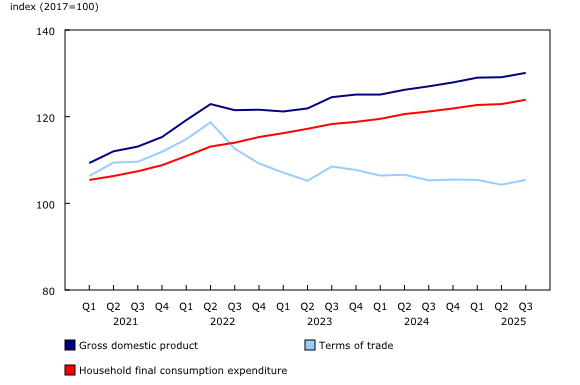
The GDP deflator was up 0.8% in the third quarter, following a 0.1% increase in the second quarter. The increase in the third quarter was led by higher export prices (+1.6%), particularly for energy products. Import prices rose 0.6% in the third quarter; as a result, the terms of trade—the difference between the price of exported goods and services and the price of imported goods and services—increased 1.0%. This was the largest increase in the terms of trade since the third quarter of 2023.
Chart 6
Gross domestic product price indexes, selected components
Compensation of employees rises
Compensation of employees rose 1.1% in the third quarter, following a 0.3% increase in the second quarter. Wages were up in all industries in the third quarter, except for federal government public administration excluding military (-4.2%).
The major contributors to wage growth in the third quarter were professional and personal services (+1.1%), finance, real estate and company management (+1.7%) and health care and social assistance (+1.2%).
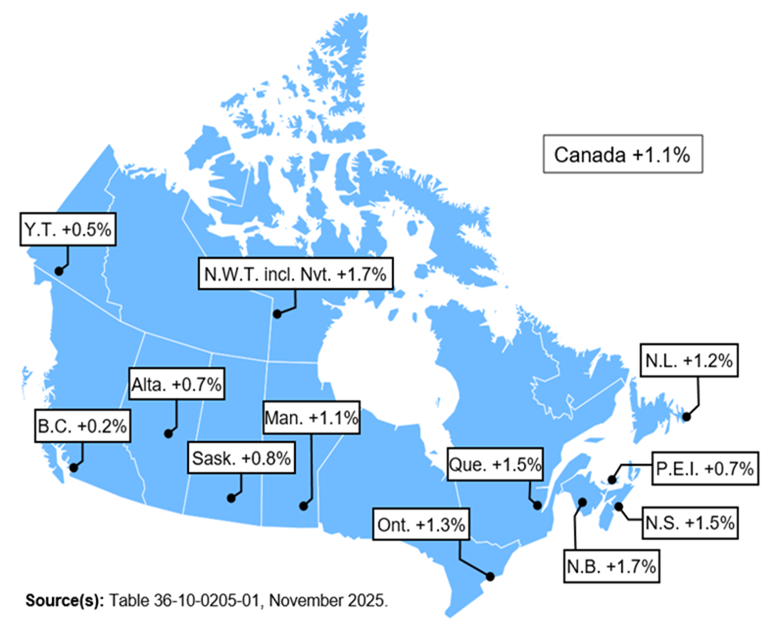
Compensation of employees increased in all provinces and territories in the third quarter. The highest growth was in New Brunswick (+1.7%) and the lowest increase was in British Columbia (+0.2%).
Map 1
Compensation of employees, quarter-to-quarter % change, seasonally adjusted data
Household saving rate up, as income grows slightly more than spending
The household saving rate (4.7%) ticked up in the third quarter, as disposable income (+0.8%) slightly outpaced nominal household spending (+0.7%). The household saving rate is aggregated across all income brackets; in general, saving rates are greater in higher income brackets.
Disposable income gains in the third quarter were mainly due to increases in wages and salaries, followed by higher self-employment income (termed net mixed income) and investment income (termed property income received).
Investment income rose 1.1% in the third quarter, the same pace as in the second quarter, driven by higher domestic dividend income.
Household property income payments, comprised of mortgage and non-mortgage interest expenses, declined 0.6% in the third quarter, along with a reduction in the Bank of Canada’s policy interest rate. Interest paid on mortgages accounted for more than two-thirds of the decline in overall property income payments.
Corporate income rebounds from second quarter decline
Corporate income (termed gross operating surplus) increased by 2.5% in the third quarter, as increased production of energy products brought in more income from non-financial corporations. The increase was further bolstered by higher mining sector income, driven by rising prices.
Income of the manufacturing sector was broadly positive in the third quarter, led by increased sales of refined energy products, while the publishing, broadcasting and telecommunications sector benefitted from successful summer events. Financial corporations’ income was up in the third quarter, mainly due to higher surpluses among chartered banks. Financial corporations’ income thus established a three-quarter upward trend and contributed to the overall rise in corporate income.
Sustainable development goals
On January 1, 2016, the world officially began implementing the 2030 Agenda for Sustainable Development—the United Nations’ transformative plan of action that addresses urgent global challenges over the following 15 years. The plan is based on 17 specific sustainable development goals.
Data on gross domestic product, income and expenditure are an example of how Statistics Canada supports the reporting on global sustainable development goals. This release will be used to measure the following goals:


Note to readers
Revisions to 2022 to 2024
In this release, new benchmark values from the supply and use tables (SUTs) for the 2022 reference year have been incorporated into the gross domestic product (GDP) by income and expenditure accounts. The SUTs integrate data from a wide range of sources into a balanced accounting framework. They represent the most detailed, coherent accounting system for the structure of the Canadian economy and are considered the most accurate benchmarks on which to base estimates.
Updates to the 2023 and 2024 reference years reflect the incorporation of several new or updated data sources, including, but not limited to, the Annual Survey of Manufacturing and Logging, the Annual Survey of Research and Development in Canadian Industry, the Annual Wholesale Trade Survey, the Annual Retail Trade Survey, Government Finance Statistics, as well as various administrative data, such as T2 corporate income filings and T1 personal and unincorporated business income filings. Wage and salary estimates were updated to reflect the final T4 employment income filing data for 2023 and preliminary T4 data for 2024. Results from the 2023 Annual Capital and Repair Expenditures Survey, Actual, were incorporated, and 2024 data were revised to incorporate major project updates from the upcoming release in February 2026. Results from the annual International Transactions in Commercial Services survey, the national Postsecondary Student Information System survey and student and work permit data from Immigration, Refugees and Citizenship Canada were incorporated to create updated values of Canada’s exports and imports of services. Notable revisions included those made to Canada’s computer services exports, as previous estimates were lower than survey-reported export values.
For more information on the revisions to GDP by income and expenditure accounts, see “The 2022 to 2024 Revisions of the Income and Expenditure Accounts.”
Impact of US government shutdown
Quarterly GDP by expenditure relies on international merchandise trade data as an input. In the context of the partial shutdown of the US federal government, Statistics Canada did not receive data on Canadian exports to the United States for the reference month of September 2025. Therefore, exceptionally this quarter, special estimates on Canadian international merchandise exports to the United States for the reference month of September were produced to compile third quarter statistics. Further discussion on the compilation of these special estimates is available in a release published yesterday in Statistics Canada’s The Daily.
The impact of the US government shutdown was mostly on the measurement of trade in goods. However, the measurement of trade in services with the United States was also impacted but to a lesser extent. Trade relating to exports and imports of certain transport services, as well as maintenance and repair services, are reported through customs documents received from the US government. Additionally, various other components within GDP by expenditure use trade statistics as part of their estimation method, including, but not limited to, investment in machinery and equipment.
In accordance with the revision policy for quarterly GDP statistics, data for the third quarter of 2025 will be updated when statistics for the fourth quarter of 2025 are published on February 27, 2026. Users should expect that these updates could result in larger than normal revisions for components impacted by the missing trade statistics.
General
Percentage changes for expenditure-based statistics (such as household spending, investment and exports) are calculated from volume measures that are adjusted for price variations. Percentage changes for income-based statistics (such as compensation of employees and operating surplus) are calculated from nominal values; that is, they are not adjusted for price variations. Unless otherwise stated, growth rates represent the percentage change in the series from one quarter to the next: for instance, from the second quarter of 2025 to the third quarter of 2025.
For information on seasonal adjustment, see Seasonally adjusted data – Frequently asked questions.
Real-time tables
Real-time tables 36-10-0430-01 and 36-10-0431-01 will be updated on December 8, 2025.
Next release
Data on GDP by income and expenditure for the fourth quarter of 2025 will be released on February 27, 2026.
Products
The data visualization product “Gross domestic product by income and expenditure: Interactive tool,” which is part of the Statistics Canada – Data Visualization Products series (Catalogue number71-607-X), is now available.
The document “The 2022 to 2024 Revisions of the Income and Expenditure Accounts,” which is part of Latest Developments in the Canadian Economic Accounts (Catalogue number13-605-X), is now available.
The document “Revisions to Canada’s GDP,” which is part of Latest Developments in the Canadian Economic Accounts (Catalogue number13-605-X), is available.
The Economic accounts statistics portal, accessible from the Subjects module of the Statistics Canada website, features an up-to-date portrait of national and provincial economies and their structure.
The User Guide: Canadian System of Macroeconomic Accounts (Catalogue number13-606-G) is available.
The Methodological Guide: Canadian System of Macroeconomic Accounts (Catalogue number13-607-X) is available.
Contact information
For more information, or to enquire about the concepts, methods or data quality of this release, contact us (toll-free 1-800-263-1136; 514-283-8300; infostats@statcan.gc.ca) or Media Relations (statcan.mediahotline-ligneinfomedias.statcan@statcan.gc.ca).