
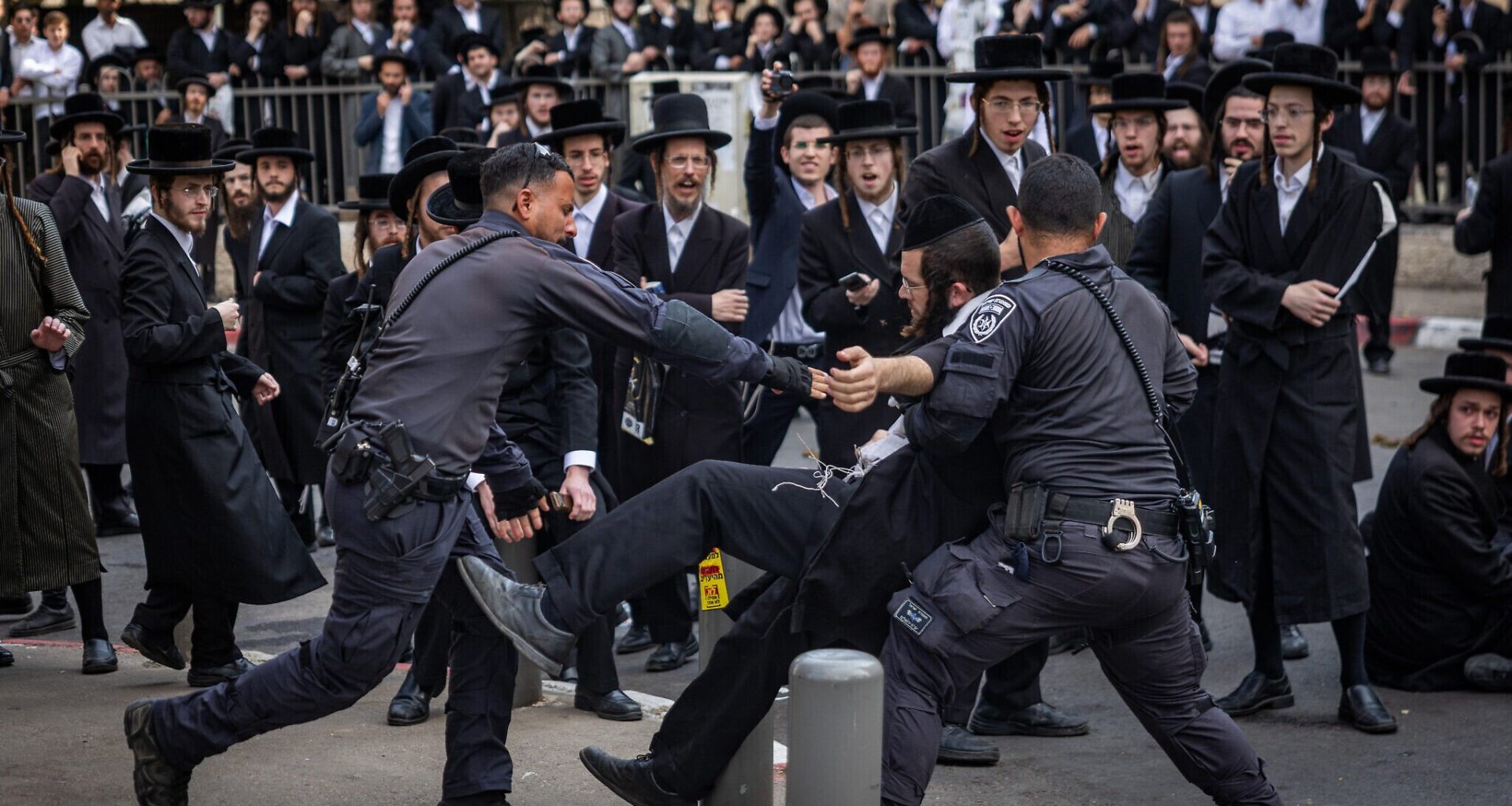
In the middle of a war and amid plans to keep calling up reservists for long rounds of service next year, Israel is going to draft Haredi men with its hands tied.
On Thursday, Likud MK Boaz Bismuth, the Knesset Foreign Affairs and Defense Committee chair, proposed a joke of a conscription law, exempting many tens of thousands of Haredi men, who may as well update their “we’ll die and won’t enlist” rallying cry to “we’ll live and won’t enlist — and everyone else can go to hell.”
Practically every clause in the draft bill’s 38 pages is enough to raise the ire of anyone who hopes for Israelis to equitably share the burden of military service — and suffers just the burden, with no equity.
Bismuth was appointed to the powerful position in July after the Likud voted out his party colleague Yuli Edelstein from the chairmanship because he had insisted Haredi draft dodgers be subject to criminal sanctions, including fines on non-compliant yeshivas, loss of social benefits and restrictions on travel abroad and getting a driver’s license.
Edelstein’s insistence led Netanyahu’s Haredi coalition partners — the Sephardic Shas and Ashkenazi United Torah Judaism — to boycott government-backed votes in the Knesset plenum. After Bismuth shared the official draft legislation among committee members on Thursday, Shas and UTJ announced they would go back to voting with the government.
Get The Times of Israel’s Daily Edition
by email and never miss our top stories
By signing up, you agree to the terms
The upshot is a piece of pretty masterful manipulation, all to enable a declaration that thousands of Haredi men will ostensibly be drafted — 8,160 over six months, to be precise. Ten percent of those will enlist in the Sherut Leumi national service corps, assisting workers in fields such as health, tech and education.
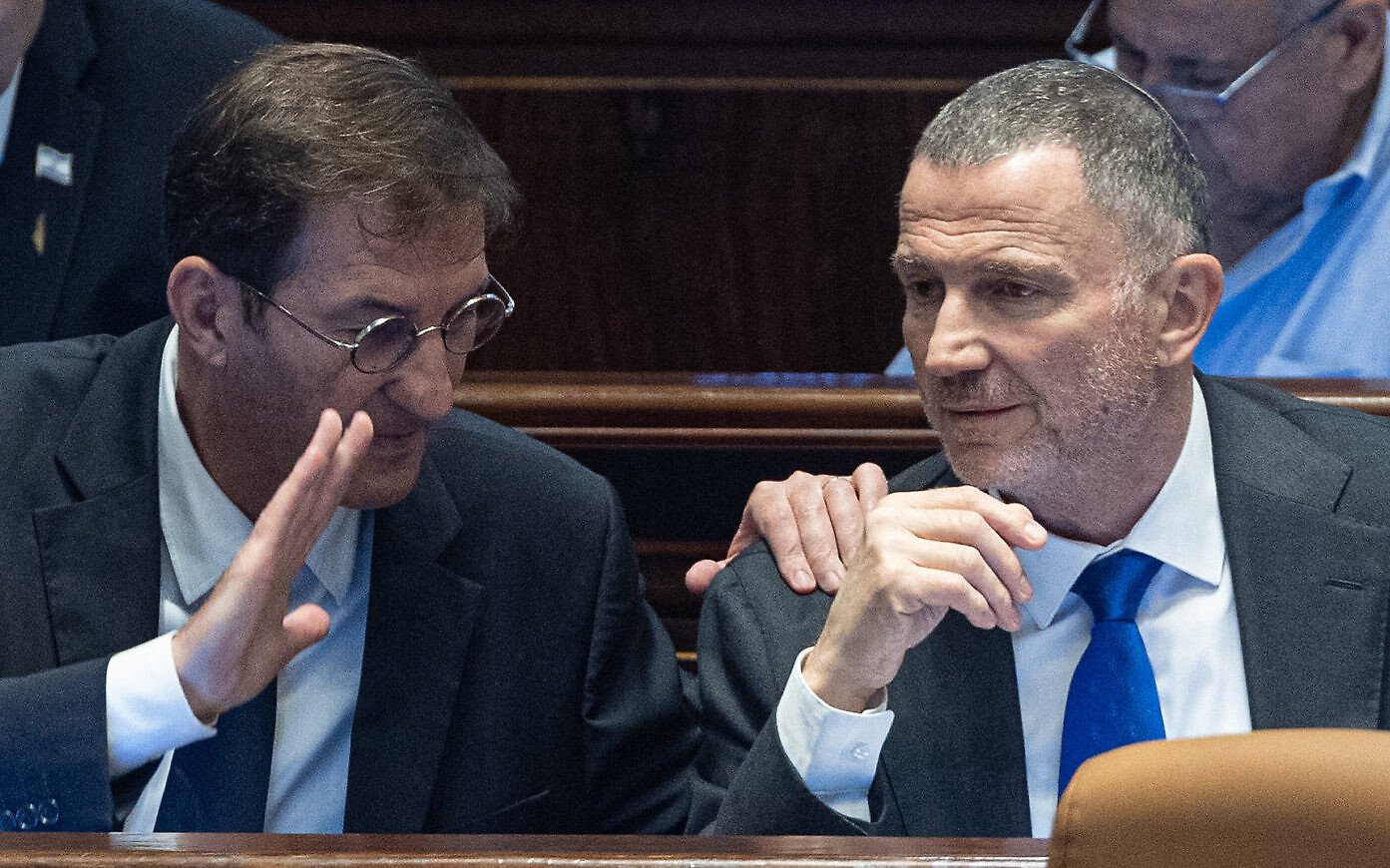
Likud MK Boaz Bismuth (left) speaks with party colleague Yuli Edelstein during a discussion on a non-binding proposal to apply sovereignty over the West Bank, in the Knesset on July 23, 2025. (Yonatan Sindel/Flash90)
But the bill’s stated goals and quotas are largely meaningless because, to give one prime example, under its terms, the “Haredi” label can be applied to such a broad swath of young men.
Under the draft law, for instance, anyone who studied in a yeshiva for two years between the ages of 14 and 18 is considered ultra-Orthodox, even if they are no longer observant. So ultra-Orthodox Yeshiva boys can stay put, their weight pulled by “Haredim” on paper who are already slated for enlistment anyway, or who are already serving in the army’s regular and reserve forces.
Even now, before any legislation has been passed, close to 3,000 “ultra-Orthodox men” are serving in various units, though various programs. But few Haredi men are in combat, and it’s clear that that will remain the case under the new law.
In practice, the new law will end up drafting only several hundred out of the roughly 80,000 enlistment-age Haredim.
Shas MK Ariel Atias, who helped cook up the law on behalf of the Haredi parties, can only be praised for his success in effectively gutting any actual draft measure for Haredi men.
The legislation likewise guts any draft orders that have already been sent to Haredi men under the current arrangement, after the High Court ruled in June 2024 that the Haredi community’s long-time de facto exemption had no legal basis.
The Military Police’s token pursuit of individual draft dodgers will come to an end, as will the massive demonstrations led by Haredi rabbis outside the prisons.
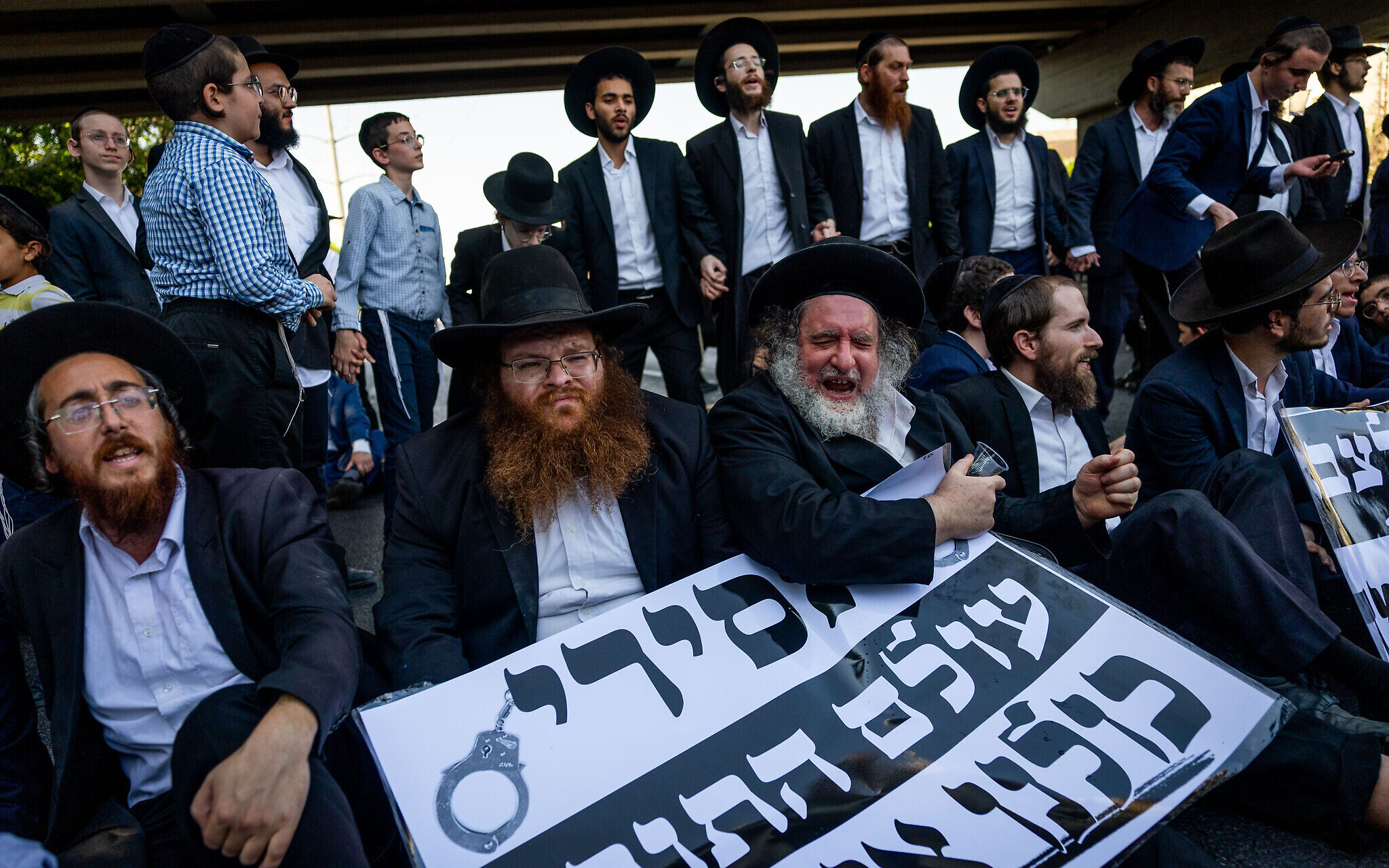
Ultra-Orthodox protesters clash with police during a protest against the arrest of Haredi men who failed to report for military duty, on Route 4 near Bnei Brak, August 19, 2025. They hold a sign reading: ‘Prisoners from the Torah world: We are with you.’ (Yonatan Sindel/Flash90)
Moreover, Haredi youth who are ordered to enlist will be able to get their driver’s licenses and go abroad, since the criminal sanctions on draft dodgers will come into effect only in June 2027 — and then, too, only if the number of actual Haredi recruits fails to crack 75% of the stipulated quota, in which case, the law says, the quota will be reexamined.
Even this bluff hides the basic charade of the driver’s license and travel sanctions, considering the reluctance of the head rabbis of yeshivas to see their students going on joyrides and traveling abroad.
Only in June 2027 will there be a decision as to whether to impose real institutional sanctions for Haredi draft dodging, such as the loss of subsidies for daycare centers and yeshivas. The decision will fall to Defense Ministry officials and a designated rabbinical committee, which will determine if the law’s stingy enlistment goals were attained.
Netanyahu wants to be ‘the first PM’ to pass a Haredi enlistment law
As this writer noted last week (Hebrew link), Netanyahu seeks to rush the bill through parliament and parade it in the coming weeks and months as a historic achievement that will lead to the enlistment of thousands of Haredi men. In reality, Netanyahu hopes the passage of a law that will broadly maintain the current Haredi non-service status quo will help him lure the Haredi parties back into his government.
In an interview with the Abu Ali Express channel on the Telegram chat app last week, Netanyahu declared, “I want to be the first prime minister in the history of the state of Israel to pass an enlistment law. I’ll draft 17,000 fighters within three years, for the sake of the IDF. That’s a division and a half. Do you know how many reserve battalions that saves us?”
Looking at Bismuth’s bill, it’s obvious that not a single battalion, never mind a division, will come of it. Nonetheless, this false propaganda will intensify ahead of the final Knesset vote on the law in the coming month, and in the Likud campaign in the elections due no later than October 2026.

Prime Minister Benjamin Netanyahu gives an interview to the Abu Ali Express Telegram channel, which aired on November 20, 2025. (Abu Ali Express screenshot/Telegram)
Netanyahu experimented with this strategy on Thursday, issuing a statement attributed to “the prime minister’s close circle” that read: “The enlistment law presented today — something that hasn’t been done since the country was founded — will lead to the enlistment of 23,000 Haredi men within three-and-a-half years.”
The statement further claimed that this total was four times both the average Haredi enlistment thus far and the goals set in an earlier draft law by former defense ministers Benny Gantz and Avigdor Liberman, both currently in the opposition.
The new draft law, according to the statement, “includes sanctions and harsh restrictions” in response to failure to meet enlistment quotas.
“This is an excellent law, and this law will pass,” the statement said.
Again, the new law proposed by Bismuth will lead — in the best-case scenario — to the enlistment of just a few hundred of the 80,000 enlistment-age Haredi men. And the sanctions are toothless and contingent.
Netanyahu’s “close circle” is right about one thing, though — the legislation presented by Liberman and Gantz was very lenient with the Haredim. But that was before the Hamas onslaught of October 7, 2023, and Israel’s ensuing conflicts across the Middle East. The “close circle” statement unsurprisingly fails to mention the completely different security reality at the time of the Liberman-Gantz proposal.

Israelis protest in Tel Aviv for an end to Haredi draft exemptions, March 14, 2024. The placard at the center urges an ‘equality of burden’ in military service. (Avshalom Sassoni/Flash90)
Right now, Bismuth’s law does not have a solid majority in the Knesset. The Haredi parties are firmly behind it — except for UTJ chief MK Yitzhak Goldknopf, who is unwilling to support any criminal sanction, real or imaginary.
But Edelstein, the former defense committee head, has vowed to vote against the bill, as have a handful of other coalition members — Edelstein’s fellow Likud members Dan Ilouz and Moshe Saada, Deputy Foreign Minister Sharren Haskel, and Immigration Minister Ofir Sofer of Religious Zionism.
The main question is what Finance Minister Bezalel Smotrich, the head of Religious Zionism, will choose to do. Religious Zionist parents of fallen soldiers have in recent days launched a pressure campaign calling on the party to “block the Bismuth bill.”

Finance Minister and Religious Zionism leader Bezalel Smotrich leads a faction meeting at the Knesset in Jerusalem, November 17, 2025. (Yonatan Sindel/Flash90)
Rabbi Hagai Lober, whose son Elisha was killed fighting in Gaza, said Thursday that “the enlistment bill doesn’t set quotas or goals. A real bill needs to be like the law against tax fraud, with personal and institutional sanctions. [We] need to financially penalize draft dodgers and reward people who enlist; that’s what will lead to a change.”
This article was translated and edited from Zman Yisrael, The Times of Israel’s Hebrew-language sister site.