

Listen to this article
Estimated 4 minutes
The audio version of this article is generated by text-to-speech, a technology based on artificial intelligence.
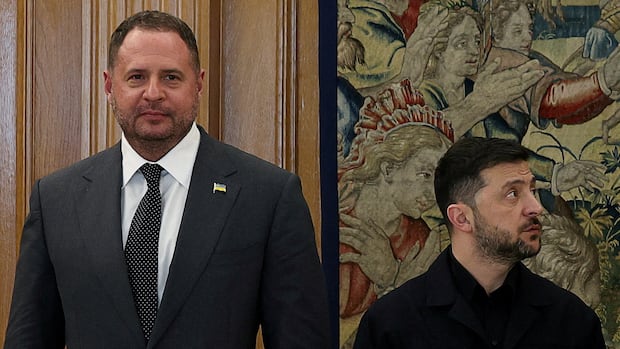
Ukrainian President Volodymyr Zelenskyy said on Friday that his chief of staff, Andriy Yermak, has submitted his resignation amid a corruption scandal.
Ukrainian anti-corruption agencies searched Yermak’s home on Friday morning. Yermak said he was fully co-operating with the investigators.
He has not been named a criminal suspect, but opposition lawmakers and some members of Zelenskyy’s own party had called for his dismissal as part of Ukraine’s worst wartime political crisis.
The departure of Yermak, 54, comes at a perilous time for Kyiv as it faces U.S. pressure to make concessions to Moscow to end its war on Ukraine and lacks the soldiers or weapons to push Russian forces back.
“Russia very much wants Ukraine to make mistakes,” Zelenskyy said in a video address. “There will be no mistakes on our part. Our work continues.”
Ukraine has been mired in scandal over an alleged plot to control contracts at the state-owned nuclear company totalling tens of millions of dollars in kickbacks and laundered money as Ukraine tries to protect energy infrastructure from Russian airstrikes.
German Galushchenko and Svitlana Hrynchuk, who served as justice minister and energy minister, respectively, resigned their posts earlier this month, though each deny wrongdoing.
The National Anti-Corruption Bureau of Ukraine and the Specialized Anti-Corruption Prosecutor’s Office said the Yermak searches were “authorized” and linked to an unspecified investigation.
LISTEN | Simon Shuster, Zelenskyy biographer, on the scandal (Nov. 19):
The Current15:14What to know about Ukraine’s corruption scandal
Yermak has been key contact with U.S.
The U.S.-backed peace push comes as Russian forces grind forward along several parts of the sprawling front line. Moscow says its troops are close to capturing the eastern city of Pokrovsk, which would be their biggest prize in nearly two years.
Russian President Vladimir Putin said on Thursday that a 28-point U.S. peace plan leaked last week could be “a basis for future agreements.” He demanded Kyiv withdraw troops from eastern land it holds before Moscow stops fighting.
Zelenskyy had requested a meeting with U.S. President Donald Trump after revisions to that plan were hammered out in Geneva with U.S. officials, but as of yet the White House hasn’t acceded to the request.
Speaking to The Atlantic magazine this week, Yermak said that “no one should count on us giving up territory.”
Another tenet of the 28-point plan was for Ukraine to limit the size of its military and to permanently abandon a bid to join NATO.
Whether wearing a sharp suit in the halls of power while visiting European countries or khaki fatigues on visits to front-line positions, Yermak has been a constant presence — a burly figure towering over his shorter boss.
WATCH | Troop reduction would harm Ukraine, European defence, says ex-NATO official:
Former NATO director weighs in on foreign troops in Ukraine as part of peace plans
Fabrice Pothier, CEO of Rasmussen Global and a former NATO policy planning director, explains why Russia shouldn’t dictate the terms of security guarantees for Ukraine.
Yermak has survived several government reshuffles and exudes confidence, despite widespread public mistrust of an unelected official holding so much power.
He has been a primary point of contact with two U.S. administrations, helps co-ordinate prisoner exchanges and peace talks, and is involved in lobbying Kyiv’s partners for weapons, funding and sanctions against Moscow.
Yermak, who was born in Kyiv and started out as a lawyer before setting up a media company, has been at Zelenskyy’s side since long before Russia’s full-scale invasion in February 2022. They met in the early 2010s, when Zelenskyy was a performer and producer in television and Yermak was an emerging figure in Ukrainian media.
When Zelenskyy ran for the presidency in 2019, Yermak was on his team and later cemented his place at the top of the administration.
Ukraine has traditionally ranked poorly in Transparency International’s annual Corruption Perceptions Index, especially among European countries. Ukraine placed 105th out of 180 countries in the most recent addition of the non-profit association’s rankings.
Ukraine was credited with “making strides in judicial independence and high-level corruption prosecutions” even amid war, but concerns were raised about state-backed stifling of dissent and the diversion of resources that could support transparency but instead have been used to sustain the country’s military agenda.