
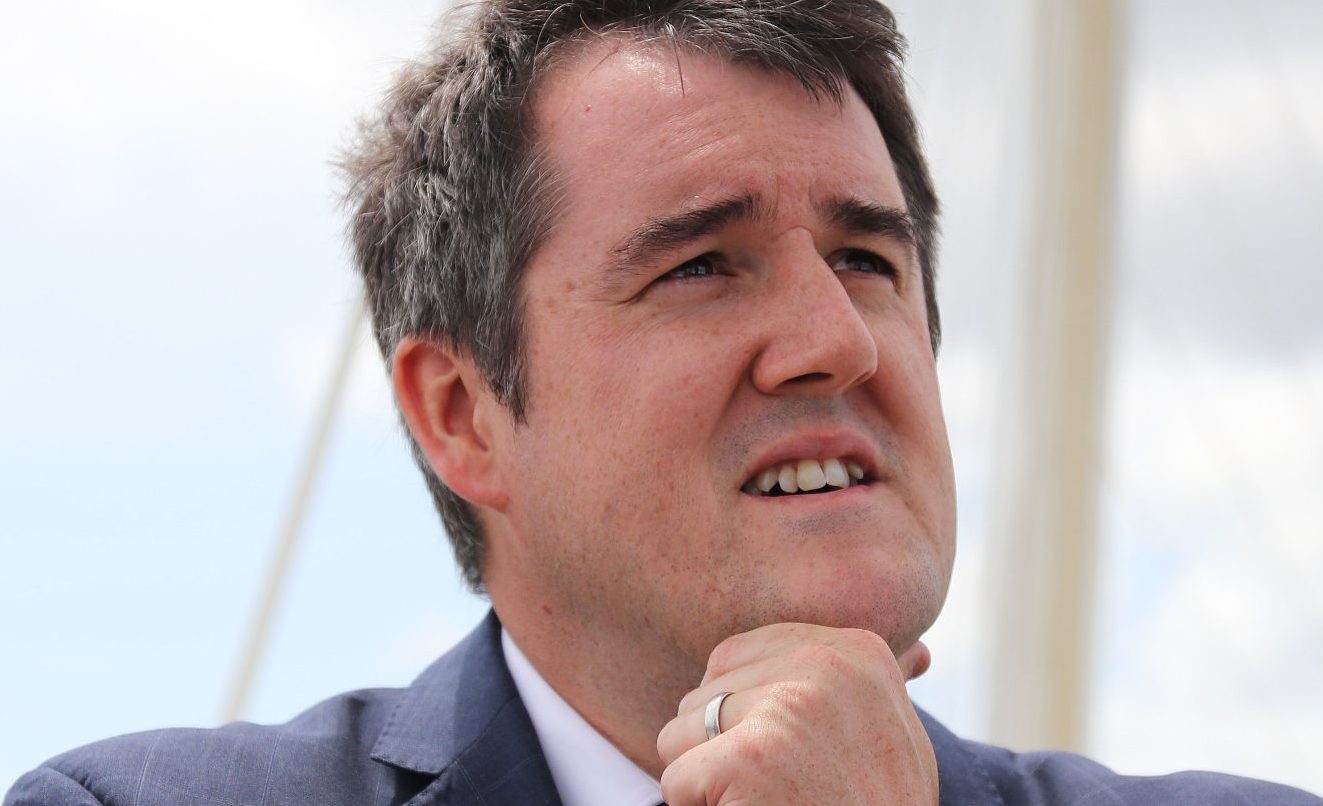
When speaking to Chris Bishop’s father ahead of his death last year, Newsroom asked the veteran journalist whether his son could one day lead the National Party – or for that matter, become the Prime Minister.
“If Luxon was crushed by a bus on Lambton Quay tomorrow, it would be Nicola or Christopher,” John Bishop said at the time.
His son, someone who’s already had an impressive political career by many standards, downplayed any leadership ambitions at the time.
Bishop admitted he’d probably been voted ‘most likely to be Prime Minister’ at high school, or something like that, but would only go so far as to say he’d do the job as minister for as long as he could, or as long as he had the Prime Minister’s confidence.
That question has become relevant again, as chatter regarding a possible National Party leadership coup has gathered steam during the past week or so.
On Tuesday, the Planning Minister and Cabinet colleague Simon Watts held a briefing in Bishop’s sixth-floor office to walk reporters through the Government’s proposed local government reforms, where Bishop spoke about the need for bold changes.
“Change is hard, and actually, this Government was elected to make tough decisions to get the economy going again and to deal with some of the long-term structural drivers that have led to lower living standards than we might otherwise have,” Bishop said.
These comments presented an obvious segue into questions about another big change that could be afoot.
When asked whether he was going to try and roll the leader, Bishop answered with a categorical “No”.
Can you make a commitment to New Zealanders that Christopher Luxon will remain the Prime Minister through to next year’s election? “Yes.”
Bishop said Luxon was the best person for the job, that he was doing a “fantastic job”, and that the Prime Minister was committed to dealing with “long-term systemic problems that governments of the past have been unwilling to deal with”.
Similarly, Luxon shrugged off the rumours on Monday when talking to Newstalk ZB, saying it was hard to take them seriously.
“Look, I don’t think that is the case. He is a great minister, he’s a good friend, and he’s doing an awesome job,” Luxon said.
“I’ve been reading this stuff and hearing this stuff ever since I came here. So, but I’m very focused on what I have to do.”
Luxon is right: these types of rumours swirl around periodically. But this round of chatter has coincided with a problematic poll for Luxon and the National Party.
Last week, the Ipsos Issues Monitor found the Nats had lost the trust of the electorate on the economy. Law and order was the only issue out of the top seven that National was more trusted than Labour to handle.
This is by no means the first bad poll for Luxon, but the effect is cumulative. And with the Prime Minister frequently polling lower than his party during the past year, there’s a strong argument to be made that he could be dragging down the ticket.
At the same time a leadership coup is always a risky manoeuvre.
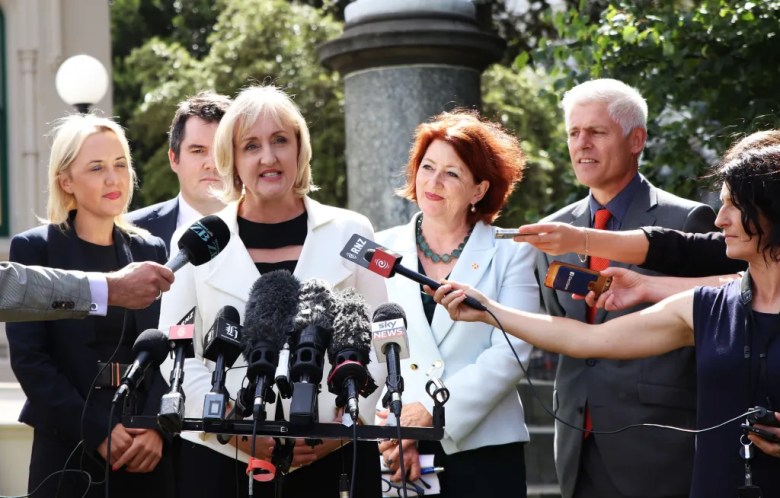 Amy Adams announces her candidacy for National’s leadership with caucus colleagues Nikki Kaye, Chris Bishop, Maggie Barry and Tim Macindoe. Photo: Lynn Grieveson
Bishop is no stranger to the machinations of leadership change, having backed Amy Adams’ failed tilt in 2018 and then playing a key role (alongside Nicola Willis) in rolling Simon Bridges to place Todd Muller in the top spot in 2020.
Muller’s short tenure was followed by Judith Collins’ leadership and a phenomenal election defeat for National, as the so-called red wave swept the country.
Similarly, rounds of leadership changes destabilised the Labour Party between 2014 and when Jacinda Ardern took over as leader in 2017.
The stakes are even higher when unseating a sitting Prime Minister. In the three cases in recent memory – the rolling of David Lange, then Geoffrey Palmer, and then Jim Bolger – the outcomes weren’t good for the parties.
All this to say, there’s a good chance the chatter is just that (especially as economic data starts to look more positive). But no one stays leader forever, meaning that one day Bishop could be a viable option for party leader – even if that day is not today.
Bishop entered Parliament in 2014 on the party list. Since then he’s won, lost and won back the Hutt South seat – the electorate where he lives with his wife (former Beehive staffer, now Wellington Airport corporate affairs manager, Jenna Raeburn), and two young children.
A decade into the job, he holds the housing, infrastructure, resource management reform, and transport portfolios. He’s also Leader of the House, associate minister of finance, and associate sports minister. Bishop also chaired National’s 2023 general election campaign, and will run the party’s election campaign again next year.
But the now-senior Cabinet minister’s political experience extends beyond his time as an MP.
He worked as a staffer for National while it was in opposition, and then in the Beehive offices of Gerry Brownlee and Steven Joyce, during John Key’s government.
There are parallels between Bishop and his former boss and mentor, Steven Joyce. Joyce was similarly thought of as a ‘Mr Fixit’, or sometimes the ‘Super Minister’ in a nod to his creation of the Ministry of Business, Innovation and Employment, the so-called super ministry.
Joyce was part of Key’s kitchen cabinet and was also sometimes rolled out as an attack dog during election campaigns, both in his official capacity as campaign manager, and in his unofficial capacity as a senior MP who was able to speak with confidence on a range of issues at short notice.
The former list MP was similarly a hard worker, with high standards and a reasonable amount of political astuteness.
Bishop has previously told Newsroom that his time working for Joyce in his seventh-floor Beehive office helped him learn the rhythms of Parliament and what was expected of a minister, ahead of his official launch into politics.
Since arriving in Parliament, Bishop has held some hefty portfolios. As well as being shadow leader of the House and Covid-19 spokesperson, he also held the police and housing portfolios in opposition. And in 2016, his member’s bill made it possible for live organ donors to be compensated.
One of the perceived taints on Bishop’s record was his stint as a lobbyist for tobacco giant Philip Morris.
Bishop is indignant at his naysayers’ obsession with this part of his work history, and has previously pointed out that both tobacco and lobbying were legal. Not only that, lobbying was part of the democratic system.
The political animal was by no means gaffe-prone, but his penchant for speaking his mind has landed him in the headlines on a series of occasions.
Then-leader Judith Collins stripped him of his shadow leader of the House portfolio in 2021, when he suggested National treat the government’s proposed banning of conversion therapy as a conscience issue, rather than a vote along party lines.
In 2023, Bishop was again in hot water over a strongly worded email he sent to a constituent, saying the actions of Hamas on October 7 amounted to barbarity, not seen since the Holocaust.
The email was shared on social media, and Luxon was forced to have a word with his third-in-charge, after the media started asking questions. But that was the end of the issue.
In May, Bishop was caught on tape referring to parts of Stan Walker’s performance at the Aotearoa Music Awards as “a load of crap”, after saying something about “performative acclaim”.
The minister later said he should have kept his comments to himself but said he was frustrated by the “politicking” around Walker’s performance.
In March, Bishop – who is housing and transport minister and Hutt South MP – agreed to Lower Hutt City Council’s request to reallocate funds earmarked for stormwater upgrades for the CityLink Bridge, a project he campaigned on.
Earlier this month, Labour criticised Bishop for shifting the Kāinga Ora money to spend on the cycling and walking bridge, saying it didn’t pass the sniff test. But the Prime Minister backed it as a “pragmatic decision”.
Of course, none of these run-ins would require an MP to tender a resignation, but ineffective MPs, who don’t enjoy the Prime Minister’s confidence and haven’t built respect among observers, have been banished to the backbenches for less.
Even backing the wrong horse – as Bishop did with Adams and then Muller – could see an MP banished to political purgatory. But Bishop’s competence, coupled with his ability to front up and answer tough questions, then somewhat style it out, has allowed him to continue rising through the ranks and leave these small misdemeanours at the wayside.
 Bishop is known as someone who’s able to work across party lines, and make friends both in politics and in the real world. Photo: Lynn Grieveson
Bishop studied law at Victoria University in Wellington, as well as history and politics.
While he’s always been politically engaged, it was during his time at university that he joined the National Party. The so-called class photos of Bishop and his caucus colleagues are displayed in his Beehive office – his loyalty and dedication to the party has never been in question.
Bishop’s interest in public law makes his position as Leader of the House a natural fit. It’s also this passion that raises questions about his Government’s use of urgency, and bypassing other constitutional processes and norms.
Bishop’s respect for the constitutional process is juxtaposed by his need for speed, but when questioned on a series of occasions, he’s said he’s comfortable with the use of urgency in order to move through a busy legislative agenda.
As recently as last week, the House passed a series of bills in a flurry, with only two more sitting weeks on the calendar.
“I personally don’t like urgency, but it exists for a reason,” Bishop told Newsroom last year. “It’s not a constitutional outrage in and of itself. It’s there for urgent things and we will use it appropriately and we have used it appropriately so far.”
As Parliament kicks back into gear for Scrutiny Week, talk of Bishop’s potential leadership may well fall by the wayside. If polls improve, and increasingly positive economic data flows through into public sentiment, the risk of potentially destabilising the coalition Government may appear less appealing.
But Bishop’s appeal as a potential leader, or at least deputy leader, is unlikely to change. As is chatter around other possible future leaders, or deputy leaders: Erica Stanford, Simeon Brown and Nicola Willis.
The respect he garners from those he works with both on the right and the left, as well as the people he meets in the electorate, counts for something. As does his ability to speak off the cuff, and with confidence and knowledge on a variety of topics.
There’s a reason he’s shown up as both a preferred successor to Luxon in recent polls, as well as in the preferred prime minister stakes.
Bishop’s father previously told Newsroom he took credit for just one piece of advice he gave to his son: “A man can never have too many friends.”
It’s clear the respect Bishop gets from New Zealanders – including non-National voters – was a source of pride for his dad, who spoke (unprompted) about how his son has continued to grow his personal vote in the Hutt, even during National’s 2020 troubles.
“His mother and I are immensely proud of him. When I see him on TV, I think: ‘You’re turning out all right’,” he said.