
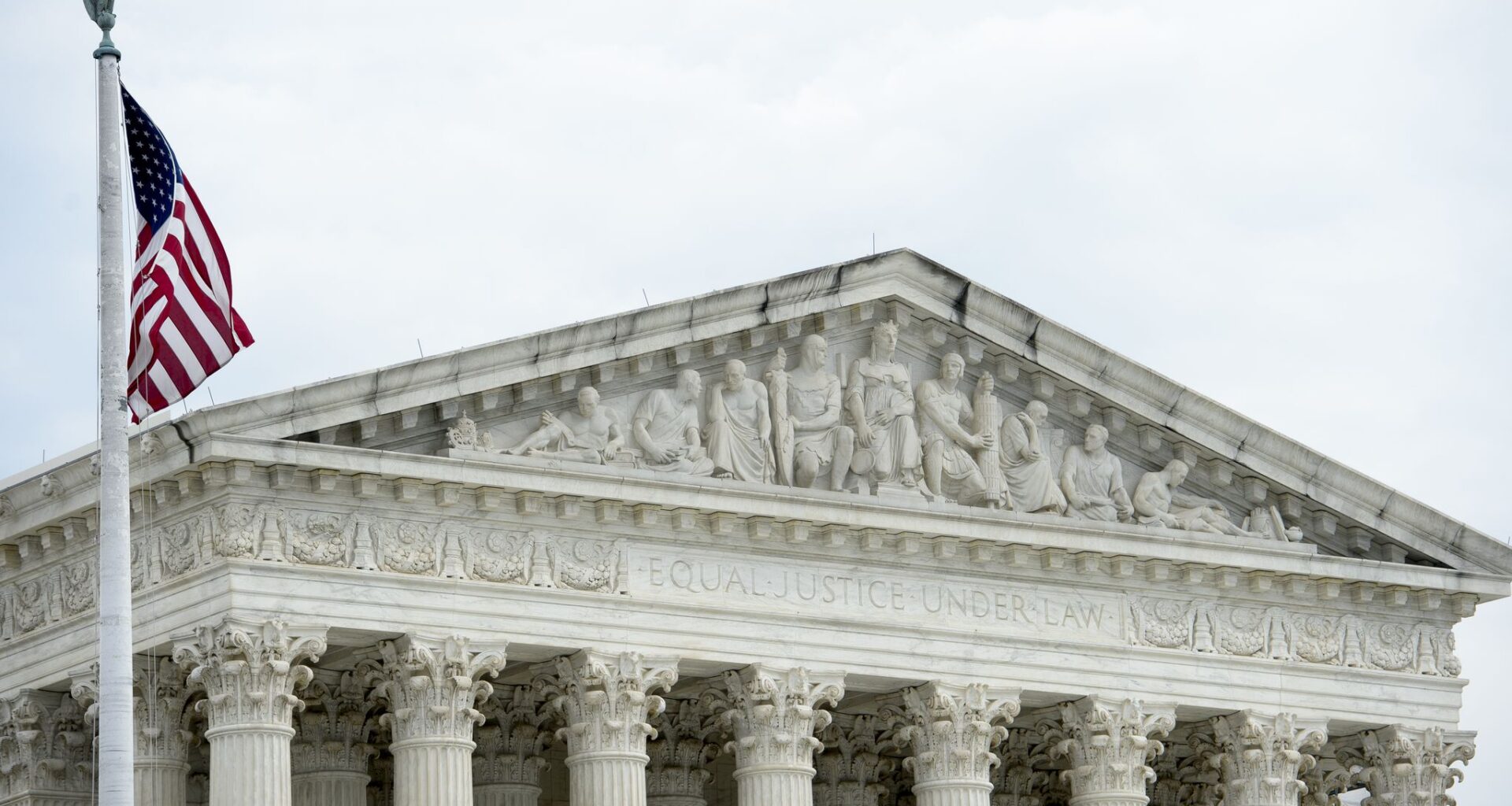
The Supreme Court of the United States is seen on Capitol Hill, Thursday, Feb. 27, 2025, in Washington. Under the “Purcell principle,” courts must refrain from judging or overturning a state’s voting rules shortly before an election.
Rod Lamkey Jr./Associated Press
In 2006, the Supreme Court, in an unsigned ruling with little explanation, allowed Arizona to enforce strict new voter identification requirements in an upcoming election on the grounds that it was too late for courts to intervene.
Now that ruling, in the Purcell case, seems likely to allow Texas and other Republican-led states to gain House seats in next year’s election by redrawing their districts. By the same standard, California’s Proposition 50, the pro-Democratic redesign of House districts approved by the voters on Nov. 4, will most likely take effect in 2026.
That doesn’t mean the new maps will ultimately be upheld by the courts. A federal court panel in Texas, led by an appointee of President Donald Trump, ruled 2-1 on Nov. 18 that the state’s redistricting, designed to gain five House seats for Republicans, was illegally crafted to weaken the voting power of racial minorities. Republican officials, in a suit filed Nov. 5 in Los Angeles, contended one new Prop 50 district was illegally designed to favor a Latino candidate.
Article continues below this ad
But under what has become known as the “Purcell principle,” courts must refrain from judging or overturning a state’s voting rules shortly before an election.
“Court orders affecting elections, especially conflicting orders, can themselves result in voter confusion and consequent incentive to remain away from the polls. As an election draws closer, that risk will increase,” the Supreme Court said in its 2006 ruling, with no apparent dissents.
San Francisco Chronicle Logo
Make us a Preferred Source on Google to see more of us when you search.
Add Preferred Source
The ruling allowed Arizona to enforce a 2004 ballot measure requiring voters to present a passport or other proof of citizenship when they register, and to show identification when they vote in person on Election Day. In a suit by Indian tribes and community organizations, the 9th U.S. Circuit Court of Appeals blocked the state law five weeks before the 2006 election, but the Supreme Court set that ruling aside without deciding whether it violated voting rights.
Since then, the court has relied on Purcell to reject lower-court rulings against state election laws in the weeks or months before an election, usually laws that restricted voter registration or participation.
Article continues below this ad
For example, a ruling in 2020 set aside an order by a federal judge in Wisconsin giving election officials additional time to count absentee ballots, which were increasingly being cast during the COVID-19 pandemic. In 2022, the Supreme Court allowed Alabama to use new election maps in an upcoming primary that packed most of the state’s Black voters into a single House district — although the court, when it later considered the legality of the maps, ruled in 2023 that they violated the Voting Rights Act.
That approach endangers voting rights, said Erwin Chemerinsky, the law school dean at UC Berkeley and a liberal legal scholar. He noted that Texas lawmakers had adopted their new House maps on Oct. 25 and that the federal court rushed to release its ruling on Nov. 18. That was less than three weeks before the filing deadline for candidates in the primary election that is scheduled in March.
“There’s no way that a challenge could have been brought sooner,” Chemerinsky said in an interview. “If the court says nonetheless that Purcell precludes this, it sends such a clear message to state legislators: You can do anything you want within a certain amount of time before the election.”
And while the court has not specified the limits of its Purcell timeline, it has used the ruling to block lower-court rulings issued two months before a scheduled primary election and nearly six months before a general election, law student David Herman said in a 2023 Yale Law Review article.
Purcell, and the court’s 2013 ruling blocking a law that required state and local governments with a history of discrimination to obtain federal approval before changing their voting laws, make it “much easier for states to hold at least one election under unlawful procedures,” Herman wrote.
Article continues below this ad
But Texas told the Supreme Court that the harm to Texas voters was being inflicted by lower courts, not state lawmakers, in violation of the Purcell principle.
“The confusion the district court’s order has injected into Texas’s congressional elections is real,” lawyers with state Attorney General Ken Paxton’s office said in a filing asking the court to block that order and leave the state’s maps in effect for the upcoming election.
They quoted Supreme Court Justice Brett Kavanaugh’s concurring opinion in the 2020 ruling rejecting a judge’s extension of Wisconsin’s deadline for counting absentee ballots:
“It is one thing for state legislatures to alter their own election rules in the late innings and to bear the responsibility for any unintended consequences,” wrote Kavanaugh, who was appointed to the court by Trump. “It is quite another thing for a federal district court to swoop in and alter carefully considered and democratically enacted state election rules when an election is imminent.”