
The Armenian Apostolic Patriarch of Constantinople, Sahak II Marshalian, says Christian Churches need to find new ways “to think about and model a new pattern of ecumenism.”
By Christopher Wells
The First Council of Nicaea, celebrated 1700 years ago, “is a very important reference point for us, for unity, since it happened and it lasted,” says the Armenian Patriarch of Constantinople, Sahak II Marshalian. “The effects of Nicaea never disappeared,” he notes. “It is a living fact among Catholic, Orthodox, and Protestant churches. Therefore, it is a uniting point for us, practically also.”
Pope Leo’s visit to Nicaea ‘a turning point’
In an interview with Vatican News ahead of the Pope’s visit to Istanbul, Patriarch Sahak II explains that the anniversary of the first ecumenical council can therefore “be an opportunity to ‘fire’ that understanding,” and achieve “a better understanding and collaboration of unity. In this sense, I think it’s an inspiring point. And it’s important that we emphasize – all the churches – the importance of this anniversary. And His Holiness’ presence here, in that sense, in Nicaea, I think will be a turning point.”
For the Armenian Apostolic Church, the largest Christian community in Türkiye, the visit of the Pope – “the head of the Catholic Church, the biggest brother” Church — is “a great consolation” and “an important event,” especially in light of the concurrent celebration of the anniversary of Nicaea, the Patriarch says.

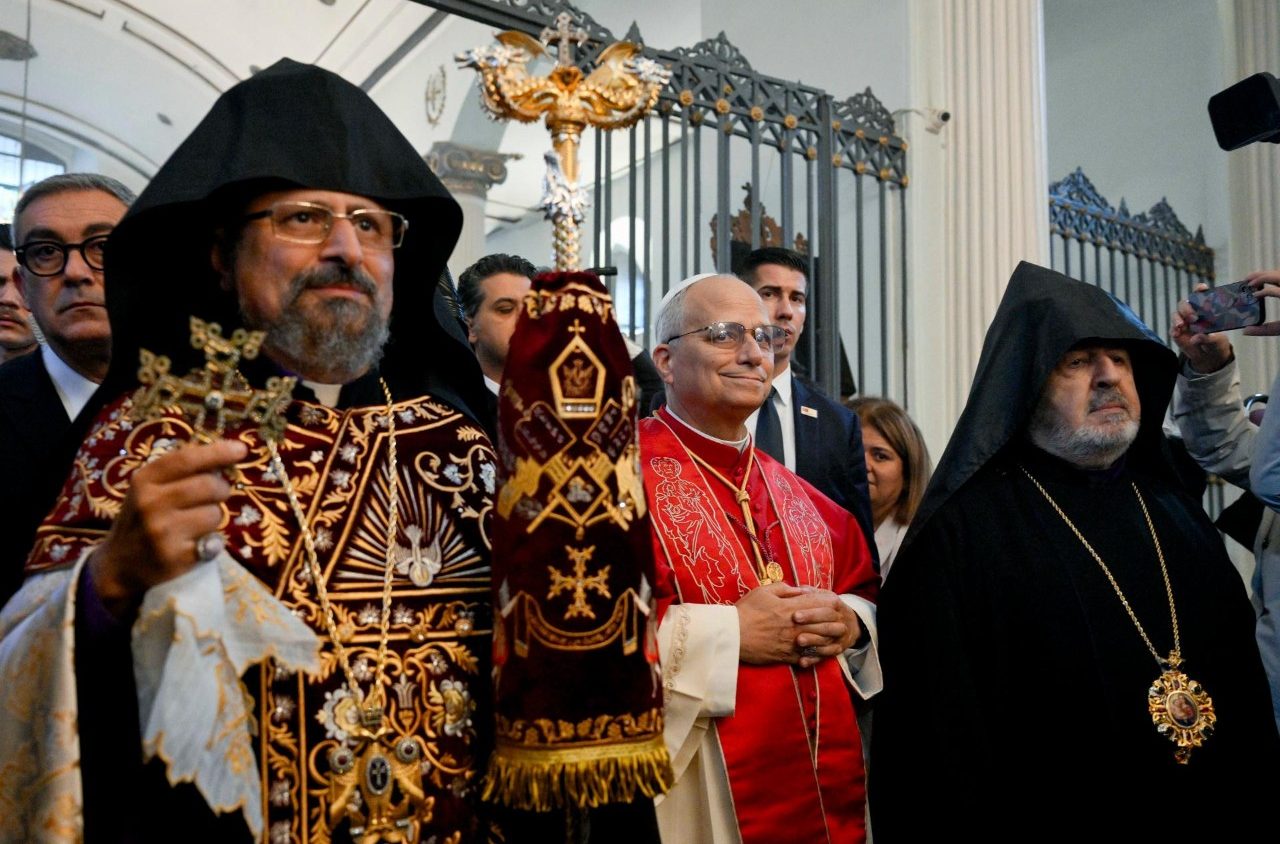
Pope Leo XIV and Patriarch Sahak II during the Pope’s visit to the Armenian Apostolic Cathedral in Istanbul (@Vatican Media)
Practical ecumenism
Patriarch Sahak II notes that ecumenism has been one of the most important agenda items for the churches in recent decades, and asks, in light of the papal visit, “How can we be united?” How can “the old historical hostilities” be united so that Christians can be brothers “and that unity can be reached to perfection?”
For that reason, “the church speaks, prays, and holds meetings.” So, he says, “The visit of the Popes is a practical ecumenism.”
A new pattern of ecumenism
Patriarch Sahak II explains that there are many “platforms of dialogue” between the Armenian Church and the Catholic Church, and that there are very few issues that remain to be discussed.
“But there are historical divisions, and bridging them is very difficult,” he says. Sometimes, despite sincere efforts on all sides, “the old systems cannot be broken and made anew.”
“Therefore,” he continues, “in ecumenism, I think we need new ways, forgetting the past, to think and to model a new pattern of ecumenism.” The Patriarch says that practical unity can contribute toward the goal of “full communion nearly realized.”

Patriarch Sahak II Marshalian speaks with Vatican News ahead of Pope Leo XIV’s Apostolic Journey
He cites both reciprocal visits of church men along with the exchange of Catholic and Armenian students who spend time studying in the schools of the other church. “This really makes for practical ecumenism, which is more realistic than theoretical or theological discussions,” the Patriarch says.
He points to ordinary Christians, even churchmen, who “pass through the barricade of full communion” as an example of full communion. “But the problem, of course, is the expression of the full communion among the churches,” he says, adding, “We hope we can reach that point.”

Pope Leo XIV prays at the Armenian Apostolic Cathedral in Istanbul, and thanks God for the courageous witness offered by Armenians throughout history, often amid tragic …
The Armenian Apostolic Church in Türkiye
Patriarch Sahak II heads one of four Sees of the Armenian Apostolic Church, an Oriental Orthodox Church united under the spiritual leadership of the Catholicos of Armenia and of all Armenians in Holy Echmiadzin. The Oriental Orthodox Churches are distinct from both the Catholic Church and the Eastern Orthodox Churches in that it recognizes only the first three ecumenical councils.
Pope Leo’s first Apostolic Journey outside of Italy included, on Sunday, a brief visit to the Patriarchal Church of the Holy Mother of God, in the Kumkapı quarter of Istanbul’s Fatih district, where he was welcomed by Patriarch Sahak as “our brother in Jesus Christ.”
“Your presence among us today,” the Patriarch said, “is not only an honour, it is a blessing for our community, for the churches of Türkiye, and for all who labour for the unity of Christians.”

Patriarch Sahak II Marshalian and Pope Leo XIV stand together by the memorial plaque commemorating the Pope’s visit. (@Vatican Media)