
Is there any vitriolic anti-Israel charge which The New York Times would not jump to embrace?
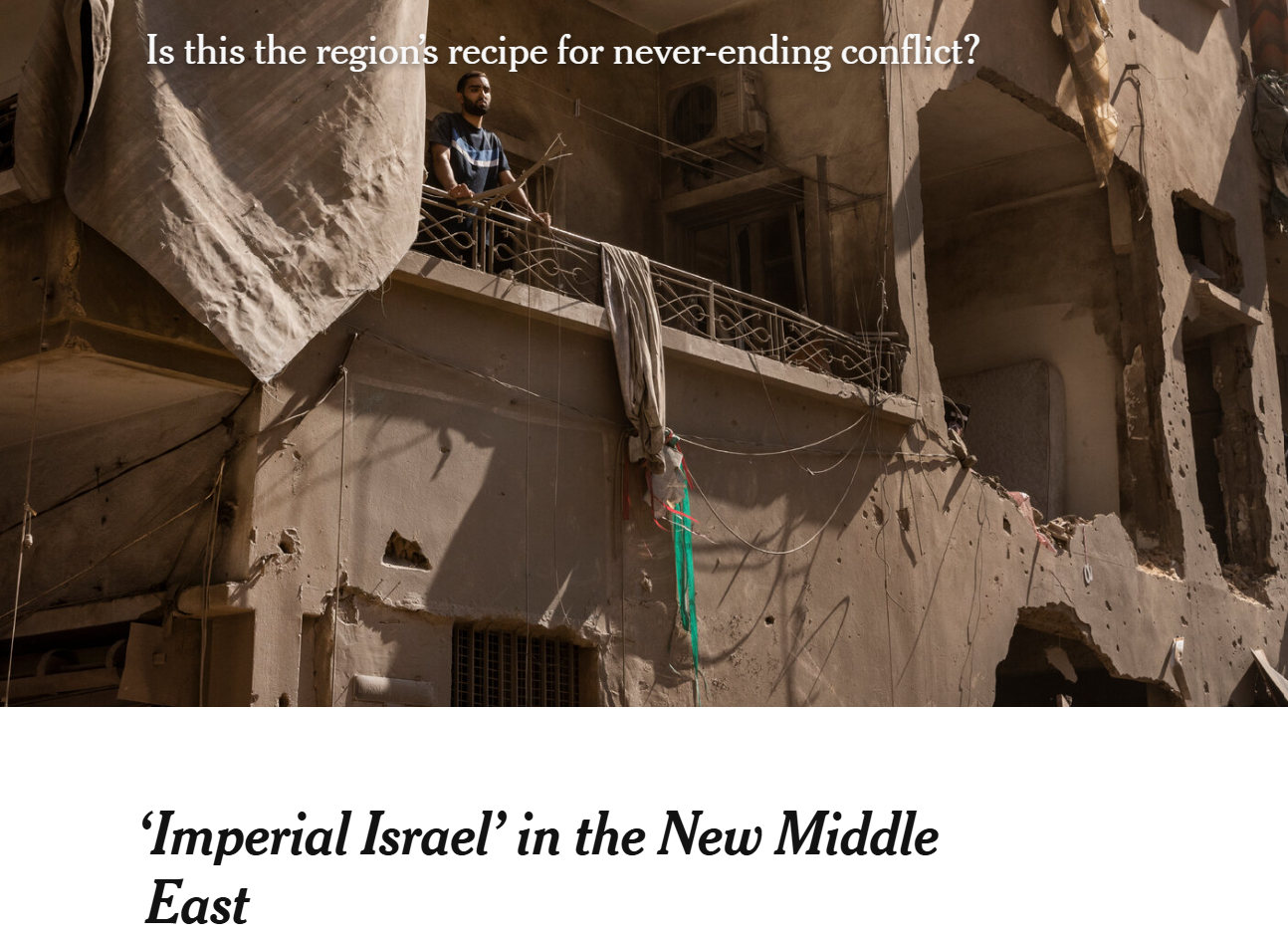
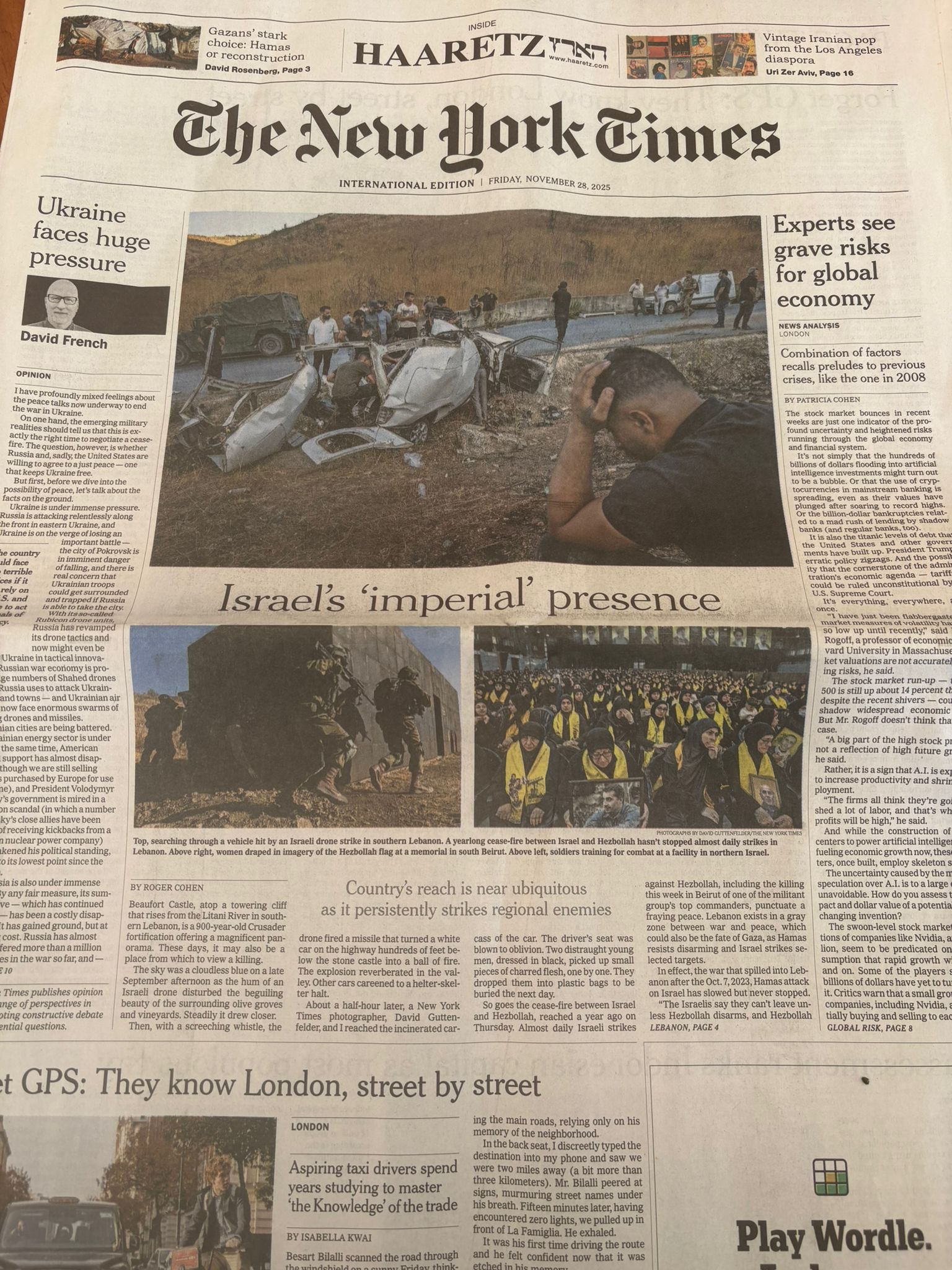 One throw-away, baseless comment by an Emirati political science professor was enough last week for The Times to publish a page-one headline and 3500-plus story absurdly arguing that Israel’s determination to preemptively defend itself against Iranian-backed enemies bent on its destruction is imperialistic. “Israel’s ‘imperial’ presence” read the above-the-fold Nov. 28 page-one international edition headline. “‘Imperial Israel’ in the New Middle East,” claimed the digital headline.
To recast preemptive strikes as imperialism, Roger Cohen engaged in the same dishonest methodologies widely deployed to promote earlier false libels such as genocide, apartheid and famine.
First, there’s the redefinition of terms. Second, there’s the concealment of information which belies the predetermined narrative.
Britannica defines “imperialism” as follows:
imperialism, state policy, practice, or advocacy of extending power and dominion, especially by direct territorial acquisition or by gaining political and economic control of other areas. Because it always involves the use of power, whether military or economic or some subtler form, imperialism has often been considered morally reprehensible, and the term is frequently employed in international propaganda to denounce and discredit an opponent’s foreign policy.
There’s nothing in the thousands of words penned by The New York Times journalist which supports the notion that Israel is seeking to extend its power and dominion over other nations. Thus, while the term’s definition isn’t relevant to Israel, The Times apparently can’t resist the associated moral reprehensibility, which well serves the long preferred predetermined narrative in which Israel is caricaturized as the neighborhood pariah.
Thus, the paper quoted the Emirati academic, stretching the definition of imperialism beyond recognition to include preemptive military strikes against enemies who openly work towards realizing their publicly stated genocidal ambitions:
The region is adapting to what Abdulkhaleq Abdulla, a prominent political science in the United Arab Emirates, calls an “imperial Israel,” a country that will kill enemies anywhere: from Lebanon to Syria, Gaza to Iran, Yemen to Qatar. Pre-emptive Israeli strikes are the new norm.
It is apparently on the basis of this lone comment which The Times dedicated a page-one headline smearing Israel as “imperial.” There is nothing further in the article to support the latest false anti-Israel charge.
Second, there’s the standard whitewashing and concealment of facts and information which contradict the desired narrative.
Thus, in great detail and with immensely powerful imagery, Cohen used the first three paragraphs to portray a graphic scene of a fatal Israeli strike marring an otherwise perfectly serene landscape. Death encroached on the “magnificent panorama” already in the first paragraph. His story opened with Beaufort Castle, atop a towering cliff that rises from the Litani River . . . is a 900-year-old Crusader fortification,” and, these days, also “a place from which to view the killing.” But it’s not until the third paragraph that the deadly strike finally slammed into the pastoral perfection:
Then, with a screeching whistle, the drone fired a missile that turned a white car on the highway hundreds of feet below the stone castle into a ball of fire. The explosion reverberated in the valley. Other cars careened to a helter-skelter halt.
Cohen and Times photographer David Guttenfelder reached the scene quickly enough to see the “incinerated carcass of the car,” the “driver’s seat blown to oblivion,” and two “distraught young men, dressed in black” who “picked up small pieces of charred flesh, one by one.”
Cohen’s resplendent description of carnage, as crisp and clear as the unobstructed view from Beaufort Castle to the killing sites, is replete with all kinds of crucial details, including the color of the bystanders’ clothing. But the veteran Times reporter was much less forthcoming on the minor matter of the victim’s identity.
Thus, only in the 17th paragraph, did Cohen return to this incident, giving the first veiled clues about whom Israel targeted on that other glorious September day. He elliptically reported:
“When the Israelis find these guys, they just taken them out, so you have two or three a week that are whacked,” [Tom Barrack, U.S. ambassador to Turkey] said of the strikes against Hezbollah.
That was the fate of Hassan Abdel Karim Shahrour, later identified by Hezbollah, in his white car beneath Beaufort Castle on Sept. 20. The Israeli military said it had “eliminated” a “Hezbollah terrorist.”
A Hezbollah statement the next day read: “You are invited to participate in the blessed funeral procession of the happy martyr on the road to Jerusalem.”
At no point did Cohen make clear that Hezbollah itself identified the man in the white car as one of their own. Though Cohen didn’t say so, Hezbollah usually reserves the phrase “martyr on the road to Jerusalem” for its own operatives.
Following Cohen’s dramatic description of the Israeli missile crashing down into the white vehicle with unspecified personage, Cohen charged:
So goes the cease-fire between Israel and Hezbollah, reached a year ago on Thursday. Almost daily Israeli strikes against Hezbollah, including the killing this week in Beirut of one of the militant group’s top commanders, punctuate a fraying peace.
Notably, according to this skewed account, it is only the Israeli strikes against Hezbollah which intrude on the ceasefire, but not Hezbollah’s refusal to disarm and efforts to rebuild its arsenal.
The 2024 ceasefire agreement between Israel and Hezbollah is highly explicit and detailed about the requirement for the terror organization’s disarmament. Section 7 requires the Lebanese military and security forces to
a. Monitor and enforce against any unauthorized entry of arms and related materiel into and throughout Lebanon, including through all border crossings, and against the unauthorized production of arms and materiel within Lebanon.
b. Starting with the Southern Litani Area, dismantle all existing unauthorized facilities involved in the production of arms and related materiel, and prevent the establishment of such facilities in the future.
c. Starting with the Southern Litani Area, dismantle all infrastructure and military positions, and confiscate all unauthorized arms inconsistent with these commitments.
In more than 3000 words focused on the shaky Israel-Lebanon ceasefire, at no point did Cohen find space to note that the ceasefire requires Hezbollah to disarm, and that the terror group’s adamant refusal to do so is a violation of the most basic terms of the agreement.
It’s not that The Times likewise ignored an alleged Israeli violation. To the contrary, Cohen reported about five Lebanese hilltops in which Israel maintains communications towers: “Israel, to Lebanon’s fury, has refused to remove the small encampments around them despite the cease-fire that called for a complete Israeli withdrawal.” [Emphasis added.]
Cohen’s effort to minimize Hezbollah’s belligerence even obscured the fact that the terror organization was responsible for opening the front against Israel in October 2023. Cohen abandoned the crystal-clear reporting reserved for the incinerated white car and charred flesh carnage in favor of murky reporting obscuring Hezbollah’s responsibility for the current conflict: “In effect, the war that spilled into Lebanon after the Oct. 7, 2023, Hamas attack on Israel has slowed but never stopped.” The war did not “spill” into Lebanon. Hezbollah brought it there, choosing to fire on Israel Oct. 8, as Israel was still reeling from the ongoing Hamas massacre in the south.
About the real imperialist power in the region, with proxies from Yemen to Lebanon, the Gaza Strip, and (formerly) Syria, Cohen said of Iran:
The situation in Lebanon offers a compelling example of a new Middle East where Israel’s reach is near ubiquitous. The Iran-led “axis of resistance,” of which Hezbollah has been a central part, is a shadow of its former self. Iran, battered by Israel in a brief June war, is weaker. Syria, after the fall of the Assad regime last year, is no longer a friend of Tehran; nor is it the pipeline for Iranian arms to Hezbollah that it once was.
Indeed, over the last two years, Israel’s military situation significantly improved while that of Iran and its proxies, including Hezbollah, diminished. As Haaretz‘s Amos Harel reported Nov. 28:
In the summer of 2023, on the eve of the war, Israel was afraid to remove a tent pitched by Hezbollah in Israeli-controlled territory on Har Dov. Now it has killed another Hezbollah chief of staff and the organization has not reacted, so far. That is a sea change, stemming from the consequences of the war. After the terrible failure of October 7 in the Gaza-border communities, Israel is not allowing risks to grow. And given Israel’s responses in other arenas, its foes are apparently more cautious and calculating.
There’s no question that Israel has achieved a more favorable balance of power better positioning it to prevent another Oct. 7 catastrophe. But a favorable balance of power enabling preemptive strikes against an Iranian-backed terror organization with genocidal aims is imperialism just like The Times’ latest hit piece is journalism.
See also “Violations, Hezbollah’s and AP’s“
Comments are closed.