
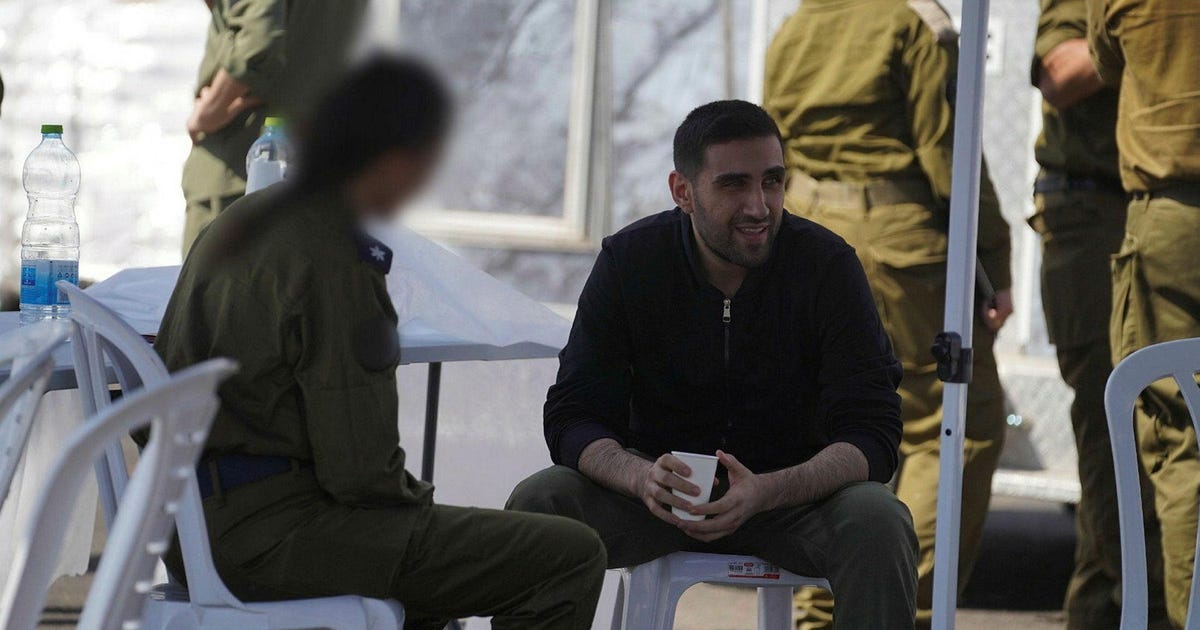
Freed Israeli hostage Segev Kalfon revealed new details about the physical and mental abuse he suffered while in Hamas captivity, including being subjected to an “execution game,” in which his captors drew lots to decide which hostage they would execute.
Kalfon, who was taken hostage from the Nova festival on October 7, told The New York Times in an interview published on Saturday that he and five other hostages were told to pick who would be immediately executed and who would be shot in the leg.
When they refused to pick, their captors chose for them, but ultimately abandoned the “game,” and all six hostages returned alive to Israel.
Haaretz WeeklyFrom Gaza to Epstein: Why Israel is losing MAGA and the evangelicals
play
Haaretz Weekly
From Gaza to Epstein: Why Israel is losing MAGA and the evangelicals
Volume: 0.5
1X
total– : –time0:00
fast forward15
play
rewind15
The 27-year-old Kalfon described the daily cruelty he faced through his 738 days in captivity: deprivation of food, constant abuse and the fear of Israeli airstrikes. “All I would think of was how to survive another day,” he said.
Most days, he and the other hostages received only a quarter of a tomato and a bowl of rice to share; later, in an underground tunnel, they were sometimes given rice with worms, moldy pita bread or no food at all. By contrast, he recalled his captors appearing well-fed, eating openly in front of the hostages and snacking on “large bags of cookies and mixed nuts.”
 Close
Close
Kalfon, with his family, following his release from Hamas captivity en route to an Israeli hospital, in October. Credit: Tomer Appelbaum
Kalfon, with his family, following his release from Hamas captivity en route to an Israeli hospital, in October. Credit: Tomer Appelbaum
Kalfon told The Times that beatings by his Hamas captors intensified after far-right National Security Minister Itamar Ben-Gvir boasted publicly about the poor conditions in which Palestinian prisoners were being held in Israel. This claim has been previously corroborated by freed hostages Bar Kuperstein and Maxim Herkin.
 Close
Close
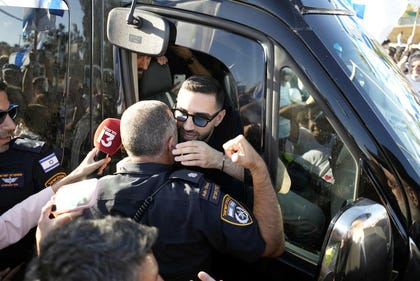
Kalfon embraces an Israeli police officer as he is received by a joyous crowd upon his return to his family’s home in southern Israel in October. Credit: Ilan Assayag
Kalfon embraces an Israeli police officer as he is received by a joyous crowd upon his return to his family’s home in southern Israel in October. Credit: Ilan Assayag
Kalfon said that desperation throughout the second year in captivity drove him to create an escape plan. At one point, the group of hostages was given a radio to listen to recitations of the Quran in a bid to pressure them into converting to Islam, Kalfon said, but the group managed to build an improvised antenna – picking up an occasional Israeli radio transmission.
Related Articles
During one of those transmissions, Kalfon heard his mother, Galit, saying that she misses him. He then decided not to carry out his escape plan, saying his mother gave him “an ocean of hope” that he could return to Israel.
Ahead of his release last month, he said his captors increased the amount of food they gave the hostages in an apparent attempt to improve their frail appearances.
Days before his release, Kalfon said he was moved to a tunnel with other hostages. There, a Hamas member told him that he was to remain in the tunnels beneath Gaza.”I almost had a stroke on the spot,” Kalfon recounted.