

More than 35,000 families left the GTA last year for other parts of Canada, according to Environics data. This story is part of a two-part series examining where households are moving and why.
Andrea Griffith thought an annual income of $200,000 would be enough.
Enough to stay in Toronto, enough to buy a modest home and enough to build a stable life with her partner and new young daughter.
Only one problem — it wasn’t.
After being forced out of a basement rental in Scarborough just weeks after giving birth, at 43, Griffith and her partner realized that even with strong incomes, staying in the GTA meant living on edge financially, with little room to grow.
“We made the decision that we no longer wanted to be living according to someone else’s needs,” she told CTV News.
Last fall, the family moved more than 300 kilometres southwest to Chatham, Ont., trading familiar streets for a decent sized detached home and a quieter life that came with unexpected emotional costs.
New data compiled by Environics Analytics shows that more than 35,000 households left the Greater Toronto Area over the past year. Many of them relocated to other parts of Ontario, with Simcoe County and Hamilton among the top destinations.
Researchers say it’s a continuation of a long-term trend. In just one week since the initial report, CTV News has heard from dozens of families who say affordability, access to suitable housing, schooling, safety, and quality of life played a significant role in their decision to leave or actively plan a move.
When staying means becoming ‘house poor’
In an interview, Griffith says that she and her partner qualified for a mortgage of up to $750,000.
On paper, they could buy. But in practice, she said, it felt like a trap.
“With $200,000 income… we were only able to qualify for $750,000, and I actually didn’t think that $750,000 was reasonable for us,” Griffith said. “I knew we would be house poor.”
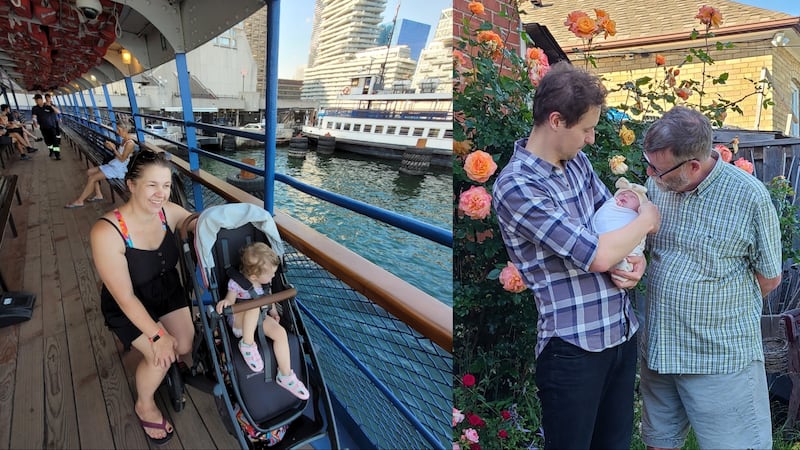 Andrea Griffith (Photo supplied by Andrea Griffith)
The couple wanted a standalone home, but she says they didn’t believe that level of debt made sense with a young child.
“We just didn’t think that was realistic,” she added.
In Chatham, they bought a house. Financially, the decision brought relief. But personally, she says the adjustment has been even harder.
“We’ve been struggling to make friends,” Griffith said. “I started crying because she’s not going to have anyone at her second birthday. We don’t know anyone here.”
Still, she’s clear that staying in Toronto would have meant ongoing instability and frustration.
“If renting in Toronto had been more secure or affordable… we definitely would have stayed longer,” she said.
Safety, a big concern for new parents
For 43-year-old Dustin Titus, the tipping point wasn’t just cost, it was also safety.
One afternoon living in South Etobicoke’s Long Branch neighbourhood, his young son veered toward traffic on a strider bike.
“That moment really shook me,” Titus said. “You feel very unprotected in Toronto these days.”
After years of navigating congestion, speeding traffic, and frequent encounters with open drug use in public spaces, Titus and his family left the city for Horseshoe Valley in Oro-Medonte, part of Simcoe County.
 Dustin Titus A photo of the Titus family that moved to Horseshoe Valley in Oro-Medonte, part of Simcoe County. (Photo supplied by Dustin Titus)
In contrast, he said, the sense of community was almost immediate.
“In the first three days we had moved in, every single neighbour stopped to introduce themselves,” he said. “That’s when we realized we were in the right place.”
Titus said the move gave his family what they couldn’t find in the city when it comes to space, trust, and the ability to walk their children to school without fear.
“It feels natural,” he said. “And that’s a really important feeling.”
‘Why are we staying?’
For 39-year-old Morley Abbott and his wife, leaving Toronto wasn’t just about affordability. It came down to access to schools.
The North York couple owns a three-bedroom condo across the street from a highly ranked elementary school. But he said that because of changes to the boundaries for the catchment area for that school, their daughter would instead have to be taken by bus to another school several kilometres away.
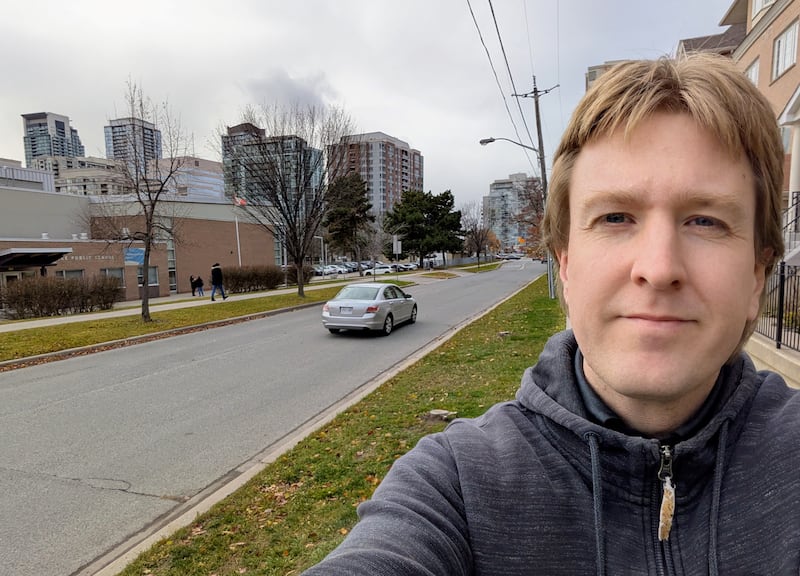 Morley Abbott A photo of Morley Abbott outside the school he says his daughter won’t be able to attend due to residential zoning rules. (Photo supplied by Morley Abbott)
“We love our neighbourhood,” Abbott said. “But suddenly we sort of have a catalyst. Our daughter starts kindergarten next year, and we’re asking: why are we staying here?”
The family plans to move to London, Ont., where their daughter can attend school with cousins.
“It feels like the school system just doesn’t care for families like ours,” Abbott said.
It’s a reality that Matti Siemiatycki, director of the University of Toronto’s Infrastructure Institute, said is a “long-standing trend.”
“You look at how much it costs or how hard it is to find daycare… you have the schools… It’s been one controversy after another depending on where in the region you are. People are looking at other alternatives, and they’re making choices of where they want to see themselves.”
City officials respond
In a statement to CTV News Toronto, Mayor Olivia Chow’s office said the city is expanding housing supply, cutting costs for families, and strengthening renter protections to improve long-term affordability.
“The Mayor believes that those who work and study in Toronto should be able to live in and afford the city,” a spokesperson from her office wrote.
“She is putting shovels in the ground on 25,000 new homes this year and next, many of them deeply affordable. This year, 77 per cent of all housing starts are city-led or city-supported project.”
Meanwhile, Coun. Brad Bradford warned that continued out-migration poses serious risks he frames as a “crisis.”
“We should all be concerned about the tens of thousands of people who are leaving Toronto each year,” he said. “If 60 per cent of your workforce was considering quitting, that would be a crisis.”
—
How is living in the GTA actually working for you right now? Did moving here meet your expectations or challenge them?
If you came for opportunity, affordability, or lifestyle and found a different reality — good or bad — we want to hear from you.
Share your story by emailing us at torontonews@bellmedia.ca with your name, general location, and phone number in case we want to follow up.
Your comments may be used in a future story.