
Some players embody a club but few have ever embodied their side more than Billy Bonds, who died on Sunday at the age of 79. He was not a one-club man but by the time he finally retired, at the age of 41, in 1988, he felt like one, having racked up a record 799 appearances for West Ham. Just as significantly, he had lifted the FA Cup twice as captain.
There was applause at the London Stadium on Sunday as a montage was shown on the big screens. It featured a number of spectacular long-range strikes because it’s easier to show somebody scoring goals than preventing them, and still harder to somehow sum up leadership.
But there were plenty of shots of him looking steely: six foot two with eyes of blue, as the song had it; and if the reality was a couple of inches shorter, who cared? He made up for it with his aura. A minute’s applause was observed with impeccable reverence, before the present captain Jarrod Bowen laid a Bonds 4 shirt in front of the North Stand. The fourth minute was met with a standing ovation.
For those of us whose football consciousness was formed in the early 80s, he seemed not only an eternal feature of West Ham but the archetype of a certain sort of English player, as comfortable in midfield as at the back, uncompromising but also good on the ball, forever rolling his sleeves up and pointing. He was the ideal captain: succeeding Bobby Moore in 1974, he held the role for a decade before passing on the armband to Alvin Martin when he retired. As it turned out, West Ham couldn’t live without him and, after a spate of injuries, he was called back into action, making 26 appearances in 1984-85 and playing on until a knee injury finally persuaded him to bring his playing career to an end in 1988 – and that despite missing the entirety of 1985-86 with a damaged toe.
Born in Woolwich in 1946, Bonds joined Charlton and had played 97 times for them when he was signed by Ron Greenwood for £50,000 in the summer of 1967. He went straight into the West Ham first team and was an ever-present through 1968-69 and 1969-70.
At the time he was a right-back but the role of the full-back was changing and, in 1970, Greenwood moved him into midfield as a foil for Trevor Brooking. Where Brooking was all languid class, Bonds was more ball-winner than ball-player. He was far more than a scuffler – finishing as the club’s top-scorer in 1973-74 – but equally he knew who the creative talent in that midfield was and that his job was to protect him and give him the ball as frequently as possible. Where Brooking could have strolled through the Somme without dirtying his shorts, Bonds seemed forever caked in mud, socks rolled down, teeth and eyes glinting through a fug of sweat and beard.
Quick GuideTributes paid to Billy Bonds, West Ham’s ‘best captain’Show
West Ham captain Jarrod Bowen paid tribute to Billy Bonds as the “best captain” in the history of the club. Players wore black armbands for Sunday’s game against Liverpool and images of Bonds were displayed on the main screens before an announcement was made ahead of applause. Afterwards, Bowen went to place a No 4 shirt on the turf in front of the Billy Bonds Stand.
Speaking on Sky Sports, Bowen said: “You can see the reaction from everyone online already, what he meant to this club, what he achieved at this club, obviously a stand named after him as well, so it is a sad day for everyone.
“He is probably going to go down as West Ham’s biggest legend, the best club captain that they have had as well. He achieved so much here. I will never emulate that success.”
West Ham manager Nuno Espírito Santo said hearing the news of Bonds’ death was a “sad moment for all of us at the club”. He told Sky Sports: “Billy Bonds represented what West Ham is all about. I know that our fans are feeling sad.
The former West Ham forward Tony Cottee, who played alongside Bonds, paid tribute on social media to one of his “heroes growing up”, while former midfielder Joe Cole told TNT Sports that Bonds was “everything that’s good about West Ham”.
The former Irons goalkeeper Rob Green said the sadness at Bonds’ death would be “something that will resonate throughout the generations of West Ham fans”, adding on Sky Sports: “As soon as you join the club, it is one of the names mentioned, and that is something which is part of West Ham.” PA Media
Thank you for your feedback.
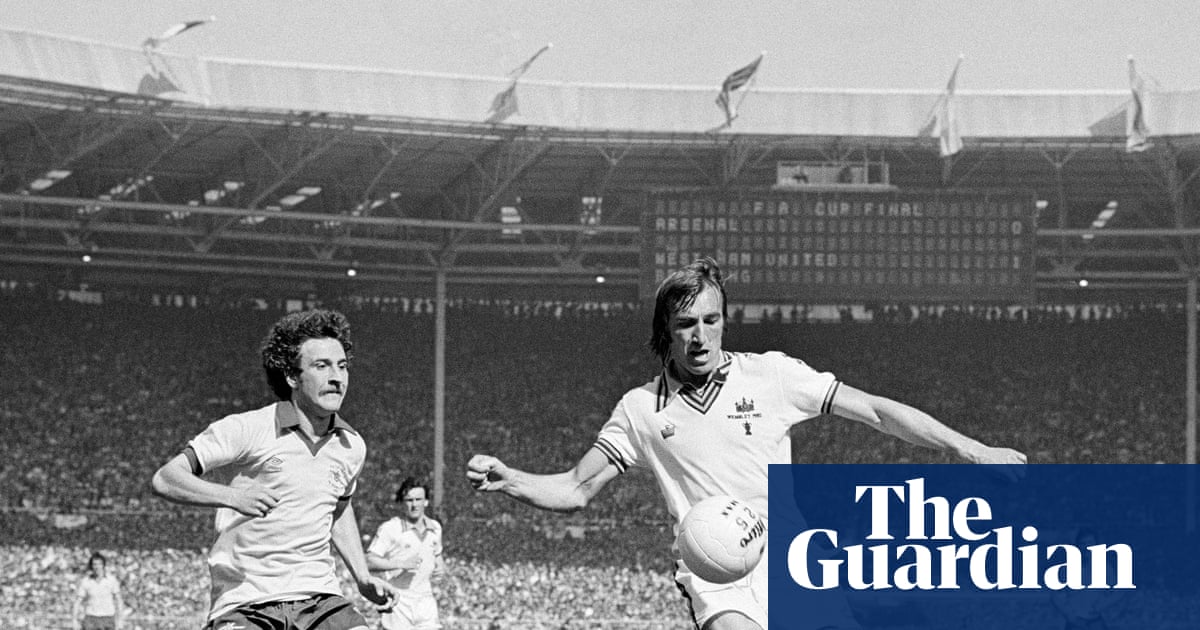
There was never any question of Bonds leaving after relegation in 1978, and he was still there as captain when they became the third Second Division side in eight seasons to win the FA Cup, beating Arsenal in the final thanks to Brooking’s rare header. The following season was almost as glorious, as West Ham won promotion back to the First Division and reached the League Cup final. But for broken ribs suffered in a collision with Phil Parkes on the final day of the season, he probably would have made his England debut in a friendly against Brazil that summer. He never got another chance.
skip past newsletter promotion
Sign up to Football Daily
Kick off your evenings with the Guardian’s take on the world of football
Privacy Notice: Newsletters may contain information about charities, online ads, and content funded by outside parties. If you do not have an account, we will create a guest account for you on theguardian.com to send you this newsletter. You can complete full registration at any time. For more information about how we use your data see our Privacy Policy. We use Google reCaptcha to protect our website and the Google Privacy Policy and Terms of Service apply.
after newsletter promotion
Billy Bonds lifts the FA Cup in 1980 after West Ham’s 1-0 win against Arsenal. Photograph: PA
To speak only of Bonds the player, though, is to underplay his importance to West Ham. He became youth coach under John Lyall in 1988 and succeeded Lyall’s replacement, Lou Macari, in February 1990. He won promotion in his first full season and also led West Ham to the FA Cup semi-final, where they lost to Nottingham Forest after Tony Gale’s early red card. They were relegated immediately but Bonds stayed on and led West Ham back into the top flight at the first attempt. They finished 13th in their first Premier League season but Bonds resigned shortly before the start of the following campaign to be replaced by Harry Redknapp, whom he never quite forgave. A subsequent managerial stint at Millwall did not go well.
But although he coached at QPR and Reading, it never felt right seeing Bonds anywhere but West Ham. He was Hammer of the year four times and had the East Stand at the London Stadium named after him in 2019.