
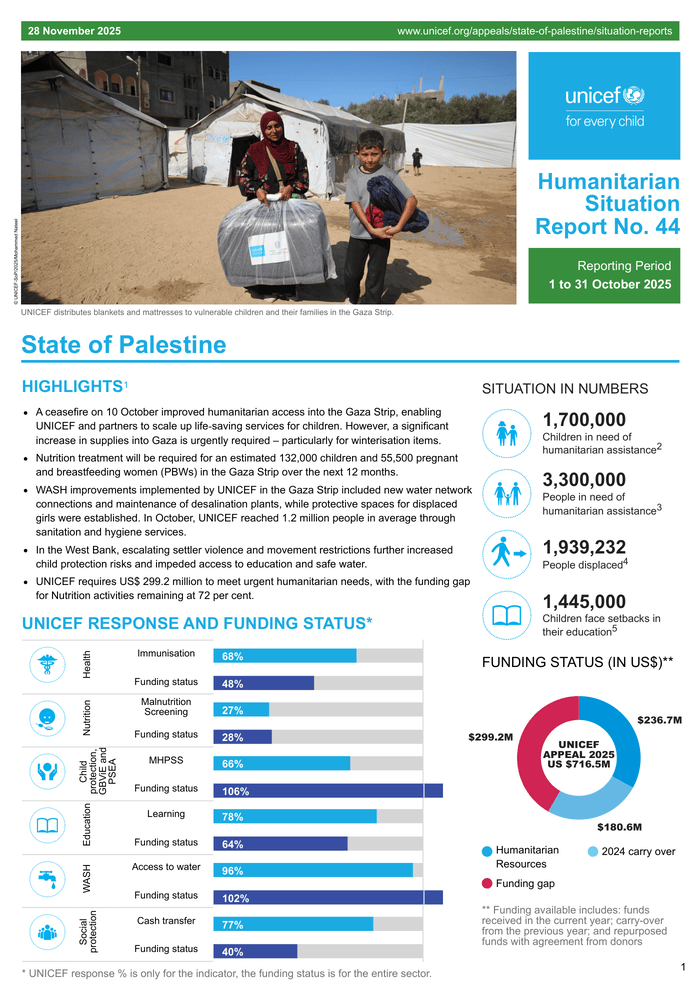
Highlights
A ceasefire on 10 October improved humanitarian access into the Gaza Strip, enabling UNICEF and partners to scale up life‐saving services for children. However, a significant increase in supplies into Gaza is urgently required – particularly for winterisation items.
Nutrition treatment will be required for an estimated 132,000 children and 55,500 pregnant and breastfeeding women (PBWs) in the Gaza Strip over the next 12 months.
WASH improvements implemented by UNICEF in the Gaza Strip included new water network connections and maintenance of desalination plants, while protective spaces for displaced girls were established. In October, UNICEF reached 1.2 million people in average through sanitation and hygiene services.
In the West Bank, escalating settler violence and movement restrictions further increased child protection risks and impeded access to education and safe water.
UNICEF requires US$ 299.2 million to meet urgent humanitarian needs, with the funding gap for Nutrition activities remaining at 72 per cent.
SITUATION IN NUMBERS
1,700,000 Children in need of humanitarian assistance
3,300,000 People in need of humanitarian assistance
1,939,232 People displaced
1,445,000 Children face setbacks in their education
FUNDING OVERVIEW AND PARTNERSHIPS
An Inter-Agency Flash Appeal6 was issued on 11 December 2024 and outlined the need for US$ 4.1 billion7 to assist 3 million people, 2.1 million in the Gaza Strip and 900,000 in the West Bank including East Jerusalem, through December 2025.8 Aligned with this appeal, UNICEF’s Humanitarian Action for Children (HAC) appeal – revised in August 2025 to update programme indicators and target figures – seeks US$ 716.5 million to meet the urgent needs of children and their families. As of now, only 58 per cent of the appeal is funded. UNICEF urgently requires an additional US$ 299.2 million to scale up life-saving assistance.
Flexible funding enables UNICEF to adapt to the evolving realities on the ground to respond promptly and more effectively to prioritise lifesaving assistance to children and their families where it is most needed. Without adequate funding, children are at a greater risk of malnutrition, of not being reunified with their families, and of not being able to access essential services, including safe water and health care.
UNICEF benefited from Global Humanitarian Thematic Funding from Denmark, Germany, the Netherlands, Sweden and UNICEF national committees, which enabled UNICEF to respond with agility to the acute and fast-evolving needs of the most vulnerable children and their families.
UNICEF sincerely thanks its partners for their valuable and timely contributions, including the governments of Australia, Canada, Croatia, Denmark, France, Italy, Ireland, Japan, Kuwait, Malta, the Netherlands, New Zealand, Republic of Korea, Saudi Arabia, Slovenia, Sweden, Switzerland, the United Kingdom, United States, as well as the European Union, European Civil Protection and Humanitarian Aid Operations (ECHO), Gavi – the Vaccine Alliance, Norway and the OCHA Country-based Pooled Fund. Through UNICEF National Committees, UNICEF is grateful for the assistance provided by the peoples of Australia, Austria, Belgium, Canada, Denmark, Finland, France, Germany, Hungary, Iceland, Ireland, Italy, Japan, Luxembourg, the Netherlands, New Zealand, Poland, Portugal, the Republic of Korea, Slovenia, Spain, Sweden, Switzerland, Türkiye, the United Kingdom and the United States. UNICEF would also like to thank private sector companies in Algeria, Argentina, Bahrain, Belarus, Chile, Colombia, Croatia, Egypt, Greece, Ireland, Jordan, Kazakhstan, Kuwait, Lebanon, Malaysia, Mexico, Morocco, Pakistan, Philippines, Oman, Qatar, Romania, Saudi Arabia, Serbia, Singapore, Thailand, Tunisia, United Arab Emirates, Uzbekistan and UNICEF Goodwill Ambassador Tetsuko Kuroyanagi.
SITUATION OVERVIEW AND HUMANITARIAN NEEDS
Gaza Strip
In October 2025, following a ceasefire agreement that entered into effect on 10 October, humanitarian access to the Gaza Strip improved. Though, despite the increased availability of food assistance, famine persists in Gaza City and has begun to spread to southern governorates, where children are living in dire conditions without reliable access to adequate nutrition, thus exacerbating the risks to their right to survival and development.10 Gaza’s malnutrition crisis remains at catastrophic levels, with the entire child population under five – over 320,000 children – at risk of acute malnutrition, a staggering figure that reflects a profound violation of their right to health and nutrition.11 Nearly 250,000 women and girls are living in catastrophic conditions (IPC Phase 5 – famine).
Since 7 October 2023, over 68,865 Palestinians have been reported killed, including at least 20,179 children. As many as 16,828 fatalities, including more than 4,160 children, were reported since the previous ceasefire ended on 18 March 2025. Additionally, more than 170,670 Palestinians were reported injured, including at least 44,143 children. Humanitarian workers also continue to face deadly risks, with 577 reported fatalities, including 386 UN staff. Since the beginning of the current ceasefire on 10 October 2025, more than 200 Palestinians have been reported killed, among them more than 50 children. More than 500 Palestinians were reported injured. The deadliest incidents occurred on 28-29 October when airstrikes reportedly killed over 100 people, among them more than 40 children, and injured more than 250.
As of 24 September 2025, at least 811 attacks on healthcare have been recorded by WHO since October 2023 (of which 168 in 2025). Ongoing attacks and resource shortages have severely weakened the health system, damaging or destroying 94 per cent of hospitals. health systems remain severely weakened despite some health centres now reopening. Many facilities were damaged or destroyed, most services remain limited, the health workforce is overstretched, and supplies, fuel and specialist care are significant constraints.
Education, which had already been severely disrupted by months of conflict and infrastructure damage, remained suspended across most of the Gaza Strip during October, with no significant reopening of schools due to ongoing security concerns and widespread destruction, depriving an estimated 500,000 school‐age children of their right to education.13 With 90 per cent of housing and infrastructure damaged or destroyed and winter fast approaching, displaced children and families remain at high risk, requiring comprehensive and holistic intervention.
West Bank, including East Jerusalem
October 2025 recorded the highest monthly number of Israeli settler attacks since 2006, with more than 260 attacks resulting in injuries or fatalities, property damage or both, an average of eight incidents per day. This dynamic affects children access to services and their safety on a daily basis. UN humanitarian chief Tom Fletcher called for the protection of Palestinians in the West Bank.14 Another trend is Palestinians being killed trying to cross the Barrier as economic situation deteriorates in the West Bank.15
Between 7 October 2023 and 30 October 2025, at least 999 Palestinians were killed by Israeli forces or settlers in the West Bank including East Jerusalem. During the same period,225 Palestinian children and three Israeli children were killed in conflict-related violence. Additionally, 1,859 Palestinian children were injured (43 per cent by live ammunition) in conflict-related violence in the West Bank including East Jerusalem. In October 2025, two Palestinian children were killed and at least 40 Palestinian children injured in conflictrelated incidents in the West Bank including East Jerusalem, which raised the number of children that have been killed since the beginning of 2025 to 44. As many as 52 per cent of child live ammunition injuries are in central and southern West Bank governorates with the highest in Hebron governorate. As of 24 September 2025, 909 attacks on health care were against medical facilities, personnel, or vehicles.
In the northern West Bank, some 31,919 Palestinians including 12,000 children continue to be displaced due to military closure following previous operations in Jenin, Nur Shams, and Tulkarem refugee camps. Israeli forces continued to carry out operations across cities, towns, and villages in the West Bank. In addition, since 7 October 2023, 10,000 Palestinians have been displaced mainly in East Jerusalem and Area C in the West Bank due to home demolitions (7,213, including 3,087 children), settler violence and access restrictions (1,897 children affected). The Bedouin community of Umm al Kheir, Hebron area (70 people, including 30 children) remains at imminent risk of displacement as Israeli authorities delivered some 13 demolition orders and one stopwork order due to the lack of Israeli-issued building permits.
Reported Casualties and Abductions in Israel
Israeli authorities report that some 1,200 Israelis and foreign nationals were killed in the attacks of 7 October 2023, including 37 children and more than 7,500 people were reported injured. More than 250 people, including 36 children, were abducted from Israel into the Gaza Strip, of whom 252 were released or returned,16 including 34 children released in 2023 and two children whose remains were returned in February 2025.