
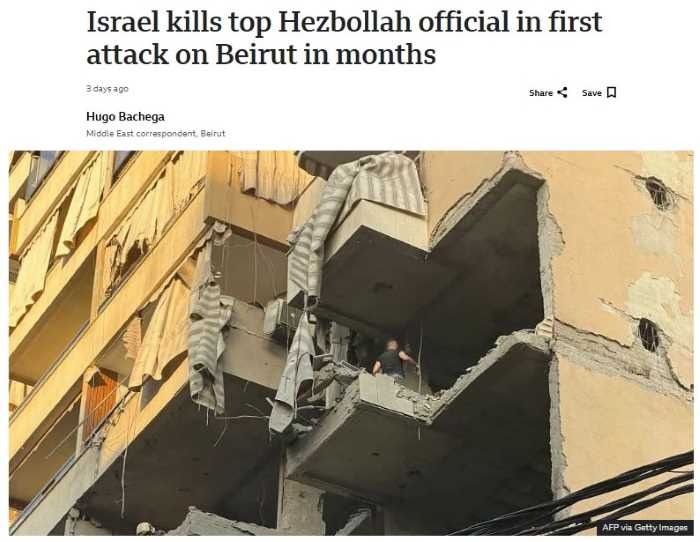
On November 23rd, some three hours after news broke concerning a strike in Beirut’s Dahiya suburb targeting Hizballah’s chief of staff, a report appeared on the BBC News website under the headline “Israel kills top Hezbollah official in first attack on Beirut in months”.
Over the next four or so hours, that report – credited to Hugo Bachega in Beirut – was updated four times, with the latest version naming the target of the strike as Haitham Ali al-Tabtabai rather than Ali Tabtai, as had appeared in the earlier versions.
In line with BBC editorial policy, Bachega’s descriptions of Hizballah throughout the report do not clarify in the BBC’s own words that it is a terrorist organisation. Having told readers that Hizballah is “a militant group” and “a Shia Muslim group supported by Iran”, Bachega adds in paragraph twelve (out of sixteen) that it is “considered a terrorist organisation by countries including the US and UK”.
On the topic of Tabatabai’s resume, at the end of his report Bachega tells BBC audiences that:
“The US government imposed sanctions on Tabtabai in 2016 and designated him a terrorist. It has a $5m (£3.8m) award on offer for information about him.
The US described him as a key Hezbollah military leader who once commanded the group’s special forces in Syria and Yemen, adding his actions in these countries were part of a larger Hezbollah effort to provide training, material, and personnel “in support of its destabilising regional activities”.”
Readers are not told of Tabatabai’s past role as commander of Hizballah’s Radwan Force – the unit assigned with invading northern Israel.
Bachega tells readers that:
“Lebanon’s health ministry said at least five people were killed and 28 others wounded in the strike, which hit an apartment building in the densely populated Dahieh district.”
That statement does not distinguish between civilians and combatants and the BBC did not update Bachega’s report to clarify that four of the other people killed were claimed by Hizballah as its operatives.
Similarly, Bachega later tells readers that between October 2023 and November 2024:
“Lebanese authorities said Israel’s attacks killed about 4,000 people there – including many civilians – and led to the displacement of more than 1.2 million residents.”
In fact, the majority of those killed in Lebanon were members of Hizballah or other terrorist organisations.
Notably, Bachega repeatedly stresses a particular point in his report: [emphasis added]
“Israel’s military has killed a senior member of the militant group Hezbollah in an air strike on the southern suburbs of the Lebanese capital, Beirut, despite a ceasefire.”
“It comes as Israel has escalated its campaign on people and targets it says are linked to Hezbollah – a Shia Muslim group supported by Iran – despite a ceasefire brokered by the US and France that came into effect last November.”
“Lebanon’s President Joseph Aoun has urged the international community to put pressure on Israel – which continues to occupy at least five locations in southern Lebanon – to stop the attacks and withdraw from the country, saying the Israeli actions are a violation of the agreement that put an end to 13 months of conflict.”
Bachega does not clarify that the agreement reached between Israel and Lebanon in November 2024 states:
“These commitments do not preclude either Israel or Lebanon from exercising their inherent right of self-defense, consistent with international law.”
He does however tell readers that:
“The Lebanese government has vowed to disarm Hezbollah, but the group has rejected calls to discuss the future of its weapons before Israel stops its attacks, fully withdraws from Lebanon, and releases Lebanese prisoners.
A Western diplomatic official, who spoke on condition of anonymity, told the BBC the authorities are under pressure from the Trump administration, which is growing impatient with what they see as the slow progress against the group…”
The ceasefire agreement states that Lebanon will:
“a. Monitor and enforce against any unauthorized entry of arms and related materiel into and throughout Lebanon, including through all border crossings, and against the unauthorized production of arms and materiel within Lebanon.
b. Starting with the Southern Litani Area, dismantle all existing unauthorized facilities involved in the production of arms and related materiel, and prevent the establishment of such facilities in the future.
c. Starting with the Southern Litani Area, dismantle all infrastructure and military positions, and confiscate all unauthorized arms inconsistent with these commitments.”
The failure of the Lebanese authorities to fulfil that agreement reached a year ago is of course the context needed to understand Israeli strikes in Lebanon but Bachega has nothing to tell readers in his own words about topics such as weapons smuggling from Syria into Lebanon, weapons production or weapons stockpiling by Hizballah. Instead Bachega repeatedly describes Israel as being the party that acts “despite a ceasefire” and presents Hizballah’s rebuilding of its capabilities solely as an Israeli claim:
“Israeli officials say Hezbollah has been trying to rebuild its military capabilities, is smuggling weapons into Lebanon and stepping up the production of explosive drones as an alternative to rockets and missiles, and there are growing fears of an escalation of hostilities.”
Significantly, neither does Bachega provide BBC audiences with any information about the role of Tabatabai in Hizballah’s rebuilding in southern Lebanon.
Related Articles: