

 Close
Close
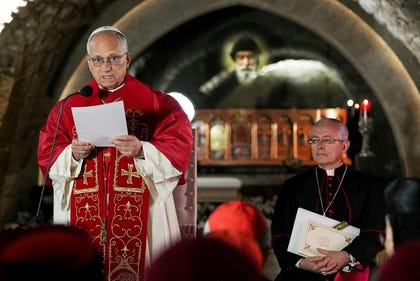
Pope Leo XIV delivers his speech in front of the tomb of Saint Charbel Makhlouf at the Monastery of Saint Maroun, in Annaya, Lebanon on Monday. Credit: Domenico Stinellis/REUTERS
Pope Leo XIV delivers his speech in front of the tomb of Saint Charbel Makhlouf at the Monastery of Saint Maroun, in Annaya, Lebanon on Monday. Credit: Domenico Stinellis/REUTERS
Pope Leo will meet with leaders from Lebanon’s diverse religious sects on Monday, where he is expected to urge them not to flee the country despite years of conflict, political paralysis and economic crisis that have prompted waves of migration.
Leo, the first U.S. pope, will visit Lebanon’s Christian community before hosting an inter-religious dialogue with members of Lebanon’s Sunni Muslim, Shi’ite Muslim and Druze communities, as well as migrant workers.
The pope, in the country on what he has described as a mission of peace, urged Lebanon’s political leaders on Sunday to persevere with peace efforts despite facing a “highly complex, conflictual and uncertain” regional situation. Leo, 70, is visiting Lebanon until Tuesday on the second leg of his first overseas trip, which started in Turkey.
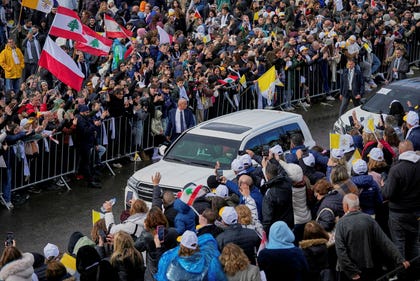
Crowds gathered there early on Monday to greet him, carrying umbrellas to shield them from the rain and ululating as his convoy approached to the sound of church bells. “We have really been waiting for the pope’s visit because it is raising our hope now. He has come to confirm for us that what we are living through, (that) it will not always be like this,” said Rev. Toni Elias, a Maronite priest from Rmeich, a Christian town close to the Israeli border.
 Close
Close
People wave to Pope Leo XIV as he leaves the Monastery of Saint Maroun after praying at the tomb of Saint Charbel Makhlouf in Annaya, Lebanon on Monday. Credit: Hassan Ammar/AP
People wave to Pope Leo XIV as he leaves the Monastery of Saint Maroun after praying at the tomb of Saint Charbel Makhlouf in Annaya, Lebanon on Monday. Credit: Hassan Ammar/AP
“And we believe that he brings with him the message of peace, which we really need.”
Lebanon, which has the largest share of Christians in the Middle East, has been rocked by the spillover of the Gaza conflict, as Israel and the Lebanese Shi’ite Muslim militant group Hezbollah went to war, culminating in a devastating Israeli offensive.
The country, which hosts 1 million Syrian and Palestinian refugees, also is struggling to emerge from a severe economic crisis following decades of profligate spending that sent the economy into a tailspin in late 2019.
Leo will host a meeting with young people, where he is expected to urge them to work for peace in a country still being hit by near-daily Israeli bombardment.
 Close
Close
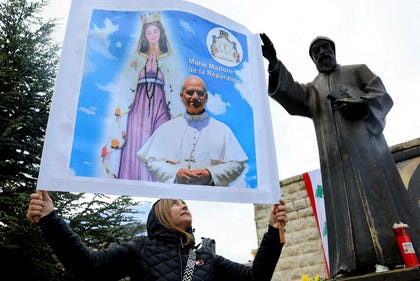
A woman holds up a placard with the images of Pope Leo XIV and “Mary, Madonna of Reparation” next to a statue of St Charbel on the day Pope Leo XIV visits the Monastery of Saint Maroun, in Annaya, Lebanon on Monday. Credit: Mohamed Azakir/REUTERS
A woman holds up a placard with the images of Pope Leo XIV and “Mary, Madonna of Reparation” next to a statue of St Charbel on the day Pope Leo XIV visits the Monastery of Saint Maroun, in Annaya, Lebanon on Monday. Credit: Mohamed Azakir/REUTERS
Israel says its continued strikes since last year’s cease-fire agreement are to prevent Hezbollah from re-establishing military capabilities and posing a renewed threat to communities in northern Israel.
His schedule includes a prayer at the site of a 2020 chemical explosion at the Beirut port that killed 200 people and caused damage worth billions.