
Zelenskyy sets out Ukraine’s red lines, hints at possible Trump call
In his comments, Ukraine’s Zelenskyy says that Ukraine’s priorities remain focused on security guarantees, maintaining sovereignty and territory, as he insists that Russia must not get rewards for its aggression on Ukraine.
He also plays down the Kremlin’s claims of Russian advances, saying they are exaggerated.
He says he hopes to have talks with US president Donald Trump to discuss next steps once Steve Witkoff is back from his talks in Russia this week.
Key events
42m ago
Macron lauds Europe’s effort to put more pressure on Russia, backs use of frozen assets
54m ago
Zelenskyy sets out Ukraine’s red lines, hints at possible Trump call
1h ago
More talks on peace, security guarantees expected in coming days, Macron says
1h ago
Russia has shown no sign of ending aggression, Zelenskyy says, as he insists no decisions on Ukraine without Ukraine
1h ago
Macron, Zelenskyy about to speak after Paris talks
1h ago
‘Not everyone in Washington and no one in Moscow’ wants Poland involved in Ukraine talks, Tusk says
2h ago
Tusk welcomes close Polish-German relations on defence, but notes disagreements over past, WW2 reparations
2h ago
Merz hails German-Polish relations, says there can be no ‘dictated peace’ on Ukraine
2h ago
Germany’s Merz and Poland’s Tusk due to brief media after political talks in Berlin
3h ago
Macron, Zelenskyy spoke with European leaders, Witkoff, Élysée says
3h ago
Ukraine peace must be ‘durable,’ Zelenskyy says after talks with Macron
3h ago
EU foreign policy chief worried pressure will be put on Ukraine to make concessions
3h ago
‘Our job is to support victim, not reward aggressor,’ EU foreign policy chief says
3h ago
Russia made ‘biggest advance in year’ in November, study says
6h ago
We ‘must confront reality’ that Brexit ‘significantly hurt’ our economy, UK prime minister says
6h ago
Overnight Russian attack on Dnipro kills three, injures dozen
6h ago
Are we closer to a peace deal on Ukraine? – video explainer
7h ago
Zelenskyy arrives at Élysée for talks with Macron
7h ago
Putin set to welcome US Witkoff for Ukraine talks on Tuesday, Kremlin says
7h ago
Vilnius sees more flights disruptions caused by contraband balloons in its airspace
8h ago
‘A pivotal week for diplomacy’ on Ukraine, EU foreign policy chief says
8h ago
Zelenskyy faces ‘mini-revolution’ in governance system after shock Yermak resignation
8h ago
Morning opening: Zelenskyy visits Macron in Paris
Show key events only
Please turn on JavaScript to use this feature
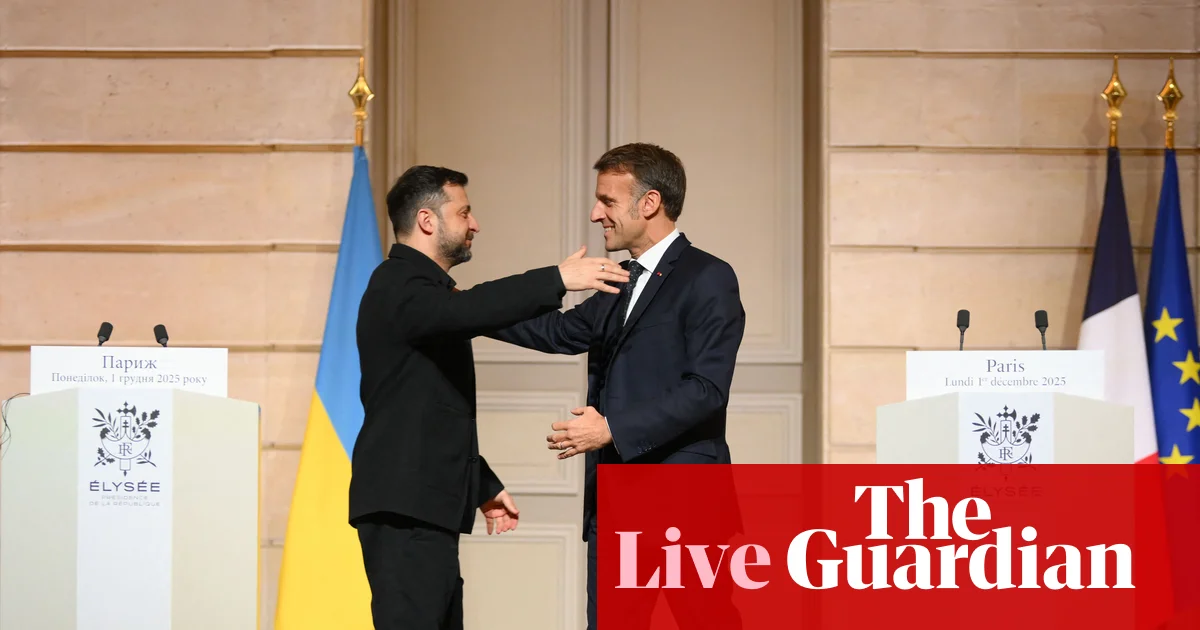
And they end the talks just as they started this morning (11:11), with a friendly embrace between the leaders, a clear sign of solidarity with Ukraine from Paris.
French president Emmanuel Macron, right, and Ukrainian president Volodymyr Zelenskyy hug each other after a joint press conference at the Élysée Palace in Paris. Photograph: Christophe Ena/APFrench president Emmanuel Macron (R), and Ukrainian president Volodymyr Zelenskyy (L) leave after a joint press conference at the Élysée Palace in Paris, France. Photograph: Christophe Ena/EPAShare
In his comments, Macron also notes that Ukraine has been open to various proposals on ceasefire and ending the war throughout 2025, with Russia repeatedly blocking them from progressing.
He welcomes the American efforts, and says that Russia’s response will show whether it’s serious about peace.
Similarly, Zelenskyy says he will get a full debrief on the latest talks with Russia, and this will inform his next steps.
Responding to a question from a Ukrainian journalist, he also says he is still continuing his search for Yermak’s replacement as the head of his office, but insists there are capable candidates.
And that ends the press conference.
ShareMacron lauds Europe’s effort to put more pressure on Russia, backs use of frozen assets
Asked about Europe’s pressure on Russia, Macron says that the latest round of sanctions, including on oil and gas sectors as well as the shadow fleet, has put most pressure on Russia “since the start of the war,” and could be “a gamechanger.”
“ I really believe that in the weeks to come, come, the pressure on the Russian economy and the capacity of Russia to finance the war efforts will drastically change,” he says.
He also gets asked the use of frozen Russian assets to fund Ukraine and Belgium’s continuing opposition to the EU’s proposed reparations loan, insisting he is confident “we will find an option that technically addresses all the legitimate questions being raised.”
Responding to a question about the corruption investigations in Ukraine, including Zelenskyy’s former senior aide, Andriy Yermak, Macron says the EU followed these issues very closely, but – toeing the EU line – insists the fact that the probe was progressing showed the authorities were working freely.
He says it’s right to demand accountability and scrutiny from Ukraine, but notes that the key issue is how the state responds to any allegations, through independent authorities and judiciary.
He also points out that the developments in Ukraine come in stark contrast to how such allegations are handled in Russia.
ShareZelenskyy sets out Ukraine’s red lines, hints at possible Trump call
In his comments, Ukraine’s Zelenskyy says that Ukraine’s priorities remain focused on security guarantees, maintaining sovereignty and territory, as he insists that Russia must not get rewards for its aggression on Ukraine.
He also plays down the Kremlin’s claims of Russian advances, saying they are exaggerated.
He says he hopes to have talks with US president Donald Trump to discuss next steps once Steve Witkoff is back from his talks in Russia this week.
ShareMore talks on peace, security guarantees expected in coming days, Macron says
Macron says that “the coming days will see further essential discussions between the US and the Coalition of the Willing to clarify American participation” in any future security guarantees for Ukraine.
Similarly, when it comes to the broader issue of peace negotiations, he says there will be “greater clarity” once US and Russian representatives talk in the coming days, with the key question of whether Russia is prepared to move from its demands.
“For our part, we will continue to support all peace efforts in the meantime, and we will continue to support Ukraine’s resistance efforts,” he says.
ShareRussia has shown no sign of ending aggression, Zelenskyy says, as he insists no decisions on Ukraine without Ukraine
Opening the press conference with Zelenskyy in Paris, Macron stressed France’s “full support” for Ukraine ahead of what he says is “a moment that could be a turning point” in talks about ending the war.
Straight away, he notes that “at a time when we are talking about peace, Russia continues to kill and destroy.”
He commends the US efforts to end the war, and says the key objective is to stop the killing, but adds that “when we talk about peace, everyone has a role to play.”
“Russia must stop the aggression. It has given no signal, no proof to that effect,” he says.
He adds that only Ukraine can make decisions about its territory, and insists that security guarantees must not be discussed without both Ukrainians and the Europeans – and more broadly, the Coalition of the Willing – as “they are the guarantors” and would be affected by anything that changes the security of Europe.
Updated at 11.18 EST
Before we fully turn to Paris, a final note on Berlin with an unexpected hard ball from Tusk towards Berlin, among all the niceties of this press conference.
Asked about the need to provide further support for the living victims of the second world war, Merz says “we are discussing further possibilities” for what he calls “a humanitarian gesture towards the Polish people,” but declines to speculate on timelines or amounts – even as he says he is “very aware” of the historical responsibility.
But Tusk is not happy with that and says that if Germany doesn’t move by their next meeting in 2026, Poland may unilaterally start paying money to survivors.
“When I talked about this with chancellor Scholz [last year], it was a little over 60,000 [people]. Today, it is 50,000. Hurry up if you really want to make such a gesture,” he says.
ShareMacron, Zelenskyy about to speak after Paris talks
After a very, VERY lengthy delay, France’s Emmanuel Macron and Ukraine’s Volodymyr Zelenskyy are about to address the media after their talks at the Élysée Palace in Paris.
You can watch it on our live stream below, and I will bring you all the key lines here.
 Macron welcomes Zelenskyy at the presidential palace – watch liveShare‘Not everyone in Washington and no one in Moscow’ wants Poland involved in Ukraine talks, Tusk says
Pressed by journalists on Poland’s role in Ukraine talks – and some sentiment that Poland is not always adequately involved by its western partners in the key discussions – Tusk talks about his close relationship with other EU leaders and on-going consultations, also confirmed by Merz.
But curiously he then takes a swipe at unnamed leaders in Washington as he adds:
“I don’t want to stir up unnecessary emotions here, but let’s say that not everyone in Washington and certainly no one in Moscow wants Poland to be present always and everywhere.
I take this as a compliment to me, and as a compliment to Poland.
And I’ll leave it here before I say too much.”
Share Jakub Krupa
The issue of reparations is clearly still dividing the two leaders, with Merz saying that the position of the German government – this and previous governments – is known, and that the issue is essentially closed.
But he talks about the need to continue the dialogue on remembrance and notes Germany’s “responsibility” in this area, as he notes the concern on the Polish side, both on history, and on contemporary perception of both countries (as mentioned in – you guessed it – my analysis earlier).
But he somewhat deflects from the broader question as he instead heaps praise on contemporary Poland, its economy, and how it’s evolved over the years, as one of Europe’s most productive countries.
But Tusk – a historian by training, and facing domestic pressure on this issue – is not letting it go, as he repeats his earlier points about the need to know history, and stresses that it continues to shape the Polish thinking about Germany today.
He acknowledges the existence of “radicals, on both sides of the border,” who try to stoke anti-German (15:55) and anti-Polish sentiments (AfD’s co-leader Tino Chrupalla recently said “Poland could also be a threat to us” in the context of a discussion on Russia), but insists “they will not succeed.”
Updated at 10.28 EST
Jakub Krupa
If you’re wondering what’s happening in Paris: yes, we are still waiting for Macron and Zelenskyy.
But don’t worry, I’m keeping an eye on this for you.
ShareTusk welcomes close Polish-German relations on defence, but notes disagreements over past, WW2 reparations
Responding to Merz’s comments, Tusk welcomes a “good and honest” discussion between the leaders, also noting their chats with Macron, Zelenskyy and other leaders on Ukraine as he says “there is no escaping from this great tension caused by Russia’s attack on Ukraine.”
Polish prime minister Donald Tusk inspects Saint James’ skull during a cultural heritage hand over of parchment manuscripts and other looted items of cultural importance during the German-Polish government consultation at the chancellery in Berlin, Germany. Photograph: Filip Singer/EPA
But he pointedly welcomes the step change in Polish-German relations and the extent of joint work on defence issues, particularly on Nato’s eastern flank.
He says this change is particularly important in the context of past disagreements on strategically important issues, including Europe’s policy towards Russia and energy (think, Nord Stream 2).
“When we spoke about the threats resulting, for instance, from investments like Nord Stream, related to Europe’s gas dependence on Russia, I often felt isolated in Europe,” he says, but welcomes the shift in tone on these issues in recent years.
Tusk also pointedly acknowledges major differences of views on reparation and compensation for the second world war.
“I won’t say that the past is more important or the future is more important. In the life of each of us, the future is more important, but there is no good future without an awareness of what the past was and what is incumbent upon us in connection with that past.”
He says the Polish position “has not changed” as “in Poland virtually everyone without exception believes that Poland has not received compensation for the losses and the crimes from the second world war.”
But he also acknowledges and expresses gratitude for the 73 returned items, talking about his emotional response to some of the items dating back centuries.
Updated at 10.13 EST
Jakub Krupa
But if you want to get a sense of how deeply, deeply dividing the issue of Poland’s relations with Germany is, the conservative-nationalist Law and Justice-aligned Polish broadcaster Republika, one of the most popular news channels in Poland, is carrying the Merz-Tusk press conference under the (obviously false and misleading) headline of “Tusk is receiving his instructions in Berlin.”
If you want to understand what’s that about, more on this in my analysis below.
Updated at 09.59 EST
Merz hails German-Polish relations, says there can be no ‘dictated peace’ on Ukraine
Speaking in Berlin, Merz says it’s in Germany’s interest to have a close and “equal” political relationship with Poland facing the threat posed by a “revisionist” regime in Russia, as he says that “especially in these times, when European unity is under such pressure, we must not allow ourselves to be divided.”
German chancellor Friedrich Merz and Poland’s prime minister Donald Tusk hold a press conference, on the day of the German-Polish government consultations in Berlin. Photograph: Lisi Niesner/Reuters
Standing by Poland’s Tusk, he also talks about closer defence and security cooperation, including on defending the eastern flank of Nato with German fighter jets stationed in Poland and joint work on drones, with a plan to sign a new defence deal in 2026.
He also talks about the modernisation of cross-border train links between the two countries, and other transport initiatives.
Touching upon the key memory issues that so often complicated the relationship between the country, Merz says he wants to address this question in a way that could bring the two countries together.
He talks about the new political momentum for the much-awaited memorial to the Polish victims of Nazis in Berlin, and says Germany has today returned 73 items looted during the second world war.
Merz also talks about Ukraine, and the need for closer coordination on this issue during the peace talks.
He confirms the pair spoke with Macron and Zelenskyy, and stresses the importance of the upcoming days for Ukraine as he says “we are doing everything in our power to stand by Kyiv against the Russian aggressor.”
He says the European partners need to keep helping Ukraine defend itself, maintain transatlantic unity by working with the US, and remember about the broader European defence focus, pointedly mentioning the issue of frozen Russian assets.
He stresses that no decisions on Ukraine can be made without Ukraine, and “no dictated peace over the heads of Ukraine.”
Updated at 09.52 EST
We understand that other European leaders that Macron and Zelenskyy spoke with include their partners from Germany, Poland, Italy, Norway, Finland, Denmark, and the Netherlands, plus the leaders of the EU and Nato.
ShareGermany’s Merz and Poland’s Tusk due to brief media after political talks in BerlinJakub Krupa
Separately, German chancellor Friedrich Merz and Poland’s prime minister Donald Tusk are about to give a press conference after their high-level political talks in Berlin today. I will keep an eye on key lines coming out of their meeting.
German chancellor Friedrich Merz (R) and Polish prime minister Donald Tusk review a guard of honour in Berlin, Germany. Photograph: Sean Gallup/Getty Images
But as I explained in my analysis published earlier today,
Amid growing US pressure for a peace deal with Russia, Warsaw and Berlin will want to send a signal of support for Kyiv and of unity between central Europe’s largest – and militarily strongest – countries.
But below the surface, the bilateral relationship is increasingly tricky. Poland, long considered the junior partner, no longer sees itself in an inferior role. This is not only because of its economic success since the fall of communism in 1989, but because it has avoided German policies that it sees as missteps, namely on migration and relations with Russia.
“Poles have become more self-assured, especially in relation to Germany as it has always been a reference point,” says Dr Agnieszka Łada-Konefał, vice-director of the German Institute of Polish Affairs, who co-leads a study of Polish-German relations.
This year the study, which has tracked mutual sentiment for the past 25 years, showed a near record level of aversion on the Polish side, with only slightly more Poles having a positive view of Germans than negative. It is in sharp contrast to how Germans view Poles, with the study recording its lowest ever percentage of people expressing negative views of their eastern neighbours.
Updated at 09.24 EST