

Monday, December 1, 2025
Media Contact:
Kirsi McDowell | Communications Coordinator | 405-744-8320 | kirsi@okstate.edu
The College of Education and Human Sciences’ Dr. Bree Baker and her team of experts
have put a spin on the Stay Strong, Stay Healthy exercise program, studying a long
overlooked subset of agricultural workers.
Baker, an assistant professor and director of the Musculoskeletal Adaptations to Aging and Exercise (MAAX) Lab in the School of Kinesiology, Applied Health and Recreation, began implementing the Stay Strong, Stay Healthy (SSSH) program at Oklahoma State
University in the summer of 2023.
The program is part of a national Extension model developed in 2005 at the University of Missouri. Designed as an eight-week community-based
intervention, SSSH evaluates the impact of resistance exercise on strength and flexibility,
static and dynamic balance, sleep quality and more.
From its inception, SSSH was implemented with older adults, as well as less active
middle-aged individuals — those who experience higher rates of musculoskeletal dysfunction
and fall risk.
A demographic with a similar risk profile for bone and muscle injuries from repetitive
movements or falls are agricultural workers, and more specifically, those who work
in nursery settings.
“Most SSSH research has focused on aging adults as the highest risk for falls; however,
many occupations also put workers at similar or even elevated injury risk,” Baker
said.
“This working demographic is often underrepresented in research and we owe it to them
to work alongside their employers to keep them as safe and healthy as possible through
research. This is perhaps our single-most important mission as a land-grant institution.”
Various studies have been conducted on the implementation of exercise intervention
in adjacent labor-intensive industries, but just three have evaluated agricultural
workers and none used nursery workers as study subjects.
As the first study to look into the physical and psychosocial effects of resistance
training in nursery workers, the team of OSU researchers are closing a gap for individuals
with an elevated risk of workplace injury.
Based on a 2020 study, 70% of injuries reported by nursery workers were musculoskeletal
(strains and sprains) and fall-related.
The most common complaint reported is low-back pain from the repetitive movements
required of the labor-intensive job in combination with poor muscle strength and flexibility;
falls are often a result of trip hazards occurring within nursery spaces, such as
hoses, carts and equipment, or the plants themselves.
Several ergonomic solutions have been implemented for nursery workers by the U.S.
National Institute of Occupational Safety and Health (NIOSH) to mitigate such occurrences,
but there has not been any implementation of workplace-facilitated exercise programs
to improve individuals’ performance and physical safety on the job.
Over the course of two decades, the SSSH resistance training program has proven to
be an effective method of improving individuals’ strength and flexibility, so it was
predicted the same would be true for the functional capacity of nursery workers. With
enhanced physical function, the risk for workplace injuries is reduced.
Testing their hypothesis, Baker’s team partnered with a local large-scale producer
of plants, flowers, trees and vegetables, who supported their workers through on the
clock, twice a week, hourlong programming on site during regular business hours, incentivizing
their participation.
Student researchers Lindsey Phillips Abernathy, Liz Neria-Piña, Diego Diaz-Vega and
Shawn Allen (Ph.D. candidate) conducted the study, with Ph.D. candidate and graduate
teaching assistant Nick Spokely serving as principal investigator on the project.
The block-randomized, controlled, longitudinal, feasibility study included a total
of 14 individuals in the SSSH test group with a control group of eight at the conclusion
of the eight weeks. The block randomization guaranteed there was an even distribution
of age, sex and job type amongst participants.
To measure the quantitative data, the test participants engaged in SSSH Level I programming,
consisting of a light warm up and eight core exercises targeting major muscle groups,
followed by cool-down exercises.
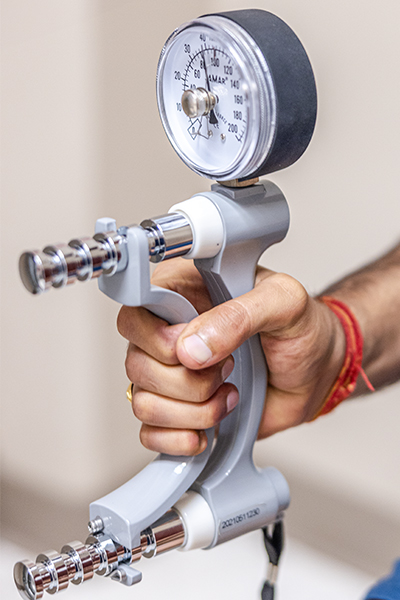 Eight functional capacity assessments were completed, ranging from sit-to-stand exercises,
upper and lower body flexibility challenges and the Stork Stand Balance test, to hand
grip dynamometry to measure muscular strength and self-selected gait speed tests.
To better evaluate the overall impact of the intervention, the study was executed
in collaboration with Dr. Lucy Bailey, a professor of social foundations with expertise in qualitative methodology.
Qualitative interview sessions were conducted pre- and post-data collection and included
questionnaires as well as conversational interviews capturing the participants’ background
and job role, physical activity levels, health descriptors and program participation.
Spokely attributes the addition of the qualitative study as an enhancement to the
overall outcome of the research, with findings that supported the quantitative data.
“Dr. Bailey and her team found that nursery workers improved their self-efficacy towards
exercise, mental health, social health and job performance; findings that our quantitative
data would not have found,” he said.
“For example, we found measurable increases to muscle strength (hand grip strength),
which was also revealed in the qualitative findings as workers cited that they felt
stronger after the 8-week on-site program.”
At the conclusion of the eight-week programming, the Stay Strong, Stay Healthy test
group demonstrated increased performance in all areas, with no changes to the control
group’s physical function; a significant finding was in improved sleep quality, which
for the majority of participants was reported as chronically low in pre-data collection.
From a qualitative standpoint, the largest barrier to maintaining exercise outside
of work is the physical demands while on the job. The majority of participants are
in labor-intensive roles in a warehouse or greenhouse providing maintenance or cultivating
plants; all of which increases during spring and summer months.
Despite this, the test subjects reported the health benefits of the SSSH programming,
its benefits to their job performance, and for some the program was a source of inspiration.
For a female participant in her seventies who works a more labor-intensive role, greater
self-efficacy was reported.
“This program helped me realize, I can do it. I don’t have to give up because of my
age. You have to find out what you’re capable of — and not just sit.”
Improvements were found in pain reduction, mobility, energy and overall job performance.
Overall, the study confirmed the team’s hypothesis.
“The primary finding was that on-site exercise improved nursery workers’ functional
health, self-efficacy, social and mental health, and perceived job performance,” Spokely
said.
The on-site accessibility was the key to participants finding overall benefit in the
program.
With this new data, the team can test the SSSH model on-site in other facilities,
scaling up their research to better inform methods of risk reduction amongst agricultural
laborers.
“Oklahoma relies heavily on the men and women who drive our energy and agricultural
sectors; however, their occupation puts them at elevated risk for muscle and bone
injuries,” Baker said.
“Exercise programs like Stay Strong, Stay Healthy may be a viable option for employers
to protect their employees and this study shows that having the program in the workplace
was viable and beneficial to all parties.”