
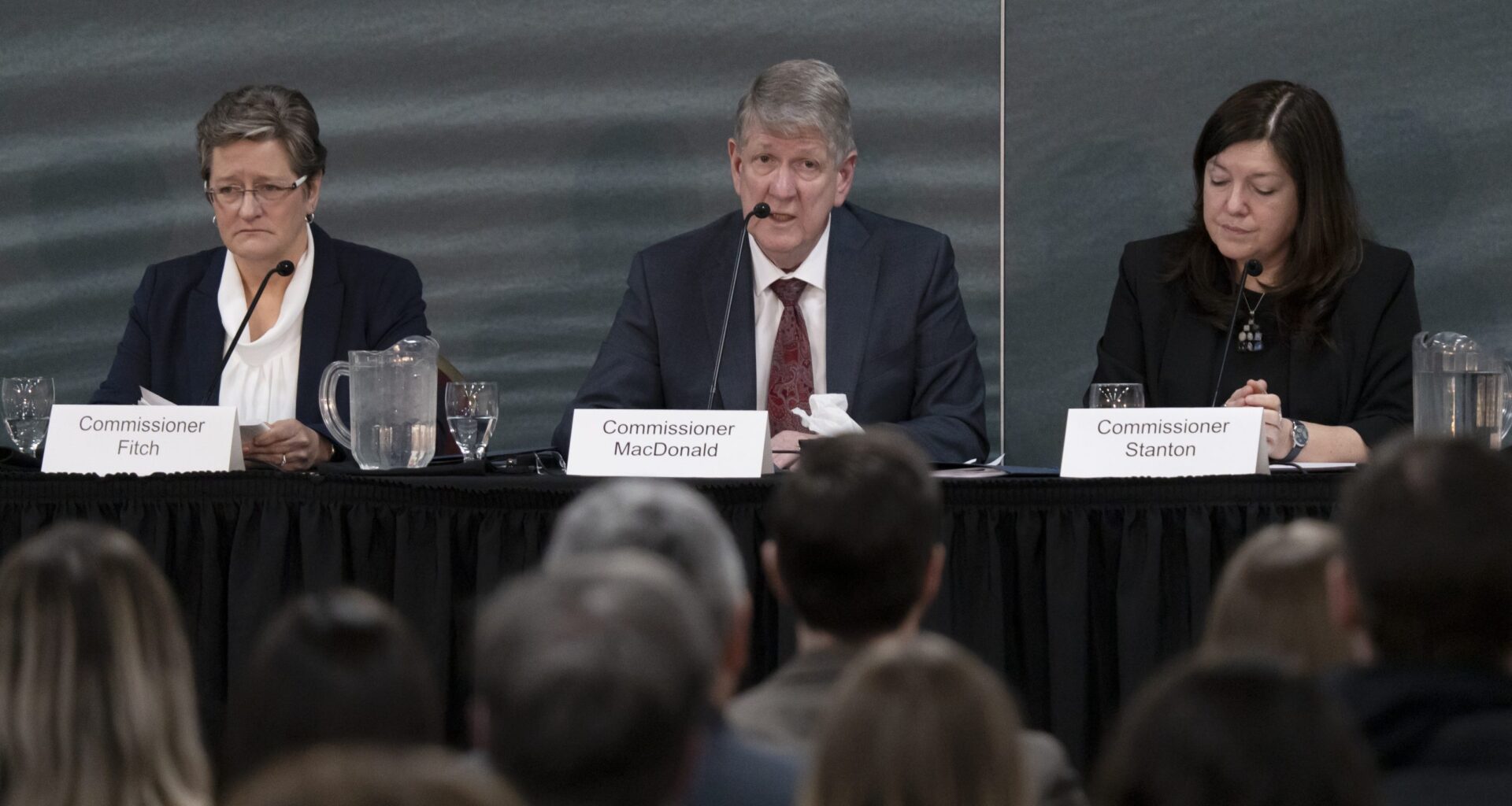
There has been a lot of commentary since Thursday when the verdict was issued in the sexual assault trial of five 2018 world junior hockey team players, all of whom were acquitted.
The survivor, whose name is only give as E.M., called the ruling devastating.
On Sunday, I listened to CBC’s Sunday Magazine where host David Common spoke with CBC Sports senior contributor Shireen Ahmed and The Athletic senior writer Dan Robson about what the decision means for hockey culture.
Ahmed said there have been changes at the rink level with programming for kids in hockey and “good people doing good work.” She added that there’s still more work to be done, including addressing misogyny, homophobia, transphobia, and racism in hockey culture.
There are people who are so precious about hockey they won’t allow change to happen where it needs to. This is one of the things I want to challenge Canadians [on]: you love hockey; don’t you want to make it better for your kids and your community?
Robson spoke about the culture of entitlement in hockey, even in the minor and junior leagues.
“You have young people, adolescents, elevated to this position where they’re sought after, they’re told they’re prospect for the next level. The entire system, even the draft in junior hockey…it feels like you’re elevated to this status,” Robson said. “There’s this thread of misogyny that’s tied in with locker rooms, within the culture that despite all of the courses you can mandate … it still lives within that system.”
Ahmed said part of hockey culture is the “complete lack of accountability.”
“The entitlement is absolutely one part of it but even doing some sort of untoward behaviour, nobody was ever questioned about it,” Ahmed said.
Closer to home, Francis Campbell at SaltWire wrote this story in which he interviewed Kristina Fifield, a trauma therapist who specializes in gender-based violence.
Fifield said the verdict comes from a larger system that normalizes sexual- and gender-based violence. She said things are not getting better for survivors of sexual assault and the verdict may prevent other survivors coming forward to report. From Campbell’s story:
I actually think things are getting worse, with everything that’s happening in the States, with misogyny, with violence and hate, things seem to be on the upswing of getting worse. I don’t think anything has changed since 2020 (the mass casualty in Nova Scotia) with what has taken place in our province.
I want to talk about the final report of the Mass Casualty Commission (MCC) in Nova Scotia. That report was released in March 2023, and included 130 recommendations, including many that deal with preventing gender-based violence. You can find the recommendations here.
First up, Recommendation V.7 Countering victim blaming and hyper-responsibilization of women survivors:
The Commission recommends that Federal, provincial, and territorial governments work with and support community-based groups and experts in the gender-based advocacy and support sector to develop and deliver prevention materials and social awareness programs that counter victim blaming and hyper-responsibilization (holding of an individual to higher standards than what would typically be expected of the average person) of women survivors of gender-based violence.
Fifield mentioned this in the article with Campbell at SaltWire. From the story:
More importantly for Fifield and others, the judge made it clear in her 91-page decision that she questioned the credibility and reliability of the now-27-year-old woman, the complainant whose identity is protected by a court order.
“These high-profile cases and what was said yesterday about E.M. not being credible basically just further intensifies the victim blaming, not believing survivors,” Fifield said, pointing out that the result is a deterrence for others to speak out about being sexually assaulted.
Of course, we saw plenty of victim blaming of Lisa Banfield, the partner of the killer in the mass shootings. Tim Bousquet wrote about that in this commentary called “The witchification of Lisa Banfield.”
There’s also a recommendation about the importance of bystander intervention. That’s recommendation C. 17, promoting bystander intervention as a daily practice:
The Commission recommends that
(a) The federal government should: (i) renew and extend bystander intervention awareness and education campaigns and support their implementation in a wide range of settings, including in education, in workplaces, and in the provision of public services; and (ii) develop and implement a longitudinal evaluation of these campaigns.
(b) Provincial and territorial governments should develop and implement a mandatory gender-based violence and bystander intervention training curriculum in the school system commencing in kindergarten and continuing until Grade 12.
(c) Municipal, provincial, territorial, and Indigenous governments should develop and implement genderbased, intimate partner, and family violence bystander intervention training for their workplaces and staff.
(d) Colleges, universities, and other education and training institutions and workplaces, to the extent they are not already doing so, should provide practical training in support of effective and safe bystander intervention.
Julie Lalonde is a an author and women’s rights advocate who teaches bystander intervention. I took her online program in May 2020 and wrote about it here. Lalonde teaches bystander intervention in such a simple way that’s easy to understand and will give people confidence to step in. This is important in hockey culture because as Shireen Ahmed at CBC said, there’s no accountability in hockey.
Lalonde also mentioned the issue of trauma of sexual assault survivors experience. She spoke with CTV about the verdict in this interview. Lalonde said the judge in the case failed to understand the “neurobiology of trauma.”
“People who are experiencing a traumatic event don’t remember things in a linear way. They often remember something in vivid detail and miss other things because your brain is overloaded with the things you’re experiencing,” Lalonde said.
Recommendation C.6 in the MCC final report talks about trauma-informed care for survivors. This applies to the RCMP and other police services but can certainly apply elsewhere. Here are some of the implementation points in the recommendation:
Preservation of victim dignity should be a priority, including through taking steps to ensure victim’s bodies are secured, covered as quickly as possible, and protected such that video footage and photographs cannot be taken.
RCMP policies, protocols, and training should recognize that in order for the family liaison officer to succeed, their colleagues (e.g., those in the Major Crimes Unit) must support them by providing accurate and timely information.
A family liaison officer should offer meaningful updates and guidance about the investigation, as well as general information on related offices and services—including, but not limited to, the medical examiner, insurance, crime scene and evidence cleaning, and mental and physical health supports.
Finally, there’s recommendation V.13 from the MCC: epidemic-level funding for gender-based violence prevention and interventions.
The Commission recommends that Federal, provincial, and territorial funding to end gender-based violence be commensurate with the scale of the problem. It should prioritize prevention and provide women survivors with paths to safety.
• Funding should be adequate and include stable core funding for services that have been demonstrably effective in meeting the needs of women survivors of gender-based violence and that contribute to preventing gender-based violence, including interventions with perpetrators.
• These services should be funded over the long term and should not be discontinued until it has been demonstrated that the services are no longer required or an equally effective alternative has been established.
• Priority should be placed on providing adequate and stable core funding to organizations in the gender-based violence advocacy and support sector.
• A further priority should be funding community-based resources and services, particularly in communities where marginalized women are located.
There has been funding for the violence-against-women sector in Nova Scotia, although not without a fight.
As Jennifer Henderson reported in March, Premier Tim Houston’s government announced $23.7 million in new funding over the next four years to help survivors of intimate partner violence (IPV), as well as for those organizations offering programs and counselling to prevent IPV.
That was just a couple months after the Transition House Association of Nova Scotia (THANS) and directors of women’s organizations got together to demand urgent action from Houston on intimate partner violence in the province.
But federally in recent days, we learned that funding to Women and Gender Equality Canada (WAGE) will be cut by 81% by 2027-2028.
According to this article by the Canadian Centre for Policy Alternatives (CCPA), those cuts will take the women’s movement back to the Harper years when, as the article notes, “then minister for Status of Women Canada, Bev Oda, famously excised the word “equality” from the agency’s mandate, arguing it wasn’t needed any more.”
In a post on Bluesky about the cuts, Lalonde noted that WAGE is a major funder of women’s organizations across the country.
“My sector clamours every time there’s a call for proposals. And the number one determinant of gender equity in a country is how strong its civil society organizations are,” Lalonde wrote.
Back in December 2024, I reported on the update from the Progress Monitoring Committee, which oversees the progress on the recommendations in the Mass Casualty Commission final report. When Myra Freeman, chair of the monitoring committee gave that update, three women had been killed by their partners in the previous months. More women have been killed since.
Here’s what Freeman said: “All of this takes time, and it’s a systemic change that we’re looking at. And it’s also an issue of societal shift in attitude, which can’t be changed overnight.”
It appears the changes won’t happen anytime soon either.
(To send or post this item, copy the website address at the top of this page.)
VIEWS/NOTICED/NEWS
1. Construction at the Woodside ferry terminal starts Wednesday
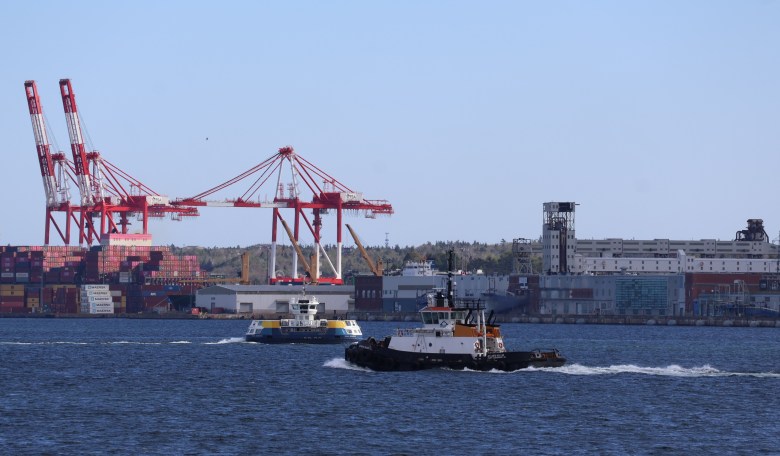 The Woodside ferry and a tugboat in front of the Port of Halifax in May 2025. Credit: Suzanne Rent
Construction work on the Woodside ferry terminal starts tomorrow and will wrap up on Aug. 13.
From a Halifax Regional Municipality press release:
The work will take place in phases over the coming weeks and includes replacing the concrete bus bays and platform installing new signage and tactile accessibility features as well as improving pedestrian connections.
Work at the bus bays will take place on weekends between 7 am and 6 pm During this time, Bays 1 to 4 will be closed, and buses will service temporary stops located on the north side of the bus loop. Access to terminal parking and the main entrance will be maintained throughout construction. A designated drop-off area for passengers will also be available near the terminal entrance.
There will also be work on a new sidewalk and bus loop at the ferry terminal in the coming months.
(Send this item: right click and copy this link)
2. Can you guess if this model is a real woman or AI?
 An AI model that is being used in ads for Guess in the August 2025 edition of Vogue. Credit: Seraphinne Vallora
Yasmin Rufo at BBC has this story about a new model that’s being used in ads for Guess in the August 2025 edition of Vogue.
The model isn’t real but rather AI generated. And the use of an AI model is also generating all kinds of concerns about unrealistic beauty standards. From Rufo’s story:
Seraphinne Vallora is the company behind Guess’s controversial advert.
Its founders, Valentina Gonzalez and Andreea Petrescu, tell the BBC they were approached by Guess’s co-founder, Paul Marciano, on Instagram and were asked to create an AI model as part of the brand’s summer campaign.
“We created 10 draft models for him and he selected one brunette woman and one blonde that we went ahead and developed further,” Gonzalez says.
I thought that photo on the left was actress and model Denise Richards. Can she sue that company for use of her likeness?
But there are all kinds of issues with statements made by the women who created this AI model. First, there’s this line: “[Valentina Gonzalez] explains there’s often a misconception that AI image generation is simple, saying it is actually a complex process.”
Stealing other photographers’ work and perhaps even the image of an actual model and actress is theft, which is pretty straightforward.
Secondly, using AI models will put real models out of work. Not all models are supermodels who make big money, by the way. On its website, the company lists one of the benefits of working with them as they eliminate “the need for expensive set-ups, MUA artists, venue rentals, stage setting, photographers, travel expenses, hiring models.”
Next, there are these lines: “We’ve posted AI images of women with different skin tones, but people do not respond to them — we don’t get any traction or likes” and “The company is yet to experiment with creating plus-size women, claiming “the technology is not advanced enough for that.”
Rofu spoke with Felicity Hayward, who is a plus-sized model who’s worked in the industry for a decade. Hayward said the use of AI models “feels lazy and cheap.” That’s because it is lazy and cheap, although the company that generates these AI models gets paid six-figures from their clients.
I’ve been enjoying more recent fashion and beauty campaigns that feature diverse women as the models. These women have different figures, are of different races and ethnicities, and have different hairstyles. We were seeing more women with tattoos, stretch marks, and so on. It all reflected how woman actually look, and it sold clothing and products because women could see how fashion works specifically for them.
I’m disappointed that women are creating AI models but am honestly not surprised. Despite recent improvements in diversity in the industry, it’s long been an industry of grifters profiting off of making women feel badly about themselves.
Let’s call out this latest AI grift.
(Send this item: right click and copy this link)
RECENTLY IN THE HALIFAX EXAMINER:
1. Community rallies to support Eddie Carvery after Africville Museum issues eviction notice
 Eddie Carvery outside his trailer on July 28, 2025. Credit: Madiha Mughees
Madiha Mughees reports:
Eddie Carvery has been issued an eviction notice from his Africville protest.
In response, to show solidarity, Carvery’s supporters and family gathered at noon on Monday at the site where he has protested for nearly 55 years following the destruction of the Africville community by the city.
Several prominent social justice advocates and community groups including representatives from Labour For Palestine, could be seen at the protest site on Monday.
As Mughees reports, the eviction notice came from the Africville Museum, which gave Carvery a deadline of midnight of July 13 to leave the site. He’s still there, and was issued a $25 parking ticket on July 14.
Mughees asked Juanita Peters, the executive director of the Africville Heritage Trust Society, which operates the museum, for comment, but hasn’t yet received a statement about the eviction.
On Monday, Carvery, who is 78, spoke to the media that gathered at the site. From Mughees’ story:
“Been a long time, it’s been a hard protest. Should’ve never happened. They were racist towards us. The institutions that they installed around us were negative and poisonous,” Carvery said.
He listed all the injustices inflicted upon the residents, including the harsh environmental racism that the community faced.
“They gave us such things like a city dump that turned out to be a toxic dump in our community for over 20 years, and it became a rodent party,” Carvery said.
Carvery’s grandson, Eddie Carvery III, told media that Africville Heritage Trust and the Africville Genealogy Society don’t represent the sentiments of the displaced Africville residents. He said he wants the community reestablished at Africville or someone else.
Click or tap here to read “Community rallies to support Eddie Carvery after Africville Museum issues eviction notice.”
(Send this item: right click and copy this link)
2. Shawn Cleary asks for report on use of Halifax police investigation reserve fund
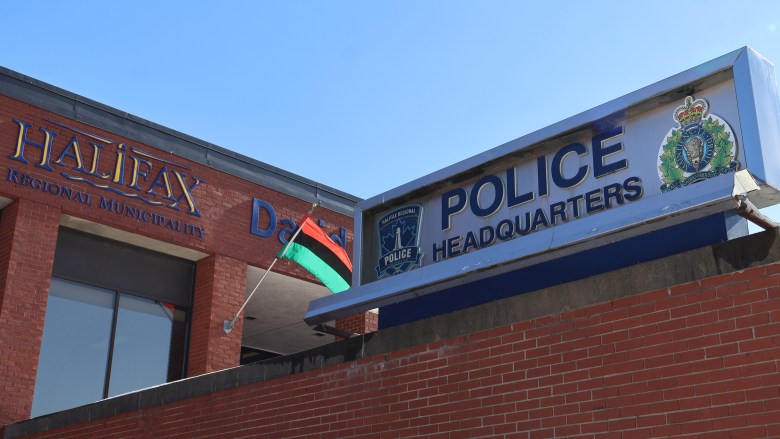 Halifax Regional Police headquarters on Gottingen Street. Credit: Suzanne Rent
My recent reporting on Halifax regional council meetings has focused a lot on strong mayor powers and bike lanes. That means I missed some debates that are important and interesting. So, my latest article from council is me catching up on some of what I missed.
That includes a debate on an extraordinary investigation fund for Halifax Regional Police (HRP). That fund was mentioned in this report on Halifax Regional Municipality reserve funds. Through the extraordinary investigation reserve, HRP have access to $2 million for larger, more expensive investigations not covered under the police budget.
According to the report, that reserve fund will be replenished each year, “if necessary.”
But Coun. Shawn Cleary had concerns about how the reserve is used, specifically that it was up to the police chief discretion on how the funds are spent. From the story:
Cleary said HRP should be required to report on the rational for using reserve funds and if those funds were used in a “responsible” manner.
“Essentially, this could be a backdoor way of increasing the police budget by $2 million every year,” Cleary said. “I’m not comfortable with that at all. I think this is a very dangerous road to go down without the proper guardrails.”
HRP deputy chief Andrew Matthews was at that meeting and spoke about about the process for how reserve funds are spent:
Matthews said spending on major investigations are budgeted to include all requirements, including surveillance, communication, and gas for vehicles.
“We’ve had investigations that have cost hundreds of thousands of dollars and some that are approaching a million dollars,” Matthews said. “[Investigations] can go on for years, depending on the complexity, how much we have to invest, and how long investigative leads take to ferment.”
Cleary introduced a motion requesting a supplementary report that will include recommendations for guardrails for use of the reserve fund in accordance with the HRM Charter, the Police Act, and bylaw P100, which deals with the police board’s role.
Council voted unanimously in favour of that motion.
Click or tap here to read “Shawn Cleary asks for report on use of Halifax police investigation reserve fund.”
(Send this item: right click and copy this link)
IN OTHER NEWS
1. Discounts on ferry trips and bridge tolls
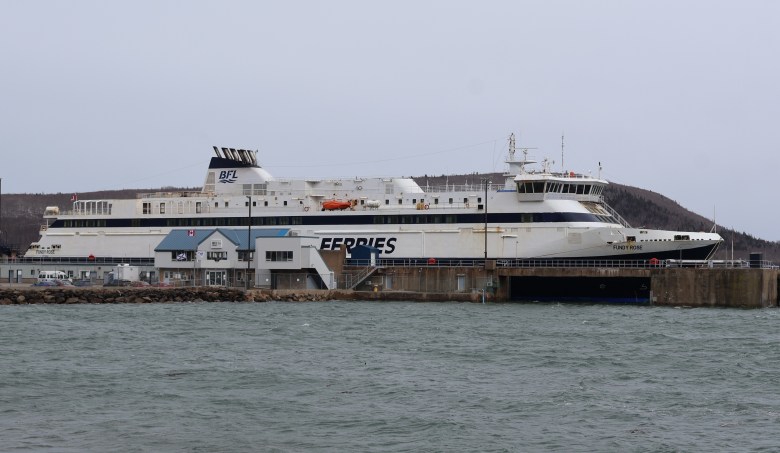 Ferry terminal in Digby in February 2025. Credit: Suzanne Rent
Alex MacIsaac at CBC reports:
The federal government is slashing tolls on the Confederation Bridge and lowering ferry fares in Eastern Canada, Prime Minister Mark Carney announced while in P.E.I. on Monday.
Effective Aug. 1, the cost of crossing the bridge, which connects P.E.I. with New Brunswick, will fall to $20 from $50.25. Transport trucks will also pay a flat rate of $20. There’s no change in the cost for cyclists, pedestrians, shuttles or motorcycles.
Fares for ferries will also be cut by 50%. That applies to the following ferry services:
Magdalen Islands, Que., and Souris, P.E.I.
Wood Islands, P.E.I., and Caribou, N.S.
Saint John, N.B., and Digby, N.S.
From MacIsaac’s story:
Fares for passengers and vehicles on the ferry that operates between Nova Scotia and Newfoundland and Labrador are also going down. Ottawa has pledged to increase funding to the operator, Marine Atlantic, to lower the price by 50 per cent. Ottawa is also freezing commercial freight rates on that route.
I don’t have any commentary on this news other than to say I took my daughter to the Magdalen Islands when she was about seven. We took the five-hour ferry trip from Souris, and I highly recommend a visit to the island. Such a lovely spot and great for a bike trip, too.
(Send this item: right click and copy this link)
Government
No meetings
On campus
Dalhousie
Tuesday
PhD Defence: Process Engineering and Applied Science (Tuesday, 9:30am, hybrid) — Oladimeji Adewusi will defend “Effects of Culture Conditions on Phytosterol Content of Selected Microalgae species and the Development of a Chlorophyll-Based Rapid Screening Pipeline”
Wednesday
PhD Defence: Computer Science (Wednesday, 8am, online) — Md Mahbub Alam will defend “Spatio-temporal Learning of Vessel Trajectories from AIS Data Using Multi-modal Clustering and Physics-informed Forecasting”
PhD Defence: Mathematics and Statistics (Wednesday, 9am, online) — Xinyue Zhang will defend “Latent Structure Identification and Personalized Variable Selection”
Literary Events
Plum Poetry Night (Tuesday, 7pm, The Maxwell’s Plum, Halifax) — details
In the harbour
Halifax
05:30: Oceanex Sanderling, ro-ro container, arrives at Autoport from St. John’s
06:00: CMA CGM Paranagua, container ship, arrives at Pier 41 from Montréal
07:00: One Minato, container ship, sails from Pier 41 for Singapore
07:30: Virginia Ann, offshore supply ship, arrives at Pier 9 from sea
07:30: Viking Neptune, cruise ship with up to 928 passengers, arrives at Pier 22 from New York, on a 14-day cruise from New York to Reykjavik
08:00: M&Em, yacht, sails from Museum Wharf right into the orcas
13:30: MSC Daisy, container ship, sails from Pier 42 for sea
15:30: AS Felicia, container ship, arrives at Fairview Cove from New York
16:30: CMA CGM Paranagua sails for sea
16:30: Viking Neptune sails for L’Anse aux Meadows
16:30: Don Carlos, car carrier, arrives at Autoport from Southampton, England
16:30: Algoma Acadian, oil tanker, arrives at Irving Oil from Saint John
Cape Breton
07:00: Leo A. McArthur, tug, transits through the causeway, en route from Hamilton, Ontario to Halifax
09:00: AlgoScotia, oil tanker, arrives at Sydney Marine Terminal from Corner Brook
09:30: Rt Hon Paul E Martin, bulker, sails from Coal Pier (Sydney) for sea
11:00: Baie St.Paul, bulker, arrives at Aulds Cove quarry from Bécancour, Québec
15:00: Advantage Atom, oil tanker, arrives at EverWind from Teesport, England
21:00: AlgoScotia sails for sea
Footnotes
On Monday morning, I was in downtown Dartmouth for an appointment and then taking some photos for our media library when I met Mabel and her owner, whose name I didn’t get.
It was hot on Monday and Mabel had the right idea to lie in the shade under a big tree on the Dartmouth Common. I wanted to join her but I think she enjoyed her peace.
 Mabel under a tree in the Dartmouth Common on July 28, 2025. Credit: Suzanne Rent