
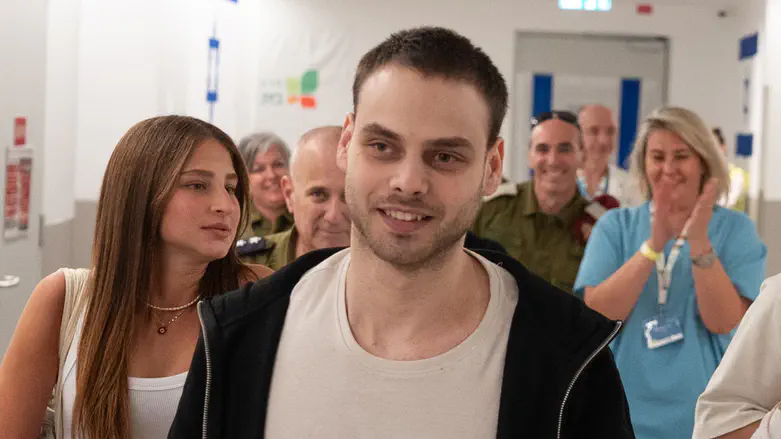
In a detailed account aired on Monday by Channel 12, Israeli captivity survivor Alon Ohel described months of brutality, deprivation, and resilience during his captivity in Gaza. Ohel, 22, recounted his determination to survive from the moment he was abducted, saying he held onto an inner belief that he would return home.
“I knew I would come back to my mother in the end,” he recalled.
Ohel said that despite the constant physical and emotional strain, he clung to his sense of choice. “In Gaza, they took away my freedom of movement, freedom and liberty, but not my ability to choose,” he said. He recalled advice from fellow hostage Eli Sharabi, who became a father figure to him: “To break is okay, but never lose hope.”
Ohel recounted fleeing the Nova music festival as rockets began to fall. “We thought it would end, but then we heard Kalashnikovs. You just wait for your death,” he said. He described witnessing fellow Israeli Aner Shapira throw grenades out of a shelter until he was killed. Ohel believes one of the explosions caused the injury to his eye.
Forced into a vehicle and taken across the border, he recalled the shock of suddenly finding himself in Gaza. “They threw me like a sack of potatoes into a truck… I said to myself: ‘Am I dreaming?'”
Ohel said he and other hostages were taken to a hospital and then to a house where they were stitched without anesthesia and forbidden to speak. “They tore me from reality and put me in hell,” he said. He described months of starvation and confinement: “Chained like an animal, eating like a dog. You’re not a person there.”
He recounted surviving on minimal food. “We ate a pita and four spoons of peas a day. Sometimes, only dry dates. You look at yourself and see a corpse.”
Ohel described forming a close bond with fellow hostage Eli Sharabi. “From the first moment, we connected,” he said. When he injured his hand in frustration, “Eli hugged me, it was a father’s hug.” Ohel said they promised each other to stay alive for their families.
The two were at times chained together. “We did everything together,” he said, describing how they endured bombings and relocations from one tunnel to another.
Ohel said he was eventually separated during a hostage exchange phase. “All my fears came true,” he said. After Sharabi and others were taken, he was left alone. He described increased threats from guards, including sexual harassment. “He came to wash me in the shower… he touched me,” Ohel said. “Luckily, it didn’t go further.”
He said the captors later improved his food supply after negotiations stalled, fearing negative publicity. They gave him an English copy of Harry Potter. “I skipped the last chapter. I told myself: ‘This is not my end.'”
After months underground, Ohel was moved to southern Gaza. There, he encountered another hostage he recognized from his military service. They were told to write letters home. “I wrote that I love them, that I’m alive and breathing, and that they’re my strength to survive.”
Hamas commander Izz al-Din al-Haddad eventually entered and told the hostages: “You’re leaving.” Ohel was handed to the Red Cross. Ohel said the representative apologized, adding that the organization had done nothing.
Only when he saw IDF reservists outside the vehicle did he feel safe. “You see who fights for you. It kills you,” he said.
When reunited with his family, he tried to appear composed. But he broke down upon learning that Sharabi had lost his entire family on October 7. “I knew them,” he said through tears.
Reflecting on his release, Ohel said: “For two years, I was a dead person. I prayed for someone to rescue me. But I discovered I’m strong. I’m not a victim. I take what I went through and grow from it. I’m going to take on this world.”