
People relying on food banks to survive have reached unprecedented numbers in Ontario as residents sink further into poverty even while working, a new report states.
Feed Ontario released their annual Hunger Report on Monday, warning that while food banks are working tirelessly to meet the record-high demand, the need is outpacing the resources available.
“We’ve reached an all-time record high with more than one million people needing to turn to food banks in the province,” Carolyn Stewart, Feed Ontario CEO, told CTV News Toronto on Monday. “It’s really showing us that as the affordability crisis is growing; it’s pushing more families from just getting by to barely holding on.”
With a total of 1,007,441 food bank users this year alone, Stewart said food bank use reached the highest number on record since the organization started collecting the data, marking an 87 per cent increase from 2019.
The report found there was a total of 8.7 million visits to food banks between April 2024 and March 2025, which marks a 165 per cent increase since 2019. It added that of the visitors, one in three were children, one in three were people with disabilities and one in four were employed but could not earn enough, which marks an 83 per cent increase since 2019.
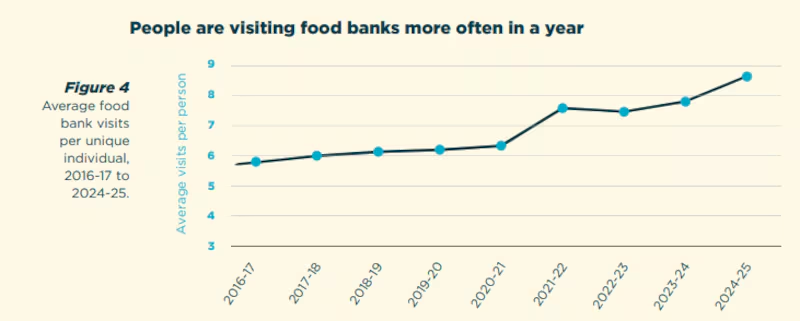 food banks The 2025 Hunger Report released on Dec. 1 reported that food bank use in on the rise in Ontario. (Hunger Report)
“If food banks fail, the consequences are going to be significant,” Stewart said. “People turn to a food bank after they’ve exhausted all their other options, when there’s nowhere left to turn. If food banks reduce services, which we are already starting to see right now, the only option for folks is to skip meals or go without.”
The report states that two in three food banks are concerned about sustaining their operations over the next six months and one in two say they are worried they won’t have enough food to meet their community’s needs.
Ryan Noble, the executive director of North York Harvest Food Bank, told CTV News Toronto on Monday that his organization, which works as a distribution hub to provide local agencies with food, is struggling to cope with the increasing needs.
“It puts a tremendous strain on the front lines, on those agencies where people are coming to get food,” he said. “It puts a tremendous amount of strain in terms of the amount of food that we need to source, but also our capacity to manage that food.”
“The common denominator, unfortunately, is that we are all suffering under a crisis of affordability and lack of affordability, and as a result, more and more people aren’t able to get by.”
Having a job is not enough to survive in Ontario anymore amid skyrocketing housing prices and rising food costs, Stewart said, adding that employed adults are the fastest-growing group of food bank visitors.
The report found that 88 per cent of people using food banks are financially stressed due to the cost of food and housing as the average rent for two-bedroom apartments in major cities like Toronto rises to more than $2,690, according to Statistics Canada.
The report presented data that showed that when food bank use goes up in Ontario, a rise in homelessness and healthcare costs follows. The report stated that several studies show that food bank use increases significantly for individuals before they become homeless as it allows them to redirect their money toward rent and housing costs.
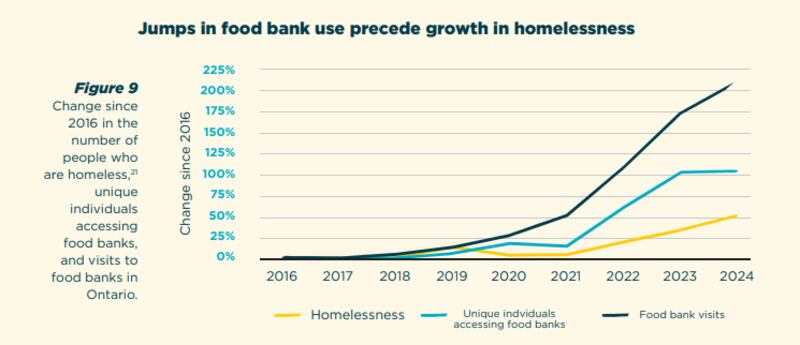 hungr The 2025 Hunger Report released on Dec. 1 stated that as food bank use increases, increases in homelessness follow. (Hunger Report)
In 2022, a McMaster University study found that only four per cent of Hamilton households turning to food banks had access to stable housing, and that nearly half (46 per cent) said they would most likely be homeless without food bank support.
“Spikes in food bank demand tend to precede spikes in homelessness,” the report stated. “The average number of food bank visits per person has increased by 13 per cent, a warning sign that another surge in homelessness is on the horizon.”
The report noted the numbers they have described do not reflect the true scale of the problem and that the issue is much worse as their data only looks at traditional food bank use.
RELATED STORIES: