
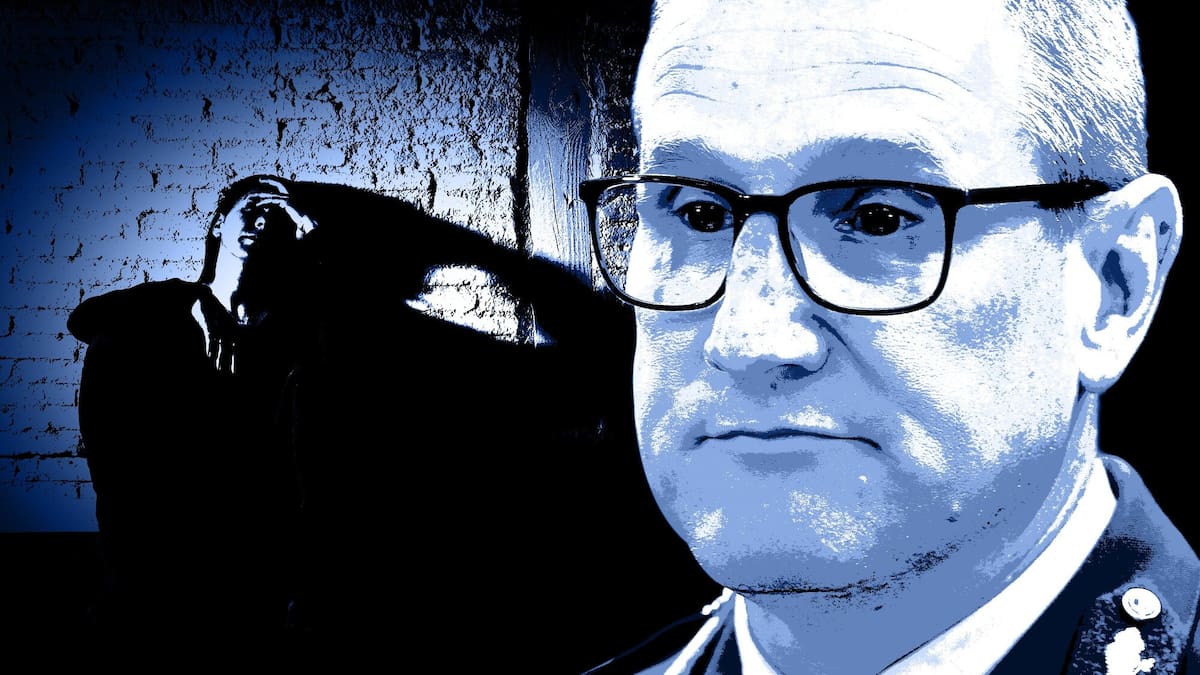
Last month, senior Herald reporter Jared Savage broke the story of how police top brass prosecuted a young woman for sending anonymous emails about Jevon McSkimming, instead of investigating her allegations of sexual misconduct against the deputy commissioner.
This is Ms Z’s story.
There
was an unexpected knock at the door. When the young woman answered to find a senior detective waiting outside, she soon realised he wanted to talk about Jevon McSkimming.
For years, she had sent anonymous emails making serious allegations of a sexual nature about McSkimming, while he kept climbing the ranks to become the second-most-powerful police officer in the country.
The 52-year-old was now on the cusp being the next Police Commissioner.
So while the detective’s visit in May 2024 was a surprise, the young woman thought he might ask if she wanted to make a formal complaint against McSkimming.
“He said ‘I think you know [what this is about]’,” the woman told the Herald.
“Then he took my phone out of my hand while I was standing at the door … and I realised they were going to arrest me instead.”
The detective had read the emails, and did want to talk to her about Jevon McSkimming: the Deputy Commissioner had made a formal complaint against her.
While McSkimming had admitted a consensual affair with the woman, he denied any criminal wrongdoing – and maintained her sex allegations were motivated by revenge after the relationship ended badly.
For years, this narrative was accepted by McSkimming’s peers largely without question.
So instead of investigating the woman’s serious accusations, the police used the anonymous emails as evidence to prosecute the woman for an alleged campaign to destroy his career.
She was arrested and charged under the Harmful Digital Communications Act, placed under restrictive bail conditions and silenced by wide-ranging suppression orders for nearly 18 months.
But the failure of the highest-ranking police officers in New Zealand to investigate her repeated allegations against McSkimming, ostensibly to protect his career, was condemned in a scathing report by the Independent Police Conduct Authority this month.
The fallout has been seismic.
Former Police Commissioner Andrew Coster is currently on leave from his new government job, while his successor Richard Chambers has apologised to the young woman (called Ms Z in the IPCA report) on behalf of the organisation.
“She was ignored and badly let down,” Chambers said. “That was unacceptable.”
Senior officers have since left the force under a cloud, others are under employment investigation for bringing the police into disrepute.
In a bid to restore the public’s battered trust and confidence in the police, the Government has agreed to implement all the IPCA recommendations to increase scrutiny of poor behaviour.
This will include the establishment of an Inspector-General position to be given far-reaching powers to investigate.
While the McSkimming debacle has erupted into one of the biggest scandals in the history of the New Zealand Police, the woman at the heart of the case has kept quiet until now.
“I’ve been bullied into silence,” Ms Z told the Herald in an exclusive interview.
“No matter what I said, no one was really interested to know whether there was any truth to the allegations.
“My life has been so damaged by this … it’s an ongoing nightmare.”
McSkimming and Ms Z met through a sports club.
While each gave a “markedly different” account of the nature of the relationship to the IPCA, it was common ground that their interactions became more frequent from early 2016 onwards.
She was a 21-year-old student, he was a 42-year-old police superintendent.
McSkimming would often go out of his way to spend time with her, Ms Z said, although she was blithely unaware of the intentions of the much older man.
They would practise at the club together, alone, and she said McSkimming would offer to drive her places she needed to go, even if she had other plans.
During these hours alone, Ms Z said McSkimming would share deeply personal information about his family, claiming his marriage was over, sharing his health issues, or boasting about his career.
Much later she learned that many of the stories were greatly exaggerated, or simply untrue.
On social occasions at the club, Ms Z claims that McSkimming would encourage drinking games, or invite members out for a night out on the town.
“I remember drinking in Police National Headquarters before going to some clubs in Wellington…it was Jevon and a bunch of 20-somethings from the [sports] club,” Ms Z said.
“I wasn’t interested in him, or hoping for a relationship or anything like that. Looking back, he was grooming me.”
Over time, the relationship became sexual. Ms Z says alcohol was a factor in their first physical encounter, and claims McSkimming had been persistent in his advances.
From that point on, Ms Z alleged that McSkimming became a constant and controlling presence in her life.
By now, McSkimming had been promoted to Assistant Commissioner and put forward Ms Z’s name for a job as a casual employee.
He then personally requested that Ms Z work from the central Wellington station, rather than the Police College at Porirua where the role was based.
It just so happened that the central station was much closer to Police National Headquarters where McSkimming worked.
Ms Z said that he would turn up at work unannounced to see her, which on one occasion she alleged, led to unwanted sexual contact inside the police station.
Other times he would insist they meet after work, Ms Z claimed, sometimes at hotels where he was staying the night despite living on the Kapiti Coast.
She said the texts and phone calls were frequent at times, then there would be periods of radio silence.
McSkimming was emotionally manipulative – including threatening to kill himself – and would make degrading comments about her appearance, Ms Z alleged, which further undermined her confidence.
She left her job in the police in January 2018 and the contact ceased a few months later.
Former Deputy Police Commissioner Jevon McSkimming at a justice select committee in Parliament in 2024. Photo / Mark Mitchell
Asked why she didn’t make a formal complaint to police, or cease contact with McSkimming earlier, Ms Z told the Herald that he “just kept forcing himself into my life”.
“I just got sucked down by him, I couldn’t keep my head above water…I got stuck in something that I couldn’t get out of.”
Even after the sexual relationship ended, Ms Z said McSkimming persistently tried to contact her for months afterwards.
She said he warned her to keep quiet about their relationship.
If not, Ms Z alleged that McSkimming threatened to release unsolicited explicit photos of her online.
“He was scared about his job, so he bullied me,” Ms Z alleged.
“He told me that no one would ever believe me, it was his word against mine.
She claimed he told her ‘I know how to destroy your life’.
In September 2018, a “Michelle Miller” posted the following message on Facebook:
“To all young females, you must be careful of Jevon McSkimming who is ironically an Assistant Commissioner of Police. He has previously preyed on a young female who he lured in with countless lies and manipulation – all for his sexual gain. He has admitted this by stating he ‘used’ her and ‘treated her like shit’. He threatened to post images of her online to keep her from exposing the truth about him.”
The New Zealand Police and the IPCA were tagged in the message.
It was the first anonymous allegation against McSkimming. He had already privately admitted the relationship to his wife earlier in the year, as well as two supervisors at work.
He had described the relationship as an affair which had ended badly, with the woman now threatening and blackmailing him.
These “harassing emails”, McSkimming told his supervisors separately, were from the woman trying to convince him to return to her.
The supervisors both asked if the woman was a police employee.
McSkimming said no. He was told to declare the relationship in any future vetting for security clearance, but no further action was taken.
The anonymous emails and social media posts kept coming. The language used was often graphic, and dramatically increased in number between December 2023 and January 2024.
The emails were sent far and wide including senior police officers, such as Police Commissioner Andrew Coster, government ministers and various media outlets.
A recurring theme in the emails was that McSkimming was a sexual predator who targets young women.
At this time, McSkimming had been promoted to Deputy Commissioner.
He had disclosed the relationship to Andrew Coster, who had been appointed as Police Commissioner in April 2020, with the same narrative: the emails were a campaign by a “woman scorned” who wanted to resume the relationship.
Out of concern for McSkimming, as well as the mental health of the woman, Coster ordered that the emails be referred to the Fixated Threat Assessment Centre (FTAC).
The FTAC is a joint initiative between the police and mental health professionals to assess interventions, such as treatment or law enforcement, to manage the risks posed by individuals with an “obsessional pre-occupation”.
The detective assigned the case then reviewed 237 emails dating back to July 2023.
In his analysis report, the detective concluded that the emails probably did reach the threshold of harassment or offences under the Harmful Digital Communications Act.
However, he also highlighted 16 examples of emails that contained allegations of sexual crimes or breaches of the police code of conduct by McSkimming, such as the misuse of police credit cards to pay for hotels.
In his four-page report presented to Deputy Commissioner Tania Kura in February 2024, the detective recommended the matter be sent to the National Integrity Unit, which investigates police officers, or the IPCA for further inquiries.
In turn, Kura forwarded the report to Detective Superintendent Chris Page, who was the acting Assistant Commissioner in charge of investigations, and later verbally briefed Coster.
Police Commissioner Andrew Coster, right, and Deputy Commissioner Jevon McSkimming in 2020. Photo / NZ Police
No one notified the NIU or the IPCA. Instead, the police focused only on Ms Z.
She was arrested in May 2024 and charged under the digital harassment laws, which carry a maximum penalty of two years in prison or a $50,000 fine.
Despite no investigation into the veracity of the sex claims made by Ms Z, police described the emails she sent as containing “false” allegations, according to documents which underpinned the prosecution against her.
All details of the prosecution were suppressed on the grounds of preventing “further harm” to McSkimming, which in effect protected his reputation as he prepared his bid to become the next Police Commissioner.
“This was all incredibly distressing,” Ms Z told the Herald.
She had never been to court before, and the unfamiliar process disrupted other aspects of her life.
The spectacle of police searching the house where she lived made things uncomfortable, while the ongoing appearances at court impacted her ability to work.
Without any family support, Ms Z felt she had no choice but to leave her job – and struggled to find a new one while the prosecution was ongoing – while her legal bills kept mounting.
“I was losing my life savings and my career was being badly damaged too.”
The career of Jevon McSkimming, however, never looked brighter.
When Coster announced in July 2024 that he would step down, McSkimming and Assistant Commissioner Richard Chambers were widely considered the two favourites to replace him.
Behind the scenes, things were more complicated.
About a month after Ms Z was charged, Kura belatedly realised that police should investigate the allegations in her emails and spoke with Assistant Commissioner Paul Basham.
The pair agreed to bring in Detective Inspector Nicola Reeves, an experienced investigator from Christchurch, to handle the case.
The terms of reference were drafted up by Page, who took a deliberately cautious approach because of McSkimming’s intention to run for the top job.
In fact, the parameters were in stark contrast to established protocols for how police investigate sexual assault complaints.
Reeves was ordered to report directly to Basham, which is unusual for a criminal investigation as she would normally report to the regional superintendent in charge.
She was having trouble making progress and asked Kura and Basham for permission to contact Ms Z, which is standard procedure.
“If we get wind of anything, any kind of complaint, that’s what the police do. We would contact someone and go: ‘Hey what’s going on. Is there something that you want to talk about?’” Reeves later told the IPCA.
Basham repeated on a number of occasions that McSkimming had applied for the top job, Reeves told the IPCA, and that if the matter wasn’t resolved soon, he would miss out.
“I personally think it should be very simple in every police officer’s world,” Reeves told the IPCA.
“Doesn’t matter who the hell you are. We speak to the person, take a complaint and investigate it. It’s all very simple.”
Reeves was given permission to speak with Ms Z, and the pair exchanged emails in September 2024.
Detective Inspector Nicola Reeves is an experienced investigator based in Christchurch. Photo / George Heard
Ms Z was cautious in her communication with the senior detective.
She sought legal advice about the potential impact speaking with police might have on her own prosecution, worried that whatever she said could be used as evidence against her.
She also feared the organisation was still trying to protect McSkimming.
“I thought it might have been a tick-box exercise.”
Reeves had also contacted the IPCA about the investigation, which was part of the standard complaint process.
Alarmed, the IPCA contacted Detective Superintendent Kylie Schaare, the director of Integrity and Conduct, to question why the police watchdog had not been notified earlier.
Schaare was also unaware of why the standard complaint processes had been bypassed for “quite some time”.
Without a formal complaint, the investigation was closed in September.
The same month, Schaare received a phone call from Coster. He asked whether she knew of any “open investigations” into McSkimming.
Schaare believed the query was prompted by McSkimming’s application to be the next Commissioner.
She checked the professional misconduct database and texted Coster back to confirm there were no “open” complaints.
However, Schaare voiced her concerns about how the usual processes had not been followed, with no record of the complaint or what had been done.
Coster replied that he understood from Kura that the “intent” was to record the complaint, but he was unsure why this had not occurred.
“To be clear, I don’t think there ever was a complaint. The woman never identified herself to us,” Coster wrote.
“However, through Jevon’s transparency on it, we knew who she was and proactively approached her … there was still no complaint forthcoming to back up her various email allegations sent from a variety of email addresses with made-up names.”
Detective Superintendent Kylie Schaare raised her concerns about the case directly with the Independent Police Conduct Authority. Photo / RNZ
Still concerned about what was happening, Schaare contacted the IPCA herself in October, which prompted a new investigation to be opened by the National Integrity Unit.
That meeting set in motion an explosive chain of events where Coster – still believing McSkimming to be a victim of harassment – tried to shape the fresh inquiry to conclude before the appointment process for the next Commissioner ended.
“I really thought that the idea of rushing through some sort of quasi-investigation was fraught with risk, particularly given the position that Jevon McSkimming was applying for and how that might later play out,” an NIU officer told the IPCA.
“The Commissioner talked about natural justice for him and my first thought at that point [was], well, if there’s any substance to what [Ms Z] is saying…how about justice for her?”
McSkimming missed out on the top job to Chambers in November 2024, and was quietly sent home on special leave as the new investigation ramped up.
Around the same time, Ms Z was interviewed by NIU detectives on three occasions.
The investigation centred on her complaints of multiple sexual offence allegations, including sexual violation by rape, sexual violation by unlawful sexual connection and indecent assault.
The 52-year-old McSkimming was formally suspended on full pay just before Christmas.
But he maintained his innocence and, in a statement issued by his lawyers the following month, said he expected to “resume his duties” after being cleared by the criminal investigation.
However, the saga was about to take another twist. Detectives discovered that McSkimming had used his police-issued work devices, primarily an iPhone, to search the internet for thousands of pornographic images.
A total of 2945 were classified as objectionable, including bestiality and child sex exploitation material.
His internet history dated back five years, with McSkimming often searching explicit terms during work hours.
When he became aware of the investigation into his internet use, McSkimming confessed to a colleague that police had found porn on his laptop.
“He said that he had found a way around the normal police systems to look at porn and that he grew up in a house where pornography was normal,” according to court documents.
“He also spoke with another colleague and said that over the years he had needed different types of pornography to make him feel anything and it just kept escalating.”
When confronted by the existence of the objectionable material in early May, McSkimming chose to resign as deputy commissioner.
If McSkimming had not fallen on his sword, Police Minister Mark Mitchell said he would have sacked him anyway.
He was eventually charged in July with possession of objectionable material, which carries a maximum penalty of 10 years in prison.
Ms Z was “incredibly disturbed” by the discovery of such extreme content on his phone.
Jevon McSkimming in the dock at the Wellington District Court on charges of possession of objectionable material. Photo / Mark Mitchell
Then in September, nearly a year after the investigation started, senior detectives met with Ms Z and told her there was insufficient evidence to prove the offences to the criminal standard of beyond reasonable doubt. He wasn’t going to be prosecuted.
She was disappointed. Criminal charges would have been an official acknowledgement that someone believed her over McSkimming.
She said it was unfortunate that the Crown had taken the position that if sex charges were laid against McSkimming, then her trial for the emails would be postponed until his prosecution was over.
“I was particularly angered by that … I needed to be able to make decisions in my life and it was going to drag on and on.”
A few weeks later, the Crown finally withdrew the Harmful Digital Communications Act charge laid following McSkimming’s complaint against her.
Ms Z told the Herald there were several reasons why she resorted to sending hundreds of emails, instead of making a formal complaint.
Knowing what police culture was like, she was worried the existence of any subsequent investigation would leak. If word spread around Wellington, Ms Z was concerned it would harm her career prospects.
She was also fearful police would discover unsolicited explicit images of her on McSkimming’s phone, or alternatively they wouldn’t find evidence to corroborate her version of events.
“It was his word against mine, and now he’s risen to the top ranks of police. I was scared of how he might retaliate.”
Sending the emails was Ms Z’s way of standing up for herself.
“You can’t gaslight or brainwash me. You’ve threatened me and I’m not just going to be silent,” Ms Z said.
“I thought he would at least be questioned about [the email allegations]. But he was obviously spreading this narrative [of the revenge campaign] around to protect himself.”
It was that largely unquestioning acceptance of McSkimming’s narrative which the police watchdog criticise Coster and other senior police leaders for, in a devastating report released in November.
The IPCA did not say whether McSkimming’s narrative was true, or not, and said that was irrelevant in making the findings.
And in considering the inaction of the former police executive, the IPCA said the significance of the report by the Fixated Threat Assessment Committee (FTAC) “cannot be overstated”.
The FTAC were provided the emails for the purpose of determining whether they could, or should, have a role in safeguarding McSkimming, not for the purpose of identifying any alleged wrongdoing by the deputy commissioner himself.
“Yet a detective read the emails and was sufficiently concerned by the allegations made in them, that he immediately raised the issue with his supervisor,” the IPCA wrote.
“Concerningly, some within the police failed to recognise that a possible victim of sexual assault, who had allegedly been told for years by a very senior police officer that she would not be listened to (and that explicit images of her might be distributed) if she tried to complain, might present as a desperate person sending sometimes extreme and abusive emails in an attempt to be heard.”
Police Commissioner Richard Chambers, left, and Police Minister Mark Mitchell answer questions about the IPCA report into how police handled the allegations against Jevon McSkimming. Photo / Mark Mitchell
While the entire episode has been distressing, Ms Z is grateful for the efforts of the IPCA to expose how McSkimming had manipulated the system to continue his rise up the ranks.
Sir Brian Roche, the head of the Public Services Commission, went so far as to call him a “devious liar”. Ms Z was also heartened by the public support for her and the response from the government to improve scrutiny of the police.
But in the wake of the IPCA report – and a subsequent audit which uncovered 20 cases of potential misuse of police devices – Ms Z believed the government should open a more powerful inquiry into police culture.
“I saw at the recent Police College graduation, Richard Chambers effectively said ‘I just want to move on’, repeatedly,” Ms Z said.
“But there is some concerning behaviour in the wider police which needs more scrutiny. The police need to change their attitudes.”
As for Jevon McSkimming, his remarkable fall from grace is nearly complete.
The man who nearly became the Police Commissioner pleaded guilty to possession of objectionable material and will stand in the dock at the Wellington District Court to be sentenced later this month.
McSkimming broke his silence to respond to Herald questions about Ms Z’s allegations, which he described as untrue.
In his first public comments for nearly 12 months, McSkimming said the relationship was a mutual and consensual one.
“She has engaged in a campaign of harassment against me for some years, since our relationship ended. These allegations are a continuation of that harassment,” McSkimming said.
“I intend to respond to Ms Z’s allegations and speak more fully about this matter in the future, but am unable to do so at this time.”
Jared Savage covers crime and justice issues, with a particular interest in organised crime. He joined the Herald in 2006 and has won a dozen journalism awards in that time, including twice being named Reporter of the Year. He is also the author of Gangland, Gangster’s Paradise and Underworld.
SaveShare this article
Reminder, this is a Premium article and requires a subscription to read.
Copy LinkEmailFacebookTwitter/XLinkedInReddit