
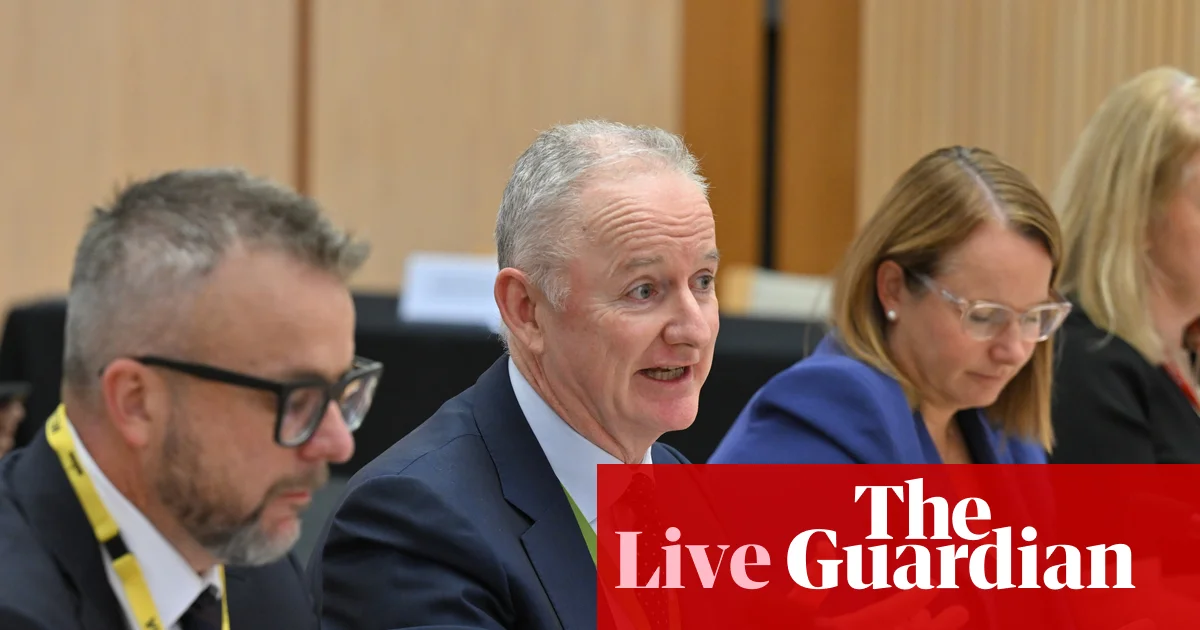
ABC boss rejects claims Patricia Karvelas is an ‘activist’ after host labelled Dutton ‘authoritarian’ in political analysis Amanda Meade
ABC managing director Hugh Marks is being asked by Coalition senators Jacinta Nampijinpa Price and Sarah Henderson to defend political analysis published by ABC News.
At Senate estimates, Price was critical of Afternoon Briefing host Patricia Karvelas for labelling former opposition leader Peter Dutton as an “authoritarian” in an online analysis last month.
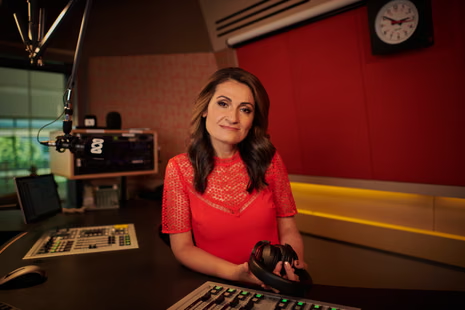 Patricia Karvelas. Photograph: Jackson Gallagher/The Guardian
Marks denied that Karvelas was an “activist” and said the highly experienced journalist had written a piece of political analysis about the internal Liberal discussion about net zero. He said:
I don’t think it would be activism. I think she’s trying to be factual and provide audiences with some context to the material she’s writing.
Anyone who watches Afternoon Briefing and reads her writing knows that she is incredibly objective and impartial. I would encourage people to read the raw article rather than going off the commentary that sat around it from Sky [News] and others.
Updated at 01.20 EST
Key events
Show key events only
Please turn on JavaScript to use this feature
NSW police charge 155 people at Rising Tide climate activist event
NSW police have said in a statement that 155 people were charged as part of an operation “conducted to ensure the safety of attendees and the wider community” at Rising Tide, a climate activism event in Newcastle.
It said:
100 were charged with “Disrupt/Obstruct Major Facility”,
52 were charged with “Breach Marine Exclusion Zone”,
Two were charged with “Boarding Vessel Anchored at Sea”, and
One was charged with “Reckless Wounding”.
Protesters at Rising Tide’s blockade. Photograph: Darren Pateman/AAP
In a statement, police said:
During the event, police called out the unsafe behaviour of several event attendees after witnessing a number of dangerous practices on the water.
The NSW Police Force recognises and supports the rights of individuals and groups to exercise their rights of free speech and peaceful assembly; however, the priority for NSW Police is always the safety of the wider community and police will not tolerate illegal and dangerous behaviour.
You can read more on the protests here:
Updated at 01.45 EST
ACT passes law to address Closing the Gap commitments
The ACT has become the first state or territory to legislate its commitments under the national agreement on Closing the Gap.
The independent for Kurrajong, Thomas Emerson, introduced the bill, which the ACT Legislative Assembly unanimously passed on Tuesday.
Emerson said in a statement:
This bill reframes our Closing the Gap commitments as core government business.
We’re nowhere near on track to meet our targets nationally, and here in the ACT the gap has remained stagnant or even widened in multiple critical areas.
We’ve been talking about Closing the Gap for the past 20 years, and I really believe the ACT can be the first state or territory to actually do it.
The Assembly’s unanimous support for this bill shows our community wants the ACT Government to act with greater urgency and ambition in improving life outcomes for Aboriginal and Torres Strait Islander people, at a time when other parts of the country are taking backward steps.
Updated at 01.27 EST
ABC boss rejects claims Patricia Karvelas is an ‘activist’ after host labelled Dutton ‘authoritarian’ in political analysisAmanda Meade
ABC managing director Hugh Marks is being asked by Coalition senators Jacinta Nampijinpa Price and Sarah Henderson to defend political analysis published by ABC News.
At Senate estimates, Price was critical of Afternoon Briefing host Patricia Karvelas for labelling former opposition leader Peter Dutton as an “authoritarian” in an online analysis last month.
Patricia Karvelas. Photograph: Jackson Gallagher/The Guardian
Marks denied that Karvelas was an “activist” and said the highly experienced journalist had written a piece of political analysis about the internal Liberal discussion about net zero. He said:
I don’t think it would be activism. I think she’s trying to be factual and provide audiences with some context to the material she’s writing.
Anyone who watches Afternoon Briefing and reads her writing knows that she is incredibly objective and impartial. I would encourage people to read the raw article rather than going off the commentary that sat around it from Sky [News] and others.
Updated at 01.20 EST
Police investigate teacher who allegedly stabbed colleague at Melbourne school
Victoria police is investigating after a teacher allegedly stabbed another staff member at a school in Melbourne’s outer south-east on Tuesday.
In a statement, police said a man was arrested after allegedly assaulting another man at a secondary school in Keysborough about 3pm. It is believed both men were teachers at the school.
In a statement, police said:
Officers quickly arrived on scene and arrested a man … [who] will be interviewed.
The victim was taken to hospital with non-life-threatening injuries consistent with a stabbing.
At this stage investigators believe the people involved are known to each other. The investigation remains ongoing.
Updated at 00.59 EST
Police car crashes in western Sydney
Seven News have reported that a police car has crashed into a property in Blacktown in Sydney’s western suburbs.
The footage from its helicopter confirms this.
Seven News’s helicopter footage. Photograph: 7NEWSShare
Updated at 00.47 EST
Queensland police investigating death in custody
Queensland detectives are investigating the death of a prisoner after an alleged assault by two other inmates at the Maryborough Correctional Centre last week.
According to a statement from police, about 9am on 26 November, a 28-year-old was “located unresponsive following a suspected altercation with two other prisoners”.
Police attended and declared a crime scene.
The 28-year-old person was transported to hospital for treatment, but passed away from their injuries on Monday, December 1.
Investigations into the incident leading to the person’s death are ongoing.
Updated at 00.32 EST
Boy, 15, dies on Surfers Paradise building site
The workplace watchdog will investigate the death of a teenage boy at a Surfers Paradise building site on Monday.
The ABC reported that Queensland police would also prepare a report for the coroner after the “sudden and non-suspicious death”.
According to a fundraising page related to the death, the boy, 15, died while working on the concreting site when he was struck by something that fell from a pump truck.
In a statement, Workplace Health and Safety Queensland (WHSQ) said:
WHSQ Inspectors attended the site and are investigating. No further comment can be made at this time.
Updated at 00.23 EST
No surgical abortion services available in southern NSW health district, budget estimates hears Natasha May
There are no surgical abortion services in a southern NSW health district, Greens MLC Dr Amanda Cohn has told NSW budget estimates.
The Murrumbidgee local health district chief executive, Jill Ludford, said the NSW Pregnancy Choice helpline and the district women’s health service directed women to where they could access the service, with the usual referral pathways to Wodonga, Sydney and Canberra.
Cohn told budget estimates that she had been advised Orange hospital was no longer seeing patients outside its district.
Ludford agreed that the situation was inequitable and said the district was committed to improving equity. She said the introduction of medical termination had been successful, but they were now facing challenges in providing surgical termination in the district. She said:
The issue we have faced is our four specialist obstetricians and gynaecologists really have their personal beliefs and values where they’ll only provide surgical termination to women who have complex medical or fetal conditions.
But we understand now the importance of balancing the rights of clinicians with the rights of women to access care. So we have made a commitment to bring stakeholders together to work on a reproductive health plan that makes our responsibilities clear about how we are going to look to provide a service using an alternative workforce and looking to see where we can provide that.
Updated at 00.22 EST
Natasha May
NSW Health confirms at least one site where mental health patients can’t see a psychiatrist
NSW Health has acknowledged there is at least one location in the state where mental health patients are unable to see a psychiatrist due to workforce shortages.
The shortages reached a boiling point at the beginning of the year when psychiatrists in the public system threatened to resign en masse, saying they were unable to keep working in such understaffed conditions, with the Industrial Relations Commission in October deciding that a special levy was necessary to avoid the “collapse” of psychiatric care in the state.
Dr Brendan Flynn, the executive director of the mental health branch of the NSW Ministry of Health, told NSW budget estimates that it was not necessarily required for psychiatrists to see every patient if a case manager (another allied health professional) and consumer were confident.
Greens MLC Dr Amanda Cohn said she was “aware of at least one location where the workforce situation has meant no patient sees a psychiatrist directly, where psychiatrists are limited only to secondary consultation to support existing staff”.
Flynn acknowledged that some patients were complex and needed to see psychiatrists directly. He said he was aware and concerned about the situation, but the government’s virtual psychiatry hub would allow psychiatrists to see patients across the state and help in these circumstances.
Updated at 00.11 EST
 Anne Davies
Sloane rejects claims of policy backflip after calling cashless gaming proposal ‘under review’
NSW opposition leader, Kellie Sloane, says there is no backtracking on Coalition gambling policy, despite telling the ABC earlier in the day that the Perrottet era cashless gaming proposal was “under review”.
A spokesperson for Sloane said: “Nothing has been watered down. The issue is that the technology has changed. Our policy will be announced closer to the election.”
A spokesperson later followed up with additional comment, saying: “There is no retreat from cashless gambling reform. Our commitment to reducing harm hasn’t moved. We’re looking at the policy before the election to reflect new technology so it’s practical, balanced and genuinely works”.
Kellie Sloane. Photograph: Dan Himbrechts/AAP
Sloane told the ABC earlier:
When the Coalition came to the last election, Dominic Perrottet, who was the premier at the time, proposed cashless gaming. That’s something we’ll review at the moment. But we’ve, we’ve had a strong and principled stand on that, you know, very happy to work with industry to look at a policy that will be, you know, have a real impact on the ground, a real and genuine reduction in problem gambling and harm, you know, harmful gambling practices in our state.
I think we have to review it, because the technology has changed in the last few years, but what we are committed to is addressing problem gambling; that hasn’t changed.
Updated at 01.45 EST
‘Adult time for violent crime’ laws for children incompatible with human rights, Victoria’s attorney-general admits Benita Kolovos
Victoria’s attorney-general, Sonya Kilkenny, has admitted the government’s “adult time for violent crime” bill is incompatible with the state’s charter of human rights.
Kilkenny introduced the bill to parliament on Tuesday, which, if passed, will uplift several serious crimes committed by children as young as 14 from the children’s court to adult courts. As a result, the maximum penalty for teenagers convicted of offences such as aggravated home invasions and carjackings will increase from three years to 25 years.
The bill has been roundly criticised by legal and human rights groups who say it will have a detrimental impact on already vulnerable young people and will disproportionately affect First Nations children.
Sonya Kilkenny and Jacinta Allan (right). Photograph: Joel Carrett/AAP
Even Kilkenny, in her compatibility statement tabled in parliament, admitted as much. Her statement reads:
The bill, as introduced to the Legislative Assembly, is in part, incompatible with the human rights set out in the Charter. The measures in the bill constitute significant limits on the fundamental rights of children who are by their nature a vulnerable cohort, which require a very high standard of justification in order to be compatible with rights.
While it is my strong view that the bill is necessary to address compelling and pressing community safety concerns brought about by unprecedented incidents of serious and violent offending by children, my acknowledgement of incompatibility accepts the inherent difficulty in meeting this high standard of justification.
The government has allocated just one hour to debate the legislation in the lower house before it is voted on. It will then be sent to the upper house, with Kilkenny and the premier, Jacinta Allan, telling reporters earlier this morning that the parliament would not rise until it passed. The Coalition have indicated they will support the bill.
It comes as more than 100 legal, human rights, social services and community groups signed a joint letter to Allan on Tuesday describing the changes as a “serious step backwards for Victoria”. It reads:
They ignore strong evidence about child development, rehabilitation and human rights, and will cause lifelong harm while making our communities less safe.
Updated at 00.08 EST
Anne Davies
NSW opposition reviews support for cashless gaming
The newly appointed NSW opposition leader, Kellie Sloane, is reviewing a long-held Coalition policy in support of cashless gaming for NSW, which was championed by the former Liberal premier Dominic Perrottet.
Perrottet backed the system as the best way to deal with problem gambling and money laundering of illegal cash through poker machines. But he lost government before it could be implemented.
The Minns Labor government trialled the technology in 2023 and a three-person executive committee reported in September 2024, but its recommendations have not been actioned, amid strong resistance from the powerful clubs and pubs lobby.
The executive committee recommended that the NSW government introduce a mandatory statewide account-based gaming system, with a phased implementation approach allowing for voluntary adoption until a centralised system is fully operational, estimated to be by 2028.
Speaking on ABC Sydney Radio 702 on Tuesday morning, Sloane agreed with a caller that there was “a lot of pain and harm caused by problem gambling” and said she supported the new restrictions on hours at gambling venues that came into force recently.
But she said she would review the proposal for the cashless gaming card because technology had moved on.
When the Coalition came to the last election, Dominic Perrottet, who was the premier at the time, proposed cashless gaming. That’s something we’ll review at the moment. But we’ve, we’ve had a strong and principled stand on that, you know, very happy to work with industry to look at a policy that will be, you know, have a real impact on the ground, a real and genuine reduction in problem gambling and harm, you know, harmful gambling practices in our state.
I think we have to review it, because the technology has changed in the last few years, but what we are committed to is addressing problem gambling; that hasn’t changed.
Updated at 01.52 EST
 Nick Visser
That’s all from me. Nino Bucci is back to take care of things for the rest of the afternoon. Take care!
Share‘Worst case scenario’ for incompatible triple zero Samsung devices on Optus at 470,000 Josh Taylor
The Australian Communications and Media Authority (Acma) says that Optus’s “worst case scenario” for Samsung devices on its network that may not be able to call triple zero is 470,000.
The figure was revealed in Senate estimates on Tuesday, following the telcos announcing in late October that dozens of older Samsung devices would not be able to call triple zero on the TPG network.
The telcos gave customers with such devices between 28 and 35 days to get new devices or upgrade their software, or face their devices being blocked from the network. TPG reported a Sydney man died last month after his Samsung device was unable to dial triple zero.
Photograph: Hollie Adams/Reuters
There has been no confirmed number of devices affected, but estimates at the time put it at about 50,000 across Australia. However, in Senate estimates on Tuesday, Acma officials said Telstra reported 114,527 devices on its network were affected and would be blocked between now and early January.
For Optus, it was having to go through a “manual process”, and officials said the “worst case scenario” was 470,000 devices.
Acma took questions on TPG figures on notice, noting that the risk factor was different for TPG customers, given they would not be able to call triple zero at all. In contrast, Optus and Telstra customers would be able to make calls on their respective networks, but not when camping on the TPG network if their networks were unavailable.
TPG blocked 5,389 devices on 16 October this year and 1,763 in late November. TPG moved to block the devices sooner, given that its customers were unable to call triple zero.
Acma said that constituted all of the devices on TPG’s network.
Updated at 22.56 EST
Benita Kolovos
Vic inquiry says group voting tickets ‘have had their day’ and should be abolished for 2026 election
A Victorian parliamentary inquiry has urged the government to immediately abolish the controversial group voting ticket (GVT) system and allow voters to preference multiple candidates above the line in upper house elections.
The electoral matters committee has tabled its report into the upper house voting system, arguing it’s time the state came into line with the rest of the nation and abolished GVTs.
Currently, voters mark one party above the line on the ballot paper. If that party is eliminated during counting, the party – not the voter – decides how their preferences will be distributed.
But the system has long been exploited, with backroom deals allowing little-known candidates to preference each other and then leapfrog rivals with 10 times as many first-preference votes.
The inquiry chair, Labor MP Dylan Wight, said the committee, community and stakeholders all agreed GVTs “have had their day”. He said:
They have led to votes being counted in ways that voters could not predict and may not have expected. Combined with the practice of ‘preference whispering’, they have undermined trust in our electoral system. Victoria is the last Australian jurisdiction to still use group voting tickets and it is time for us to remove them.
Dylan Wight. Photograph: Christopher Hopkins/The Guardian
However, there was no consensus on what the upper house should look like without GVTs. While the inquiry examined six options, Wight said there was “no single model that satisfies all perspectives, and no single change that can be made without consequences for the balance of representation, accountability and fairness”.
The inquiry recommended a two-step process to immediately abolish GVTs in time for the 2026 election and allow voters to select multiple parties above the line. Then, a new process would be set up after the poll to “build agreement about what the electoral system should be”.
“If this process recommends changes to the electoral structure, a referendum could be conducted in 2028 or 2030,” the recommendation reads.
Guardian Australia has analysed each model proposed by the electoral matters committee using the actual vote totals in the 2022 election. You can see the results here:
Updated at 22.43 EST