
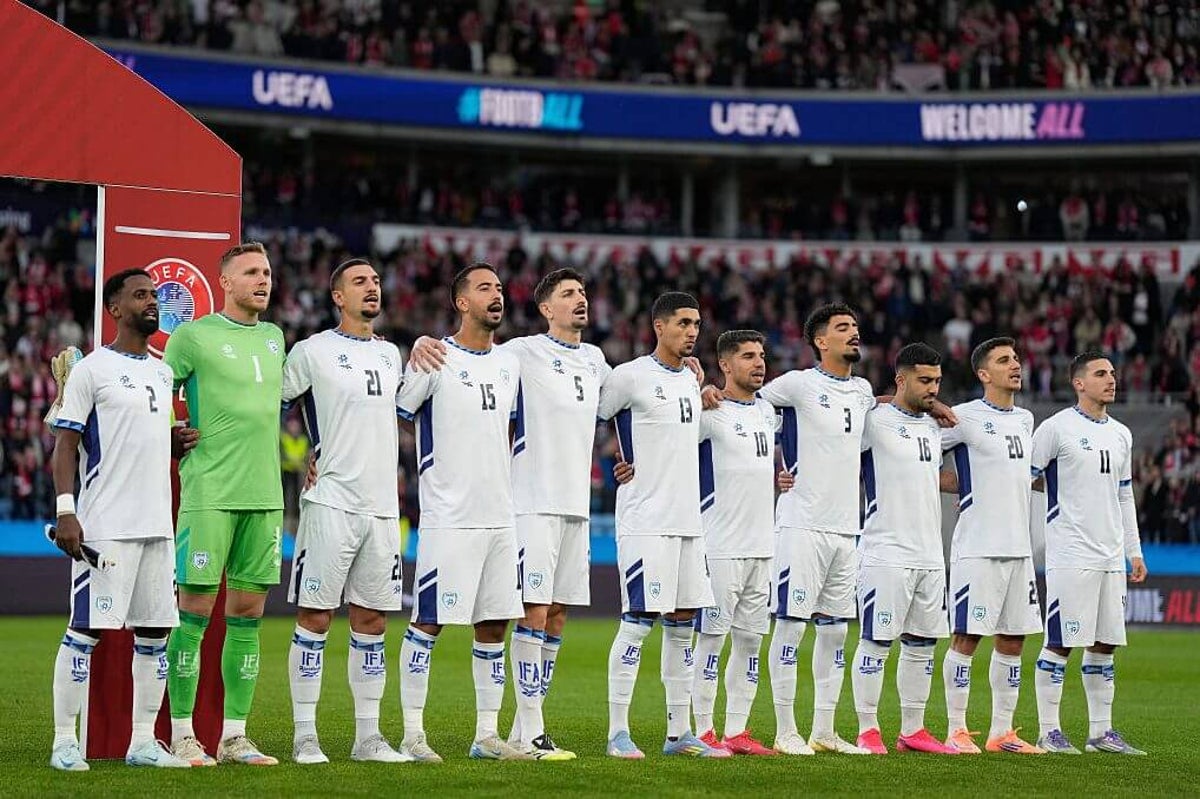
UEFA executives have held meetings with the organisers of a leading pro-Palestinian campaign, including since October’s ceasefire in Gaza, to discuss the circumstances around a potential ban of Israel from international competition, people familiar with the discussions have told The Athletic.
The Game Over Israel campaign was launched in New York City on September 17, one day after the United Nations (UN) declared Israel’s actions in Gaza as a genocide.
According to people with knowledge of the governing body’s thinking, UEFA had been close to calling a vote on Israel’s ongoing participation in European football in late September, amidst pressure from a number of its member associations, but leadership decided to hold off after a ceasefire between Israel and Hamas was brokered by the United States on September 29.
Meetings between UEFA and Game Over Israel representatives, which have continued to take place since the ceasefire, discussed the mechanisms under which a ban might be enforced, according to people briefed on the discussions, who, like others in this story, are not authorised to speak publicly.
UEFA is currently unlikely to suspend Israel through the organisation’s executive committee, which would put it at odds with other major sporting bodies. However, it is closely monitoring the progress of two legal challenges, originating in Ireland and Switzerland, which could force UEFA to implement a ban under international law.
One in-person meeting, at UEFA’s Switzerland headquarters, took place on October 15, the same week that West Midlands Police banned Maccabi Tel Aviv fans from attending a match at Aston Villa over safety concerns, according to people involved in the talks.
UEFA remained neutral during this flashpoint, which dominated the UK political landscape during that week. Publicly, UEFA stated that the body “encourages both teams and the competent authorities to agree on the implementation of appropriate measures necessary to allow (fans to travel).”
However, in that week’s meeting, according to people familiar with what was discussed, UEFA officials asked the Game Over Israel campaign to canvas insights from human rights experts, which would help inform future decision-making.
UEFA declined to comment when approached by The Athletic.
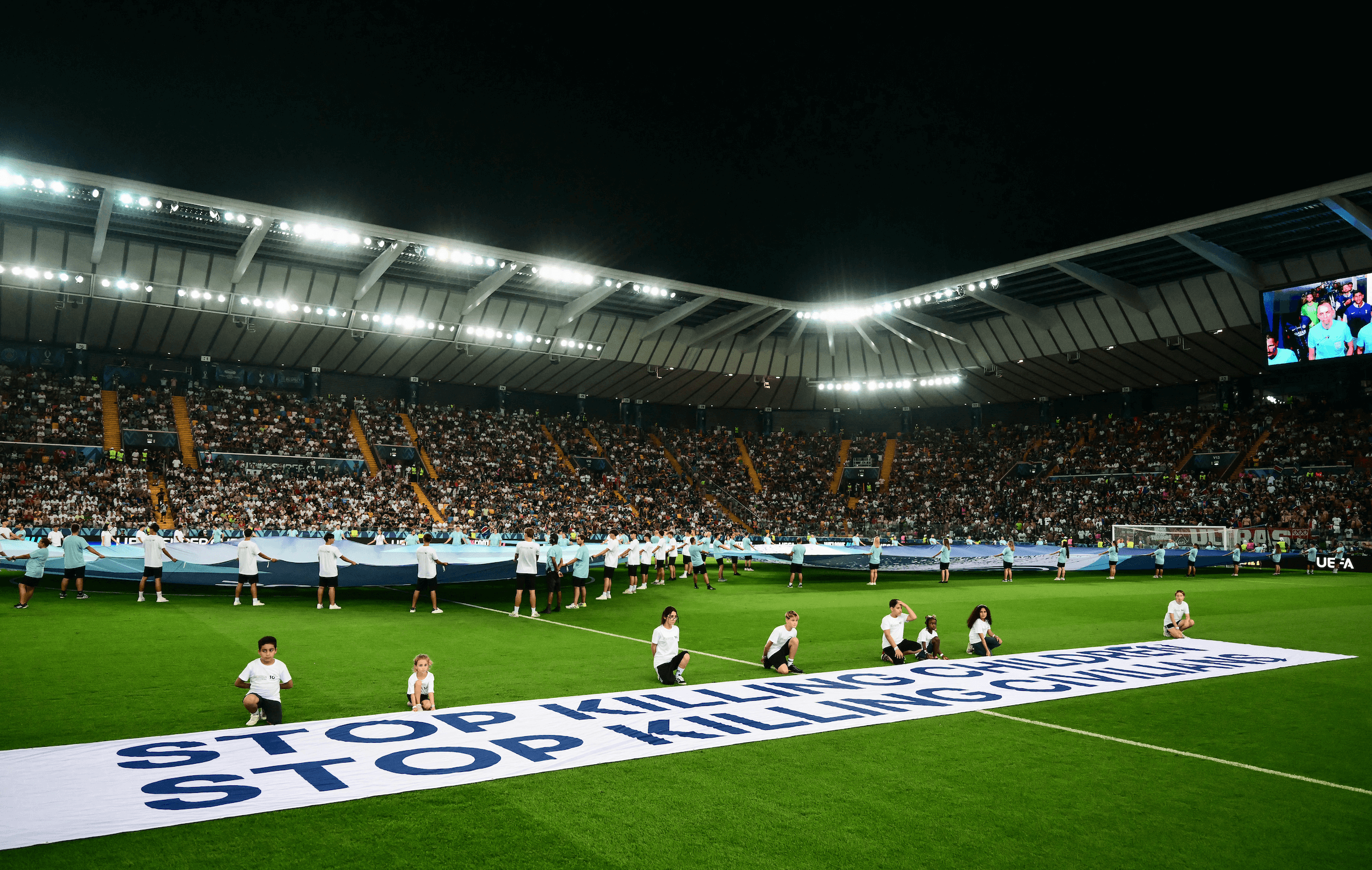
The banner at August’s UEFA Super Cup in Udine (Marco Bertorello/AFP via Getty Images)
UEFA president Aleksandr Ceferin is highly sympathetic to the suffering in Gaza, and, according to people briefed on the governing body’s internal decision-making, personally pushed for a UEFA banner to be displayed at August’s Super Cup final which read: “Stop killing children; Stop killing civilians”. Two Gazan refugee children were also involved in the medal ceremony. Ceferin also explored the prospect of meeting with Richard Falk, a former UN special rapporteur in the Palestinian territories, and a key advisor of the Game Over Israel campaign.
A letter personally delivered to Ceferin on November 12, signed by several high-profile players, including France’s Paul Pogba and Spain’s Adama Traore, called on UEFA to ensure it “does not participate in the normalisation of genocide, apartheid, and crimes against humanity”.
Four days earlier, the Football Association of Ireland (FAI) voted to submit a formal motion to UEFA, seeking to ban Israel from European competition. Its legal arguments claim that two UEFA statutes have been breached, with the body allegedly failing to implement an effective anti-racism policy, and allowing Israel to organise clubs “in illegal settlements in the occupied West Bank without the consent of the Palestinian FA”.
Another case, based on similar legal grounds, is set to be filed in the Swiss canton of Vaud over the next two weeks, where UEFA’s Nyon headquarters is based. It will be supported by a Swiss MP and will raise the issue of whether, if found guilty of breaching international law, UEFA should continue to receive its tax exemption in the country, according to case documents seen by The Athletic.
According to its website, Game Over Israel is made up of “a coalition of ordinary people” comprising “organisers, activists, humanitarians and football fans” with the shared goal of “fighting for justice, accountability and freedom for Palestine.” It is largely funded by the American Arab Anti-Discrimination Committee (ADC) and is advised by several former United Nations human rights officials.
Though there has been violent turbulence in the region for the past 80 years, the escalation of the current conflict began with a Hamas-led attack in Israel on October 7, 2023, that killed about 1,200 people and took more than 250 hostages, according to the country’s Foreign Ministry. Israel’s retaliatory offensive has killed nearly 70,000 Palestinians, according to Gaza’s Health Ministry.
Israel joined UEFA in 1994 with the nation’s national teams and club sides competing in European tournaments such as European qualifying for World Cups and, domestically, the Champions League and Europa League. Both international and club fixtures in continental competitions would be affected by a UEFA ban.
Israel were previously founding members of the Asian Football Confederation but were excluded from their competitions in 1974 when several Arab countries refused to play them.