
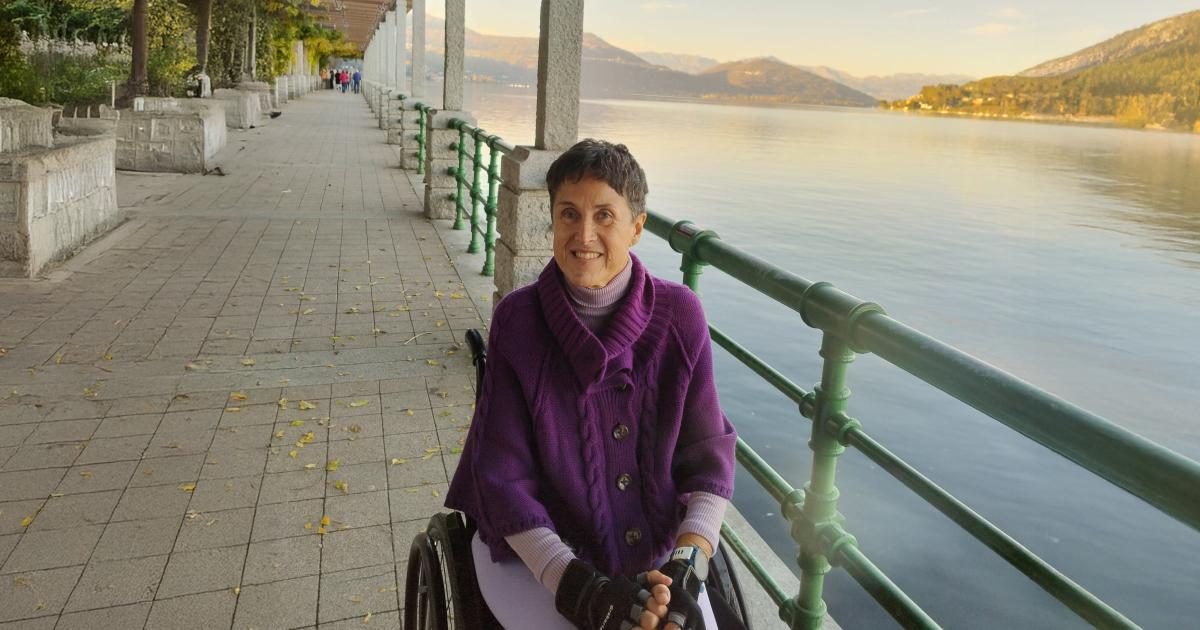
We are present. We want to be part of the world. Do not look at us with pity. We have the right to be seen. To be beautiful. To keep our body in shape. All people in wheelchairs should be able to go outside.
Donata Lerda, who lives with tetraplegia
On the occasion of the International day of persons with disabilities, we spoke to Donata from her home in Italy. The Day is intended to draw attention to the continuing challenges and barriers that people with disabilities face. From a higher risk of poverty and discrimination in the workplace, to inadequate social protection and lack of appropriate care and support.
Most disabilities are grouped as: mental, physical or congenital. Donata’s own disability occurred suddenly. Out riding her bike seven years ago, she fell, causing a spinal cord lesion. “From one second to the next my life completely changed. I used to be very sporty, active, full of initiative. It’s not something you expect,” she says. “Nobody ever imagines that a spinal cord lesion will happen to them.”
In the beginning, it was hard. “Not everything is explained to you because it’s a constantly evolving process,” says Donata. “In the past, maybe you were told by doctors that you would live for another two to three years. Now you could live much longer. No one apparently really knows what may happen to your body and mind in the long term.”
Donata’s personal quest is to get the EU to recognise spinal cord lesions, tetraplegia included, as a ‘rare disease’. “Until it is recognised as such there may be no special budget for it or funding for specialised centres. You cannot find and establish effective therapies and cures without them.”
The EU currently has a 10-year strategy in place for the rights of persons with disabilities (2021-2030). It looks to pave the way to a barrier-free Europe and to empower persons with disabilities so they can enjoy their rights and participate fully in society and economy. Initiatives include a proposal to create a new European Disability Card and an improved European Parking Card for persons with disabilities, which are expected to become operational in 2028.
Donata still finds there are architectural barriers for her to services that can help. “I can no longer work. I can’t use my hands properly. It’s hard – imagine you can no longer caress the face of your husband or children. You’re not prepared for this.”
She adds: “In a wheelchair you see a person who can’t walk. But this is the last stage of a long process of recovering. Behind it, there is a continuous history of suffering, of fighting the collateral physical effects of the disease.”
Not that Donata is downhearted about this. “I’m less depressed than many people with or without this condition,” she says with a laugh. “Everyone can fight for their rights at a personal level – like talking to the mayor of the place where they live.” Much more can be done if you are not alone.
She adds that spontaneous organisations for tetraplegia exist in many EU countries, though getting your voice heard with them and through them is not always easy.
Donata says hers is a ‘minority’ disability, among the 87 million people in the EU who have some form of disability. She sees achieving a common protocol for people with spinal cord lesions from first aid to rehabilitation as a fundamental goal for the EU and beyond. “There are so many things that Europe can do,” she says firmly. “Just unchain your heart.”
For more information
Union of equality: Strategy for the rights of persons with disabilities 2021-2030
UN: International Day of Persons with Disabilities