

Pre-announcement: upcoming changes to the HICP
As of 4 February 2026, several methodological changes will take effect in the HICP. The index will be compiled according to the new European Classification of Individual Consumption According to Purpose version 2, aligned with the UN COICOP 2018 classification. Games of chance will be included in the HICP as part of Recreation services under the division of Recreation, sport and culture. The index reference period will also be updated to 2025=100.
Overview
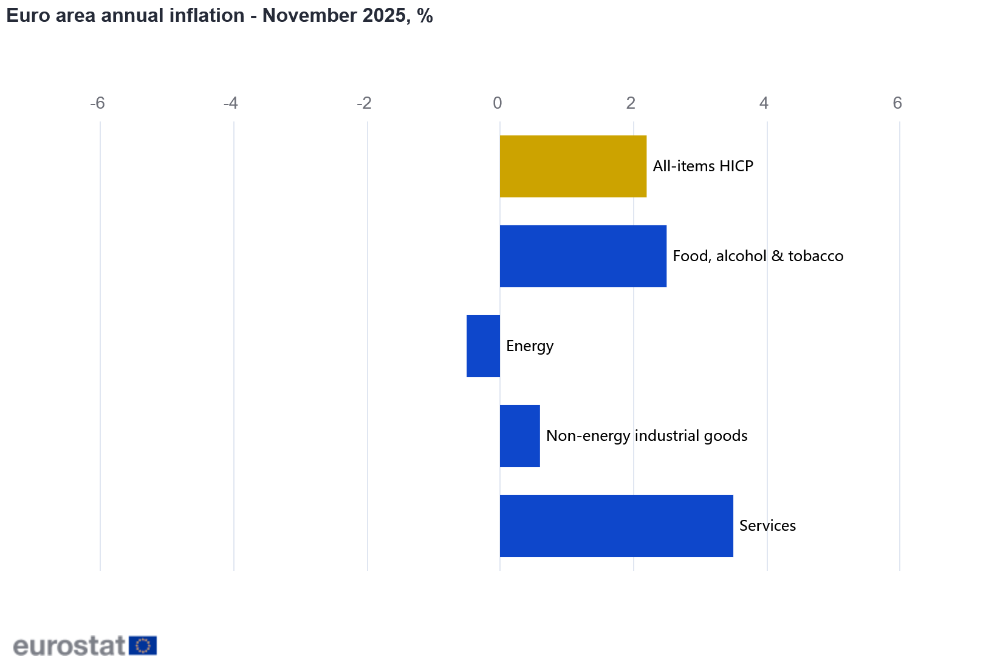
Euro area annual inflation is expected to be 2.2% in November 2025, up from 2.1% in October according to a flash estimate from Eurostat, the statistical office of the European Union.
Looking at the main components of euro area inflation, services is expected to have the highest annual rate in November (3.5%, compared with 3.4% in October), followed by food, alcohol & tobacco (2.5%, stable compared with October), non-energy industrial goods (0.6%, stable compared with October) and energy (-0.5%, compared with -0.9% in October).
Tables
Euro area annual inflation and its components (%)
Weights (‰)
Annual rate
Monthly rate
2025
Nov 24
Jun 25
Jul 25
Aug 25
Sept 25
Oct 25
Nov 25
Nov 25
All-items HICP
1000.0
2.2
2.0
2.0
2.0
2.2
2.1
2.2e
-0.3e
All-items excluding:
energy
906.0
2.7
2.5
2.5
2.5
2.5
2.4
2.4e
-0.4e
energy, unprocessed food
863.4
2.7
2.4
2.4
2.3
2.4
2.4
2.4e
-0.4e
energy, food, alcohol & tobacco
712.8
2.7
2.3
2.3
2.3
2.4
2.4
2.4e
-0.5e
Food, alcohol & tobacco
193.3
2.7
3.1
3.3
3.2
3.0
2.5
2.5e
0.2e
processed food, alcohol & tobacco
150.6
2.8
2.6
2.7
2.6
2.6
2.3
2.3e
0.1e
unprocessed food
42.7
2.3
4.6
5.4
5.5
4.7
3.2
3.3e
0.4e
Energy
94.0
-2.0
-2.6
-2.4
-2.0
-0.4
-0.9
-0.5e
0.9e
Non-energy industrial goods
256.3
0.6
0.5
0.8
0.8
0.8
0.6
0.6e
-0.1e
Services
456.5
3.9
3.3
3.2
3.1
3.2
3.4
3.5e
-0.8e
e estimate
Source dataset: prc_hicp_manr and prc_hicp_mmor

Inflation rates (%) measured by the HICP
Annual rate
Monthly rate
Nov 24
Jun 25
Jul 25
Aug 25
Sept 25
Oct 25
Nov 25
Nov 25
Belgium
4.8
2.9
2.6
2.6
2.7
2.5
2.6e
0.3e
Germany
2.4
2.0
1.8
2.1
2.4
2.3
2.6e
-0.5e
Estonia
3.8
5.2
5.6
6.2
5.3
4.5
4.7e
-0.5e
Ireland
0.5
1.6
1.6
1.9
2.7
2.8
3.2e
-0.2e
Greece
3.0
3.6
3.7
3.1
1.8
1.6
2.9e
0.0e
Spain
2.4
2.3
2.7
2.7
3.0
3.2
3.1e
0.0e
France
1.7
0.9
0.9
0.8
1.1
0.8
0.8e
-0.2e
Croatia
4.0
4.4
4.5
4.6
4.6
4.0
4.3e
0.3e
Italy
1.5
1.8
1.7
1.6
1.8
1.3
1.1e
-0.2e
Cyprus
2.2
0.5
0.1
0.0
0.0
0.2
0.2e
-1.0e
Latvia
2.3
3.9
3.9
4.2
4.2
4.3
3.8e
-0.3e
Lithuania
1.1
3.2
3.4
3.6
3.7
3.7
3.6e
0.4e
Luxembourg
1.1
2.4
2.6
2.8
3.1
3.0
3.6e
0.1e
Malta
2.1
2.5
2.5
2.7
2.4
2.5
2.4e
-3.3e
Netherlands
3.8
2.8
2.5
2.4
3.0
3.0
2.6e
-1.4e
Austria
1.9
3.2
3.7
4.1
3.9
4.0
4.1e
0.3e
Portugal
2.7
2.1
2.5
2.5
1.9
2.0
2.1e
-0.9e
Slovenia
1.6
2.5
2.9
3.0
2.7
3.1
2.4e
0.0e
Slovakia
3.6
4.6
4.6
4.4
4.6
3.9
3.8e
0.2e
Finland
1.7
1.9
1.9
2.2
2.2
1.4
1.4e
-0.2e
e estimate
Source dataset: prc_hicp_manr and prc_hicp_mmor
Notes for users
Revisions and timetable
The euro area inflation flash estimate is issued at the end of each reference month.
The complete set of harmonised indices of consumer prices (HICP) for the euro area, EU and Member States is released around the middle of the month following the reference month.
The next release with full data for November 2025 is scheduled for 17 December 2025.
Methods and definitions
Annual inflation is the price change of consumer goods and services between the current month and the same month of the previous year. Monthly inflation is the price change between the current month and the previous month.
Geographical information
The euro area consists of Belgium, Germany, Estonia, Ireland, Greece, Spain, France, Croatia, Italy, Cyprus, Latvia, Lithuania, Luxembourg, Malta, the Netherlands, Austria, Portugal, Slovenia, Slovakia and Finland.
The euro area data refer to the country composition at a specific point in time. Changes in the composition of the euro area are incorporated using a chain index formula.
For more information