
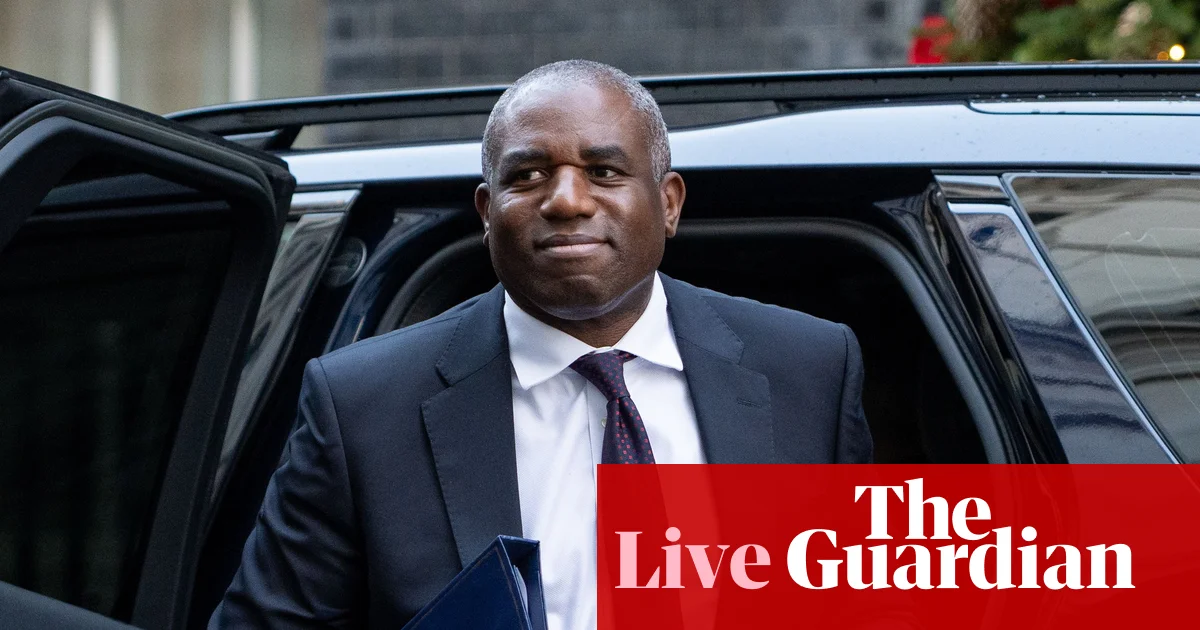
Lammy tells MPs that court system needs ‘once in a generation reform’
David Lammy, the deputy PM and justice secretary, is making his statement to MPs now.
He says Sir Brian Leveson provided the government with a blueprint for “once in a generation reform”.
Key events
Show key events only
Please turn on JavaScript to use this feature
Lammy is talking about the backlog in the courts system.
He refers to a victim abused by her partner who had to wait six years for a trial.
He says this problem is systematic.
He says Britain is proud of Magna Carta. But Magna Carta says justice must not be delayed, he says.
ShareLammy tells MPs that court system needs ‘once in a generation reform’
David Lammy, the deputy PM and justice secretary, is making his statement to MPs now.
He says Sir Brian Leveson provided the government with a blueprint for “once in a generation reform”.
ShareQuarter of police forces missing basic policies on sexual offences, says Sarah Everard report
A quarter of police forces in England and Wales are yet to implement “basic policies for investigating sexual offences”, an official report has found, with women still being failed despite promises of change after the murder of Sarah Everard four years ago. Vikram Dodd has the story.
Jess Phillips, the safeguarding minister, will make a statement to MPs on this after the David Lammy statement about courts.
ShareOBR refuses to endorse Tory claims that Reeves misled voters about state of public finances with pre-budget speech
The Treasury committee’s hearing with the two most senior figures at the Office for Budget Responsibility, Prof David Miles and Tom Josephs, has now finished. Here are some of the main points.
The OBR declined to criticise Rachel Reeves over the speech she gave at the start of November implying that she would need to raise income tax. The Tories have claimed that she lied when she gave the breakfast-time speech in Downing Street on 4 November because she had been told by the OBR that she was likely to meet her fiscal targets, but the speech implied she had a big black hole to fill. Asked about this, Miles told the committee:
My interpretation was, and others might interpret differently, that the chancellor was saying that this was a very difficult budget and very difficult choices needed to be made.
And I don’t think that that was in itself inconsistent with the final pre-measures assessment we’d be made which, although it showed a very small positive amount of so-called headroom, it was wafer thin.
It’s certainly true that there wasn’t any immediately good bit of news in that particular window …
I don’t think it was misleading for the Chancellor to say that the fiscal position was very challenging at the beginning of that week.
Whether a message was then put out to say ‘well, it’s less challenging by the end of the week’, I don’t know, and I don’t know where that message would have come from.
It certainly didn’t reflect anything that was news from the OBR being fed into the government.
When it emerged later that month that Reeves had dropped her plans to raise income tax, some journalists were briefed privately by government figures that she had changed her stance because updated OBR forecasts were better than before. Reporters believe they were misled. The OBR had presented the Treasury with forecasts that, in some respects, were better than expected, but that happened before the 4 November speech, not after it.
I wouldn’t say we were at war with the Treasury.
I mean, we have a very close relationship with the Treasury. In fact, we rely not just on the Treasury but other departments in government for analysis of many sorts of measures.
Robert Peston, ITV’s political editor, has more on the hearing on a post on social media here. He concludes:
The disagreement between the OBR and the political Treasury is not over what the Chancellor actually did in the budget.
It is about what journalists, voters and investors understood for weeks before the budget about the health of the public finances and how the OBR’s assessment was changing – which the OBR saw as seriously wrong.
Updated at 07.35 EST
 Richard Adams
Richard Adams is the Guardian’s education editor.
The University and College Union’s plans for national industrial action on campuses later this year have been dashed by poor turnout, resulting in the strike ballot failing.
Despite 70% of those who returned ballots voting to strike over pay, only 39% of UCU members took part, meaning the ballot failed to get across the 50% participation threshold required by law. The low turnout comes as universities across the UK are grappling with course closures and cost cutting including redundancies, with local strikes already taking place at many institutions.
A UCU spokesperson said:
A strong majority of our members backed strike action in response to unfair pay, worsening conditions, and widespread threats to jobs across the sector. It will be particularly disappointing for those who voted for action that, despite this clear mandate, we are not able to proceed.
ShareLammy tells of ‘traumatic’ racial abuse in youth after Farage allegations
David Lammy has spoken of his own “traumatic” experience of being racially abused at school as he called on Nigel Farage to apologise for comments he allegedly made while a teenager, Daniel Boffey reports.
There are two statements in the Commons today after 12.30pm.
First David Lammy will make his statement on curbing access to jury trials.
Then Jess Phillips, the safeguarding minister, will make a statement about the latest report from the Angiolini inquiry. The inquiry, chaired by Elish Angiolini, was set up following the murder of Sarah Everard by Wayne Couzens, a police officer, and this report (part 2 first report) will cover measures to protect women from sex crimes in public spaces.
Here is Heather Stewart’s story from the opening of the Treasury committee hearing with the Office for Budget Responsibility.
ShareDfE launches what is call ‘biggest national conversation on Send in a generation’ ahead of reform next year
The Department for Education has today launched what it describes as “the biggest national conversation on Send [special educational needs and disabilities] in a generation”. The consultation will run until the end of January, ahead of the publication of plans to reform Send provision in England next year.
Last week the Office for Budget Responsibility highlighted a £6bn shortfall in funding in 2028-29, rising to £9bn in 2030-31. The DfE says Send reform should be able to lead to costs being reduced, but it has not explained, and parents worry that provision will be cut back.
In its news release, the DfE says:
The government inherited a Send system on its knees, with too many children let down and parents fighting just to be heard. Building on conversations to date, the government is now launching a public engagement campaign, spanning every region of the country, putting families at the heart of its plans to create a reformed SEND system that will stand the test of time.
Minister for school standards, Georgia Gould is hosting nine face-to-face events, run in partnership with the Council for Disabled Children, and five online events covering the department’s five principles of reform. This will provide tens of thousands spaces for parents, families and the sector to share their views – opening up a direct line to the people who know the system best.
Today the Institute for Fiscal Studies thinktank has published a report describing the scale of the problem. Darcey Snape, one of the report’s authors, said:
The special educational needs system in England is a mess – with big fiscal costs as well as costs to children, their families and their schools. New forecasts published alongside last week’s Budget provide welcome clarity on the scale of the fiscal challenge, and should make the problem harder to ignore.
Asked if the endless leaking was damaging to the economy, Prof David Miles from the OBR told the Treasury committee that uncertainty was not a good thing.
He said the amount of time people had to wait for the budget prolonged that uncertainty.
And he suggested that the speculation about what would be in the budget did not help. The negative impact of the long wait was “exacerbated” by the briefing, he said.
Back at the Treasury committee, Prof David Miles from the OBR was asked if the OBR released the letter giving details of its forecasts because it wanted to show that it was not being used as a political tool by the Treasury.
Miles said it was more about correction misconceptions that were being reported that were “wrong and damaging to the OBR”.
He said these included claims that it had given in to pressure on choosing the window used to assess borrowing costs, that it had “found” some extra money that was helpful to the Treasury, or that its forecasts were varying “all over the shop”.