
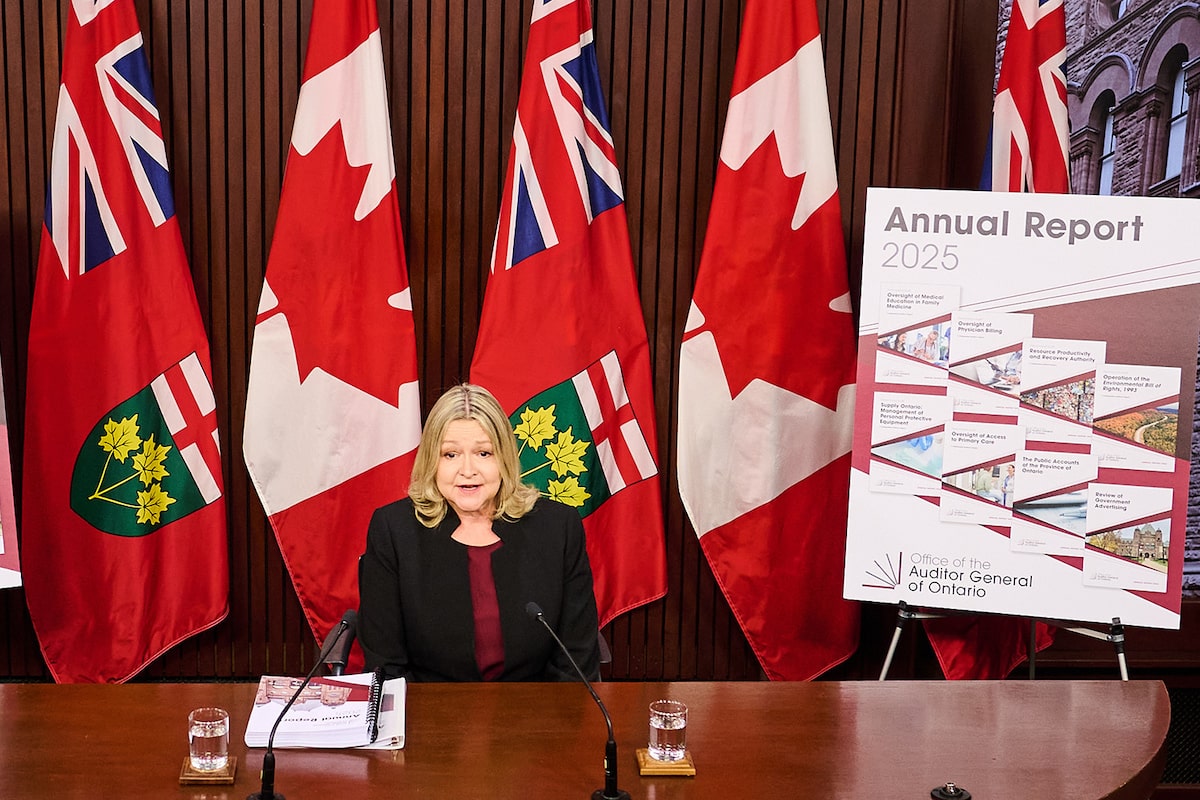
Auditor-General Shelley Spence following the release of her annual report at the Ontario legislature in Toronto on Tuesday.Sammy Kogan/The Canadian Press
Ontario’s Auditor-General says the province isn’t auditing doctors whose billings raise obvious red flags, including 82 doctors who claimed to have worked 24 hours or more in a single day, a diagnostic radiologist who billed for an average of 461 patients a day, and an ophthalmologist who billed $6.7-million in one year, more than twice as much as the next highest biller in the specialty.
The same unnamed ophthalmologist has been investigated three times for allegedly charging patients out-of-pocket fees for services that should be free through the Ontario Health Insurance Plan. The first review found the doctor wrongly charged patients, a second cleared the ophthalmologist, and a third is ongoing.
When the Ontario Ministry of Health does identify inappropriate billings, it often negotiates settlements that allow doctors to repay less than what they overbilled, Ontario Auditor-General Shelley Spence found in her annual report, released Tuesday.
“Not recovering overpayments from physicians represents a waste of taxpayer’s money,” the report said. “Stronger payment recovery mechanisms would enable the Ministry to use taxpayer funds more effectively and efficiently, including the possibility of directing those recovered funds to providing more patient care.”
Ontario has more family doctors, but fewer are working in primary care, study shows
The Auditor-General noted there hasn’t been much improvement in the oversight of physician billings since her office last flagged the problem in a 2016 audit.
In response, the Ministry of Health approved 22 additional positions for that purpose, but, according to the new report, “the Ministry permanently reallocated 17 to other areas and assigned the remaining five to areas outside of the audit function.”
Health care was a major focus of Ms. Spence’s annual report. Along with scrutinizing physician billings, she also investigated the Progressive Conservative government’s oversight of primary care and of medical education in family medicine.
Ontario Premier Doug Ford has vowed that every Ontarian will be attached to a primary-care physician or nurse practitioner by 2029. Last year he appointed former federal health minister Jane Philpott to lead a Primary Care Action Team to enact that promise.
The Auditor-General’s report, citing a network of primary-care researchers called INSPIRE-PHC, says that about two million Ontarians didn’t have a family doctor as of March, 2024, up from 1.8 million in 2020.
Opinion: Allowing doctors to practise in both public and private systems solves what exactly?
The report identifies several barriers to finding doctors for many patients. It concludes that the province’s Health Care Connect service, which is supposed to match patients in need with available doctors, has in recent years left patients languishing in the queue for too long.
Of the approximately 178,000 people who registered with Health Care Connect between 2020-2021 and 2024-2025 and who were still waiting to be referred to a physician as of June, more than 108,000 had been waiting for more than a year.
The Auditor-General also found that only 7 per cent of family doctors working in a payment model that sees them formally enroll patients were willing to take patients off the Health Care Connect waiting list.
Dr. Philpott and her team have in the past year made a concerted effort to tackle the Health Care Connect waiting list, Ontario Health Minister Sylvia Jones has said. In October, her office reported that the Primary Care Action Team was halfway to its goal of clearing the approximately 235,000 names that were on the provincial waiting list as of Jan. 1, 2025 by next spring.
In a separate audit, the Auditor-General scrutinized the Ford government’s plan to expand medical school seats for future family doctors, including by opening two new medical schools at Toronto Metropolitan and York universities.
Ontario to expand funding for primary health-care teams based on initial success
Ms. Spence and her team concluded the government failed to heed warnings from the leaders of existing medical schools that there were not enough family medicine clinics in the province with the capacity to teach medical residents. For that reason, by the end of this academic year, the Ministry of Health will have rolled out 44 per cent fewer family medicine seats than originally planned, according to the report.
As part of the physician billing audit, Ms. Spence and her office also looked at how often doctors inappropriately charge patients fees for services that are supposed to be covered by OHIP.
The Ministry of Health has conducted 452 reviews since 2020 under a law called the Commitment to the Future of Medicare Act, 83 per cent of which were related to alleged patient billing violations. About a third of those were for eye procedures, including cataract surgeries.
“We previously raised this issue in our 2021 audit of Outpatient Surgeries, which found no provincial oversight to protect patients against inappropriate charges for OHIP-funded services or physicians that may mislead and charge patients for unnecessary add-ons,” the new report says.
The Ontario government has trumpeted its plans to offer more procedures, including cataract surgeries and, eventually, hip and knee surgeries, in private clinics as a way to reduce waiting times.