
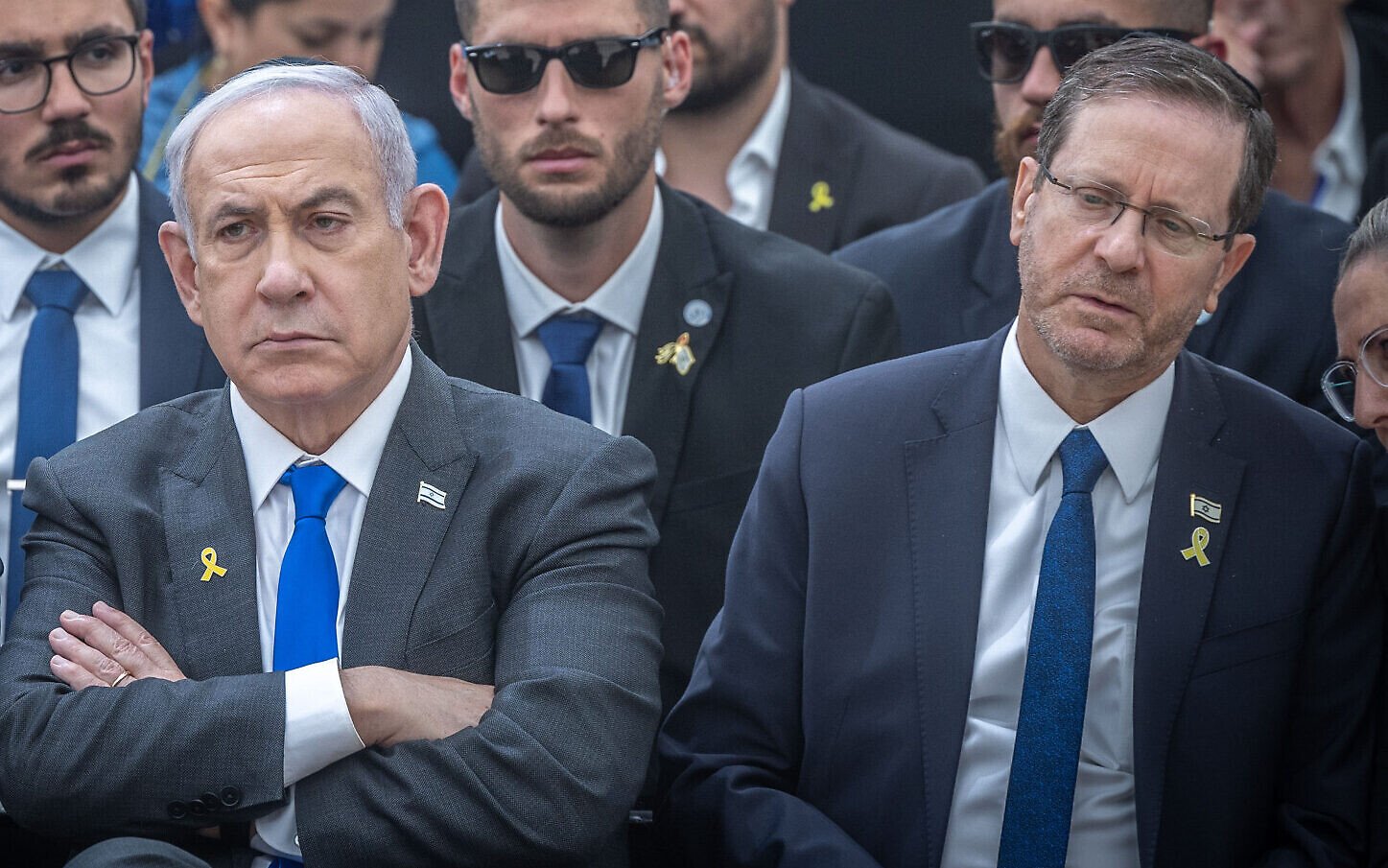
As if the country were not already laboring under enough legal and constitutional crises, Prime Minister Benjamin Netanyahu took Israel into a new minefield on Sunday when he filed a request to President Isaac Herzog asking for a pardon for the criminal charges against him in the three cases for which he is currently standing trial.
In a brief, personal letter to Herzog, Netanyahu made the case that bringing the trial to a close would benefit the public by ending national divisions over his prosecution.
He then published a message pledging to heal the nation’s divides should his trial be halted, but in the same breath enflamed the rift by arguing that not only is he innocent but that he has been framed and the indictment against him was concocted by hostile elements in law enforcement agencies.
In the pardon application itself, his lawyers argued it was also in the public interest for the prime minister to focus on the challenges facing the country, implying, but not stating explicitly, that the trial is taking up too much of Netanyahu’s time.
Undercutting the argument was the fact that the same legal team had claimed years earlier that juggling both the trial and the affairs of state was not a problem.
Get The Times of Israel’s Daily Edition
by email and never miss our top stories
By signing up, you agree to the terms
Yet it is unlikely that either the possibly disingenuous appeal to unity or concerns about legal sophistry will be decisive in Herzog’s decision regarding the request, even if they play a factor.
Rather, experts say, it is Netanyahu’s glaring omission of an admission of guilt or wrongdoing that puts his request on legally shaky ground, making it highly unlikely that the president will grant him an outright pass, and inviting the possibility of court intervention if he does.
Such a move would also create deep unrest in the country, warned Prof. Yedidia Stern, head of the Jewish People Policy Institute, with the prime minister’s opponents taking to the streets in protest and his supporters arguing that their claims of a “deep state” plot against Netanyahu and the Israeli right had been proved correct.
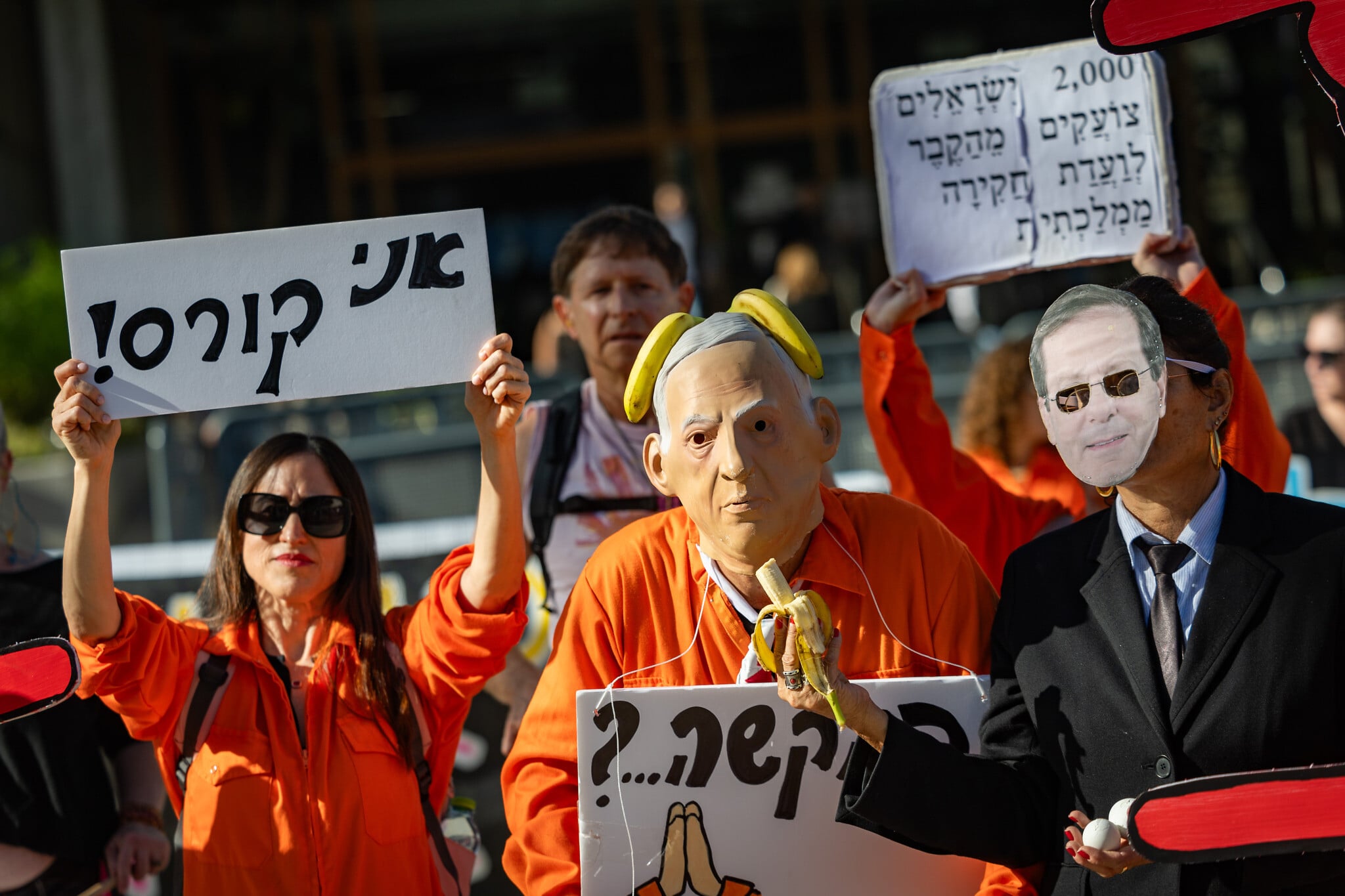
Activists protest outside a court hearing in the trial of Israeli Prime Minister Benjamin Netanyahu in Tel Aviv, calling not to grant him a pardon, December 1, 2025. (Chaim Goldberg/Flash90)
Stern, a legal expert who has been appointed to numerous public, professional committees in the past, noted that Netanyahu’s lawyers already know it is improbable that Herzog would issue an outright pardon under the circumstances, and likely see the pardon request as the beginning of some kind of negotiation process.
He speculated that Herzog may be inclined to issue a conditional pardon requiring some form of admission of wrongdoing by Netanyahu, in which the specific language would be negotiated and a firm deadline for the end of his political career established.
Pardon without an admission of guilt?
Netanyahu was indicted in 2020 on charges of fraud and breach of trust in three separate corruption cases, as well as accepting a bribe in the form of positive media coverage in one of those cases.
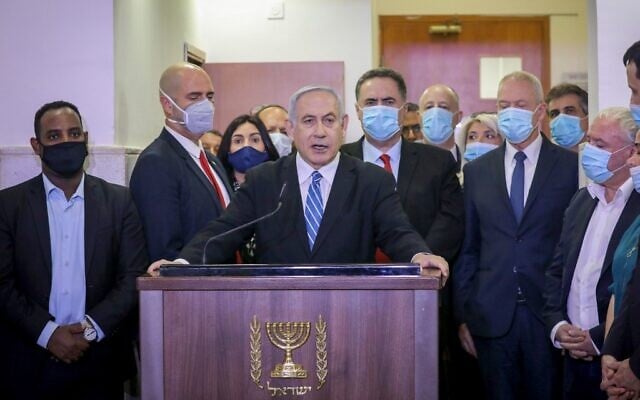
Prime Minister Benjamin Netanyahu delivers a statement before entering a courtroom at the Jerusalem District Court on May 24, 2020, for the start of his corruption trial. Among those alongside him from left are Likud MKs and ministers Gadi Yevarkan, Amir Ohana, Miri Regev, Nir Barkat, Israel Katz, Tzachi Hanegbi, Yoav Gallant and David Amsalem. (Yonathan Sindel/Pool/AFP)
Netanyahu has maintained throughout that he has not committed any crime, repeatedly accusing law enforcement agencies of conspiring against him in order to indict him.
One of the key issues raised by critics of Netanyahu’s request is the fact that his trial is ongoing, he has yet to be convicted, and he has not admitted to having committed any crime.
All three are normally considered fundamental prerequisites for a presidential pardon, though in actuality wiggle room exists.
The president’s pardon powers are laid out very briefly in Basic Law: The President. “The President of the State has the power to pardon offenders and modify sentences by reducing or commuting them,” it states.
The law does not explicitly require the recipient of a pardon to have been convicted, or condition a pardon for someone not convicted on them admitting their guilt.
But the word “offender” in the law is both crucial and logical, several legal experts have asserted, since it makes little sense for an innocent person to request a pardon.
“It’s irrational to have a pardon before conviction, a pardon for what?” said Dana Blander, a research fellow at the Israel Democracy Institute. “Usually, if people say they are innocent, they don’t need to ask for a pardon.”
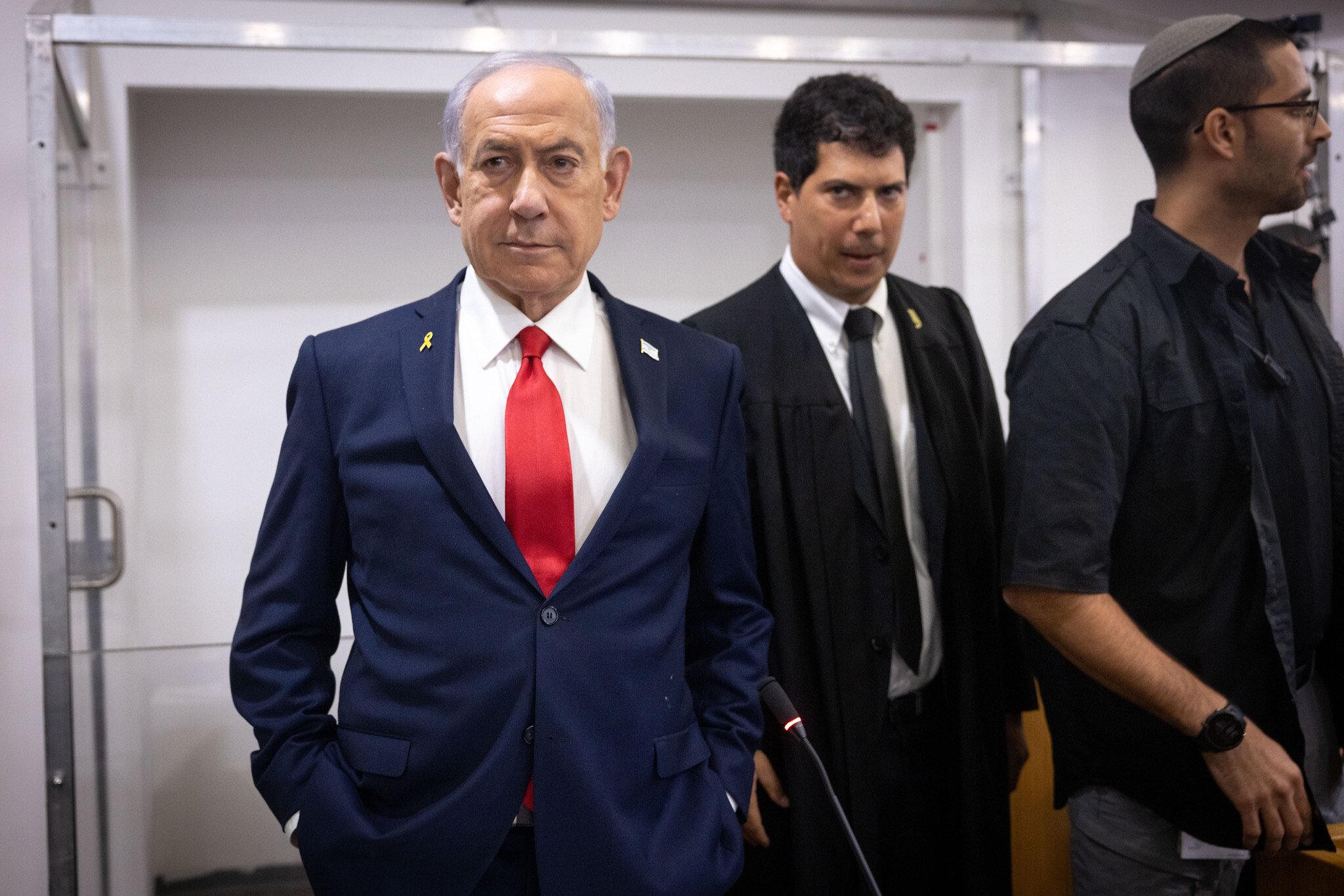
Prime Minister Benjamin Netanyahu arrives at the courtroom of the Tel Aviv District Court in the trial against him, October 28, 2025. (Miriam Alster/Flash90)
This exact concern was at the heart of legal arguments over the only real precedent for a presidential pardon before conviction in Israel: 1984’s Bus 300 affair.
Then-president Chaim Herzog, President Isaac Herzog’s grandfather, issued pardons to the head of the Shin Bet and three other Shin Bet officials for their role in the extrajudicial execution of two Palestinian terrorists who were captured alive after a deadly bus hijacking.
Unlike in Netanyahu’s case, those pardons were issued before the suspects were indicted. The legality of the pardons was challenged in the High Court of Justice, which ultimately upheld them, citing the admissions of guilt by those accused.
Court president Meir Shamgar wrote in a 2 to 1 majority ruling in 1986 that the pardons only passed judicial muster “when it was made clear that the applicants admitted having committed the criminal acts for which they asked to be pardoned; then the president had before him sufficient facts upon which to consider their pardon request.”
The admissions were a kind of de facto conviction, allowing the president to issue the pardons, said Stern.
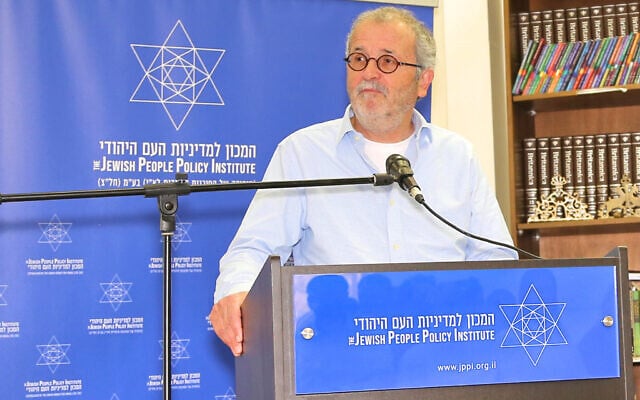
JPPI head Prof. Yedidia Stern, a leading Israeli legal scholar. (Courtesy JPPI)
“This is not the case here [with Netanyahu]. He has not admitted anything and neither have his lawyers. If you’re not an offender, then you don’t need a pardon. It’s not logical to ask someone for a pardon if you haven’t done anything wrong,” he said.
Contradictory claims?
Netanyahu’s trial, in Jerusalem District Court, is now in its sixth year, and looks unlikely to end before 2027, not including any appeals that could be filed to the Supreme Court.
Since beginning his testimony in court last year, Netanyahu has repeatedly complained that the trial is taking up too much of his time, and vigorously but unsuccessfully opposed the court’s decision to increase his testimony from two to three times a week.
The 13-page pardon application to the president filed on Sunday states repeatedly that the prime minister needs to be able to devote all his time and energy to urgent matters of state and what they described as “golden opportunities” for Israel.
“Granting this request will allow the prime minister to devote all of his time, abilities, and energy to advancing Israel in these critical times… and to dealing with the challenges and opportunities that lie before it,” the request reads.
Prime Minister Benjamin Netanyahu is seen in the hallways of the Knesset on November 3, 2025. (Chaim Goldberg/FLASH90)
The implication, though not stated explicitly, is that Netanyahu does not have time for his criminal trial.
But Netanyahu said the exact opposite when trying to convince the High Court of Justice in 2021 that he should not be relieved of his office due to the time constraints his criminal trial would impose upon him.
“The fact that part of the prime minister’s time is not in his hands does not indicate an inability to fulfill his duties,” wrote his lawyers in their response to a petition by the Movement for Quality Government in Israel at the time asking the court to order Netanyahu to recuse himself from office on the basis that he would not have enough time to both stand trial and carry out his duties as prime minister.

Dr. Dana Blander, a research fellow at the Israel Democracy Institute. (Courtesy Israel Democracy Institute)
“The prime minister’s extensive experience and qualities allow him to handle his role as prime minister without any difficulty, just as he handled the investigations and leaks, as well as various other events during his terms as prime minister of Israel over the years,” insisted Netanyahu’s lawyers in their submission to the court.
Blander noted that the court accepted Netanyahu’s arguments at the time.
What happens now?
Netanyahu’s pardon request has now been passed by the president’s office to the Pardons Department in the Justice Ministry, which will seek the position of various state institutions on the request, including that of the State Attorney’s Office, which prosecutes criminal trials, including Netanyahu’s.
It is also likely that Attorney General Gali Baharav-Miara will issue her own legal opinion since she is the head of the prosecution service and because the attorney general has ultimate authority over the indictment of senior officials.
The formal position of the Pardons Department is then passed to the justice minister, who also draws up a position paper, which is then passed to the president’s legal adviser, who draws up their own position paper, which is then passed on to the president himself.
President Isaac Herzog speaks at a state memorial ceremony marking 30 years since the assassination of prime minister Yitzhak Rabin, at Mount Herzl in Jerusalem on November 3, 2025. (Noam Revkin Fenton/ Flash90)
The process is likely to take several weeks, according to reported estimates.
According to Blander, the president accepts the recommendations of the Pardons Department in “99 percent” of cases, although he does have the discretion to reject its advice.
She added that she believed the Pardons Department will find that Netanyahu must admit guilt, in line with the High Court’s Bus 300 ruling, in order to get a pardon, and that she did not believe Herzog would go against this recommendation.
Should Herzog nonetheless grant any form of pardon to Netanyahu, it is highly likely if not inevitable that petitions would be filed to the High Court against his decision.
High Court President Isaac Amit leads a court hearing on petitions against the appointment of retired judge Yosef Ben-Hamo to lead the probe into the Sde Teiman abuse leak, at the High Court of Justice in Jerusalem, November 27, 2025. (Yonatan Sindel/Flash90)
But the Basic Law laying out presidential powers says that the president is not accountable to the courts regarding the execution of his powers, meaning that historically the court has largely refrained from exercising judicial review over presidents’ decisions, although it has done so in rare cases.
The court did assert its right of judicial review over the pardons in the Bus 300 affair, even though it ultimately decided not to intervene in Chaim Herzog’s decision to pardon the Shin Bet officials.
Blander opined that the court would likely intervene if Herzog issues an outright pardon for Netanyahu without an admission of guilt.
Whether or not the court would override a conditional pardon remains unclear, and would likely depend on the details of that arrangement.
Stern asserted that a conditional pardon may be an acceptable way out of the societal and legal conflict engendered by Netanyahu’s criminal trial, as long as he admits wrongdoing in an acceptable manner and agrees to a horizon for ending his time in office.
“This is a solution that does not humiliate any of the parties, but creates a measure of success for each of them. From a risk management perspective, each party comes away having achieved some of their desires,” he ventured.