
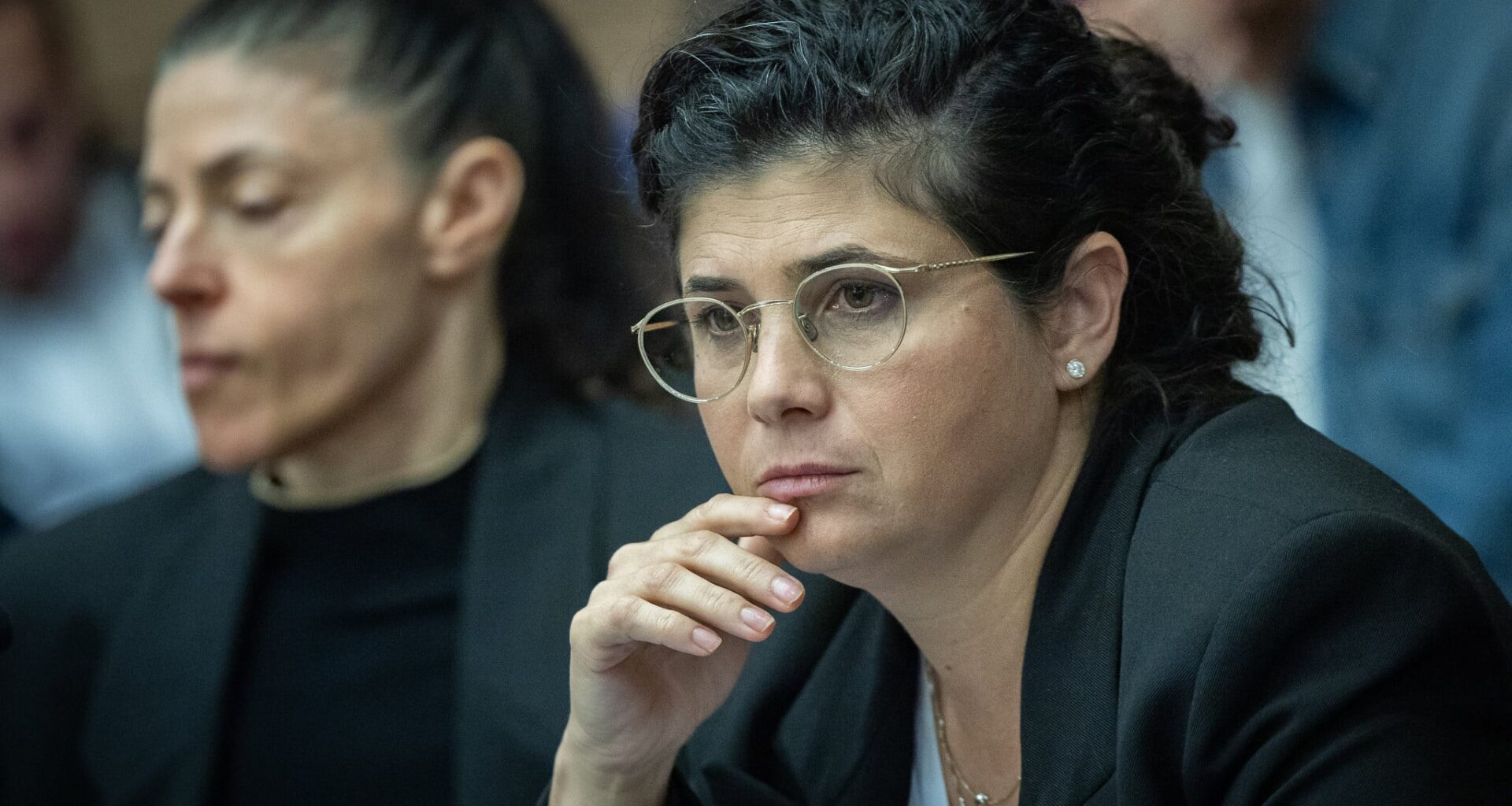
Deputy Foreign Minister Sharren Haskel on Tuesday became the first coalition member to publicly oppose the notion of a presidential pardon for Prime Minister Benjamin Netanyahu, which he formally requested from President Isaac Herzog on Sunday.
“Is it right to give a pardon in the situation we are in? I don’t think so,” Haskel told Jerusalem Radio.
Unlike members of the opposition, Haskel did not cite legal arguments or the need to see the trial through to its conclusion for accountability and the supremacy of the rule of law. Rather, she said she believed the pardon request was a “media trick” from the premier’s camp, aimed at trying to divert attention from the important things.”
She then clarified that she was referencing controversial legislative efforts to formalize widespread draft exemptions from military enlistment for the ultra-Orthodox, which have drawn opposition from multiple coalition and cabinet members, including Haskel.
Haskel said the Haredi draft bill “could endanger Israel’s security.”
Get The Times of Israel’s Daily Edition
by email and never miss our top stories
By signing up, you agree to the terms
“I also don’t think Netanyahu wants the pardon,” she asserted, claiming that the media and opposition, “like sheep,” were “making this a headline issue instead of talking about the thing that is going to determine the state’s future — which is the enlistment law.”
Both subjects have made top headlines in recent days.
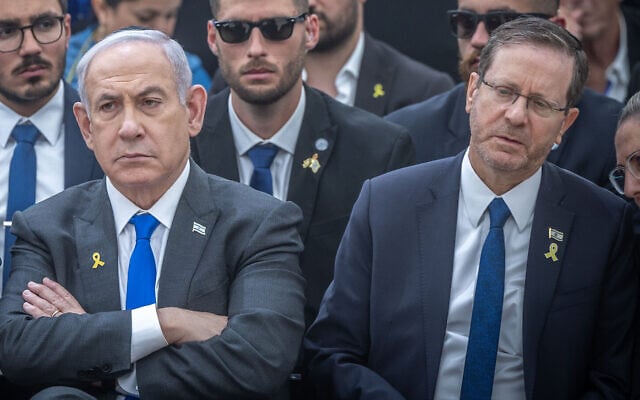
Prime Minister Benjamin Netanyahu, left, and President Isaac Herzog at a state memorial ceremony for victims of terror, at Mount Herzl military cemetery in Jerusalem, May 13, 2024 (Chaim Goldberg/Flash90)
Netanyahu’s bombshell request marks a new phase in his legal battle, which began over five years ago and has continued through the pandemic, elections, war and protests.
Netanyahu is charged with bribery, fraud and breach of trust in three separate cases. The charges relate to allegations of improper manipulation of the press and receiving illicit gifts in return for government favors. He denies any wrongdoing and has argued that the charges were fabricated in an attempted political coup by the police and state prosecution.
His trial began in May 2020 after years of investigations and following his November 2019 indictment. He has faced calls throughout by opposition figures to resign over the charges. Analysts have estimated that, should it continue, the trial, including any appeals, will take several more years.
In his pardon request, Netanyahu did not admit any guilt and, in a video statement issued shortly afterward, continued to contest the charges against him and the legitimacy of the process by which he was indicted. He also did not indicate any readiness to step down as prime minister.
The prime minister sought to frame the request as one entirely focused on the good of the state, as the trial is taking up valuable time in his schedule that could be better spent on advancing national interests. It was an about-face for Netanyahu, who had in the past insisted that he should be able to serve as prime minister despite the criminal proceedings against him because they would not impede on his ability to manage the affairs of state.
Amid speculation that Netanyahu could be gearing up for a limited admission of guilt in exchange for the pardon, his cabinet secretary and several aides have insisted that the premier has zero interest in doing so, and will maintain innocence regardless of a potential pardon.
Speaking to the ultra-Orthodox radio station Kol Berama, Cabinet Secretary Yossi Fuchs said Tuesday, “There is a greater chance of the sun not rising in the morning than the prime minister confessing to crimes he didn’t commit as part of the pardon request.”
After some interpreted the language of the premier’s letter as indicating he may halt his government’s highly divisive judicial overhaul legislation if the trial is stopped, Fuchs said, “There is no deal or intention for Netanyahu to get a pardon in return for stopping the judicial reform.”
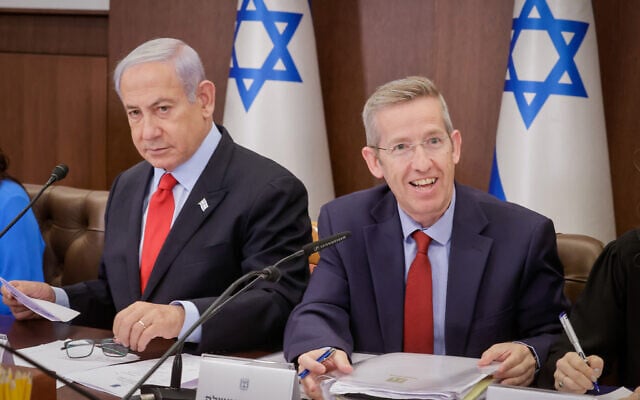
Prime Minister Benjamin Netanyahu, left, leads a cabinet meeting at his office in Jerusalem alongside cabinet secretary Yossi Fuchs, on July 30, 2023. (Marc Israel Sellem/Pool/Flash90)
Fuchs’s statement echoed several Netanyahu associates, who reportedly told Channel 12 Monday that the premier “will not admit guilt,” and insisted that “the pardon request is not an ‘opening stance,’” to negotiations on the matter.
According to the report, the request was prepared on Thursday, and throughout the weekend Netanyahu’s family debated whether to submit it.
Ultimately, Netanyahu’s associates, as well as his wife Sara, supported the move, seeing it as “a win-win situation,” the report added.
According to the network, their reasoning was that if Herzog were to grant the pardon, the indictment would be thrown out and the trial would end; if he were to grant it only in exchange for an admission of guilt, Netanyahu’s camp could claim he was being pushed into an admission through extrajudicial means; and if Herzog were to refuse the request, they could publicly argue that the prime minister had set aside his honor and requested a pardon, while the establishment — the president included — was “mobilizing to convict him at any cost.”
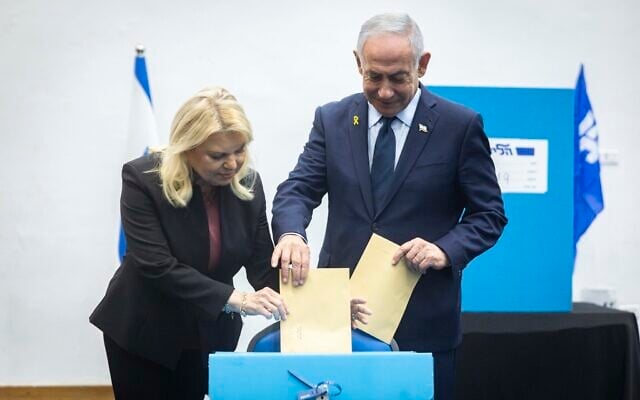
Prime Minister Benjamin Netanyahu and his wife Sara cast their votes during elections for the Likud Central Committee at the International Convention Center in Jerusalem, November 25, 2025. (Chaim Goldberg/Flash90)
The report added that Netanyahu discussed the pardon request with US President Donald Trump during their phone call Monday evening, and that the president — who had himself urged Herzog to pardon the premier — welcomed the move.
In a highly irregular intervention by an American leader in Israel’s internal affairs, Trump — who has faced numerous legal battles of his own — called for the charges against Netanyahu to be dismissed in a speech to Knesset in October and again in a letter to Herzog last month.
In a video statement on Monday, Herzog said that the request to pardon the prime minister “will be handled in the most proper and precise way. I will consider only the good of the country and Israeli society.”
The president is expected to take several weeks before reaching any decision.
You appreciate our journalism

You clearly find our careful reporting valuable, in a time when facts are often distorted and news coverage often lacks context.
Your support is essential to continue our work. We want to continue delivering the professional journalism you value, even as the demands on our newsroom have grown dramatically since October 7.
So today, please consider joining our reader support group, The Times of Israel Community. For as little as $6 a month you’ll become our partners while enjoying The Times of Israel AD-FREE, as well as accessing exclusive content available only to Times of Israel Community members.
Thank you,
David Horovitz, Founding Editor of The Times of Israel