
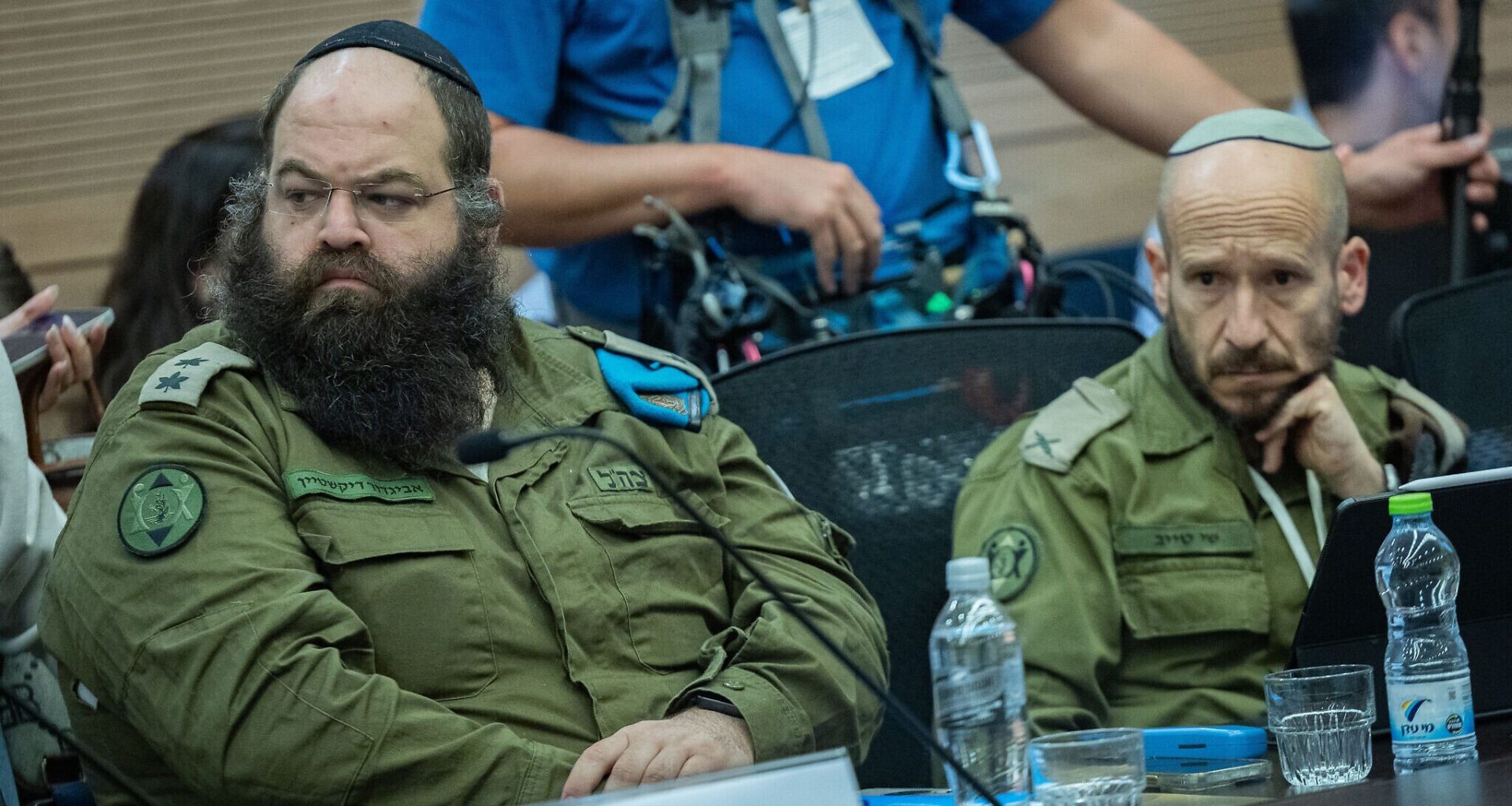
A top military officer on Tuesday told the Knesset Foreign Affairs and Defense Committee that the IDF could conscript any number of much-needed ultra-Orthodox recruits provided it is given advance warning, as the key panel continued deliberations on controversial legislation aimed at regulating Haredi draft exemptions.
Addressing the committee, Brig. Gen. Shay Tayeb, head of the IDF Personnel Directorate’s Planning and Personnel Management Division, said that the army can handle an additional 5,760 Haredi soldiers this year and “given advance warning, it could absorb everything needed beyond that” going forward.
The coalition bill regulating Haredi conscription and exemptions, which is currently being debated in the committee, calls for recruitment goals of 8,160 conscripts in the first year, 6,840 in the second, 7,920 in the third, 8,500 in the fourth, and “no less than 50 percent of the annual enlistment cohort from graduates of Haredi educational institutions” in the fifth year.
This minimum threshold will also include those performing non-military security services, although this group will be capped at 10% of the total.
“First, I said in previous committees that I personally believe everyone can serve in the IDF because we have opened enough diverse tracks,” Tayeb told lawmakers, adding that “these 10% do not contribute to what the IDF needs.”
Get The Times of Israel’s Daily Edition
by email and never miss our top stories
By signing up, you agree to the terms
For the past year, the Haredi leadership has been pushing for the passage of a law that would largely keep its constituency out of the IDF, after the High Court ruled that decades-long blanket exemptions from army duty informally afforded to full-time Haredi yeshiva students were illegal.
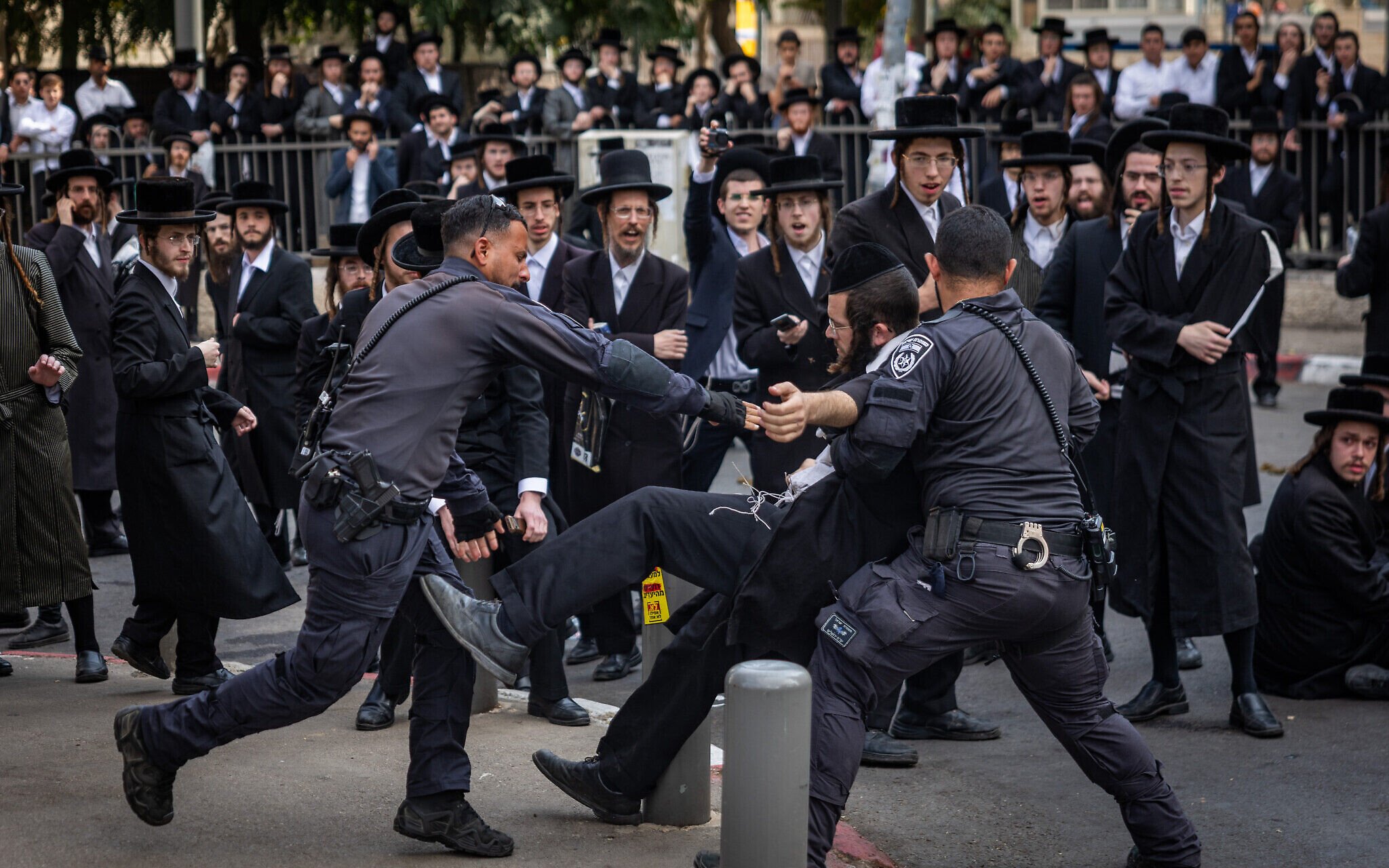
Police detain an ultra-Orthodox man during a protest against Haredi enlistment to the IDF outside a military recruitment center in Jerusalem, November 12, 2025. (Chaim Goldberg/Flash90)
Some 80,000 ultra-Orthodox men aged between 18 and 24 are currently believed to be eligible for military service, but have not enlisted. The IDF has said it urgently needs 12,000 recruits due to the strain on standing and reserve forces caused by the war against Hamas in Gaza and other military challenges.
The legislation, as currently laid out, would continue to grant military service exemptions to full-time yeshiva students while ostensibly increasing conscription among graduates of Haredi educational institutions.
However, the bill would also remove various provisions from an earlier draft by Likud MK Yuli Edelstein — who was recently deposed as chairman of the Knesset Foreign Affairs and Defense Committee — that were intended to ensure that those registered for yeshiva study are actually studying, and cancel all sanctions on draft evaders when they turn 26.
Threats against coalition dissenters
Amid rising dissent from within the coalition, including from the ruling Likud party, it is unclear whether the bill in its current form would win a majority in its second and third readings to become law without first undergoing major revisions. So far, at least eight coalition lawmakers have voiced their public opposition, with multiple others thought to quietly hold similar views.
Some coalition lawmakers who have expressed public opposition to the proposed bill have been contacted by members of Prime Minister Benjamin Netanyahu’s circle who have hinted at potential consequences should they continue to speak out against the legislation, the Walla news site reported on Tuesday.
Speaking with The Times of Israel last week, Edelstein warned that Netanyahu’s coalition is set to exert significant pressure on coalition lawmakers who are “strongly opposed” to the controversial legislation.
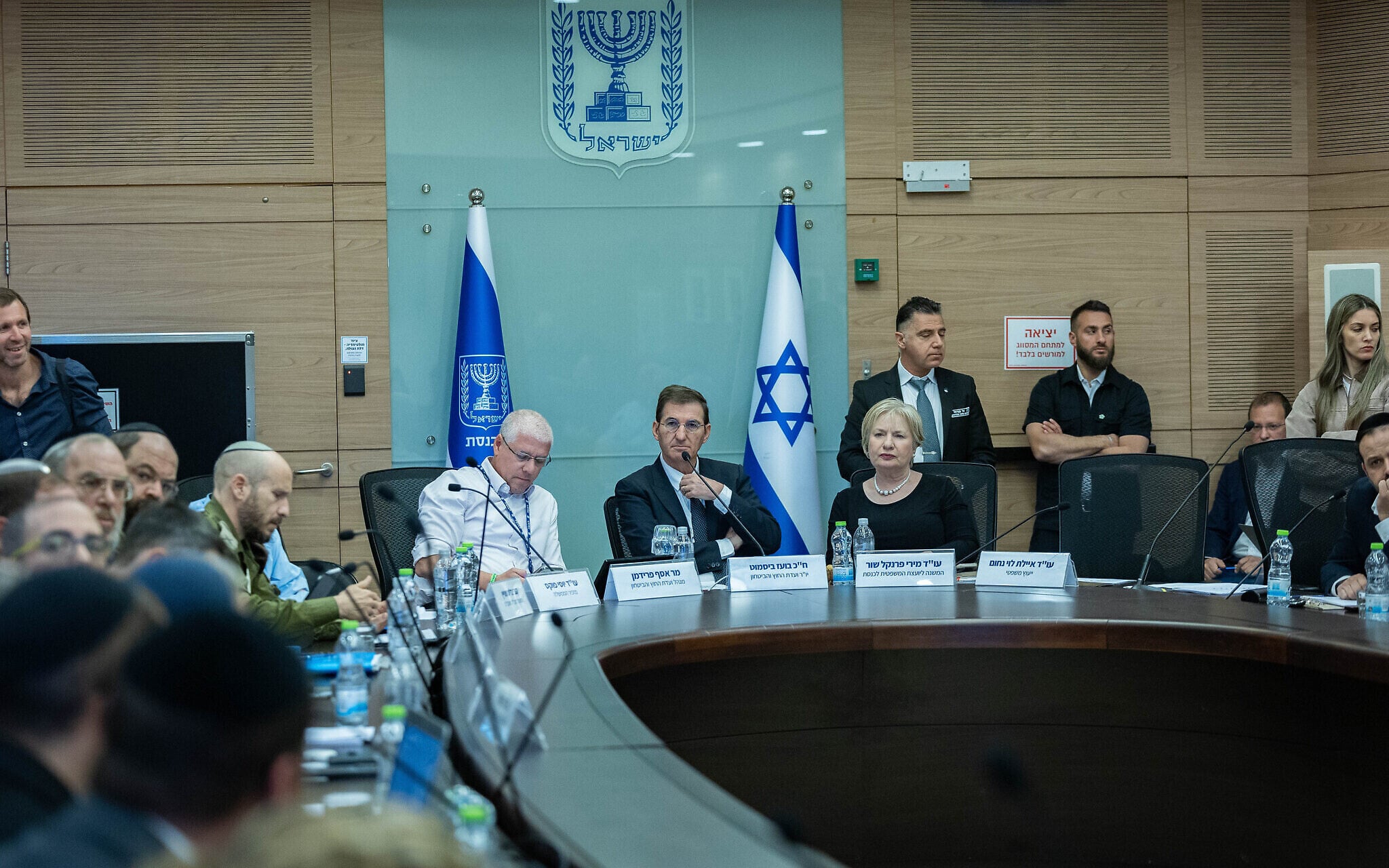
Likud MK Boaz Bismuth (C), chair of the Foreign Affairs and Defense Committee leads a meeting at the Knesset, in Jerusalem, December 2, 2025. (Yonatan Sindel/Flash90)
Asked if he or any of his colleagues had been threatened in such a way, Likud MK Dan Illouz, a vocal critic of the legislation, told The Times of Israel on Tuesday that “I haven’t seen anything like that.”
“I haven’t been approached, and I haven’t heard of other people being approached. I imagine that there will be, you call it pressure or threats or things like that,” Illouz said.
He added: “I think it’s healthy in politics for people to try to convince each other. And so if people have different views, they’ll try to convince each other. And yes, when the prime minister is the one trying to convince you, there is a certain amount of, I don’t know if I want to call it pressure, but his stature gives a certain amount of weight to his positions. And so, yes, you need to have a very strong shoulder in order to be able to keep your positions if you’re not convinced.”
Another MK also told The Times of Israel that they have not come under any pressure, although a source with direct knowledge of the matter confirms that some opponents of the bill have been subjected to threatening calls.
Meanwhile, Likud MK Avihai Boaron dismissed the criticism some of his coalition colleagues have aimed at the bill, arguing that while “maybe some adjustments need to be made here or there… ultimately, the law itself is a good law.”
“I don’t think there’s opposition inside the coalition. There are a few MKs who are uncomfortable with certain clauses, but precisely for that reason, we brought the bill to the committee table. You know what needs refining, it’s known, and the work will be done, and we’ll move forward, God willing,” he told The Times of Israel on the sidelines of the Foreign Affairs and Defense Committee debate over the bill.
Boaron claimed the bill will recruit tens of thousands of Haredim in a matter of years, significantly more than envisioned by previous opposition legislation, and will create a new reality on the ground in which Haredi soldiers will become accepted in the ultra-Orthodox community “because the rabbis approved this law and this framework, and the community will accept them.”
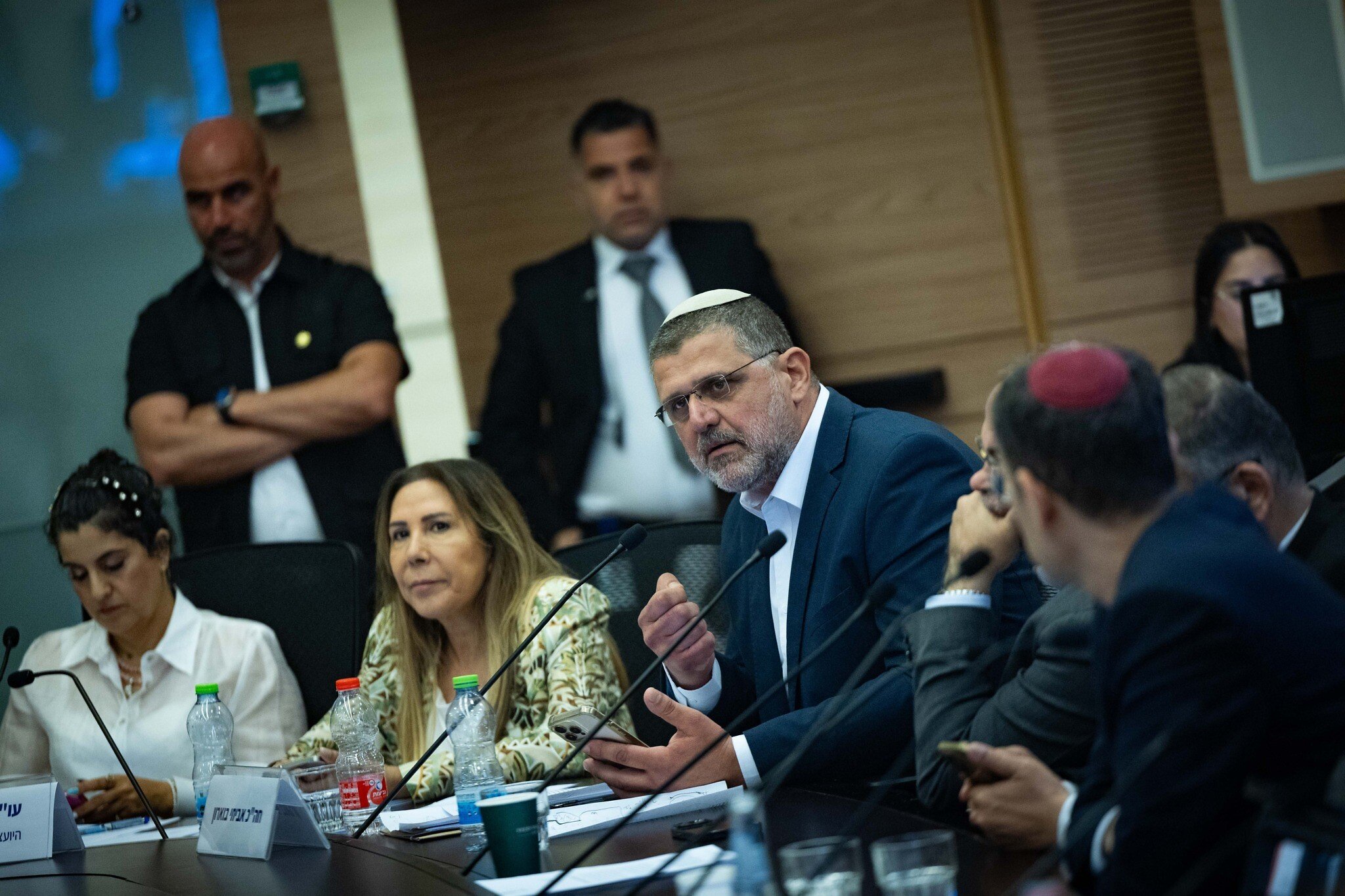
Likud MK Avichai Boaron attends a meeting of the Knesset House Committee, June 30, 2025. (Yonatan Sindel/Flash90)
“Young Haredi people will live in the example of their older peers who are enlisting, and this will bring change,” he said. “Therefore, we need to be smarter and a bit less rigid,” and “we will bring exponential change in the recruitment of young Haredim who are not occupying the yeshiva benches.”
Asked about her party’s position on the bill, which has remained vague, committee member Limor Son Har-Melech of the far-right Otzma Yehudit was noncommittal, merely telling The Times of Israel that “we support Haredi recruitment, but we oppose a method that creates antagonism.” She declined to say whether she and her colleagues will vote in favor.
Likewise, the far-right Noam party’s sole MK, Avi Maoz, declined to definitively state how he will vote, telling The Times of Israel only that while he wants to see more Haredim in the military, he would only support a noncoercive bill that receives Haredi rabbinic approval.
No Arab support
Arab-majority parties have said they will do anything to obstruct the work of the current government.
Ra’am MK Walid Taha told Radio Al-Shams on Tuesday that his Islamist party will not support the government’s proposed bill to regulate ultra-Orthodox enlistment, stating that “there will be no scenario in which Ra’am will support, be absent, abstain, or act in any way that could be interpreted as a lifeline for the government,” the Haaretz daily quoted.
Netanyahu’s ruling Likud party over the weekend denied that it had initiated contacts with Mansour Abbas’s Ra’am party in order to convince the Islamist party to vote in favor of its controversial legislation.
“The report on Channel 12 claiming that there were contacts or ‘feelers’ between Likud or anyone on our behalf and the Ra’am party regarding the conscription law is completely fake,” said Likud spokesman Guy Levy.
The chairman of another Arab party, Ayman Odeh of Hadash-Ta’al, has stated that his party’s position was “clear: We want to create complications for the government; we want to shorten its days. Anything that helps bring down the government — Hadash–Ta’al will support.”
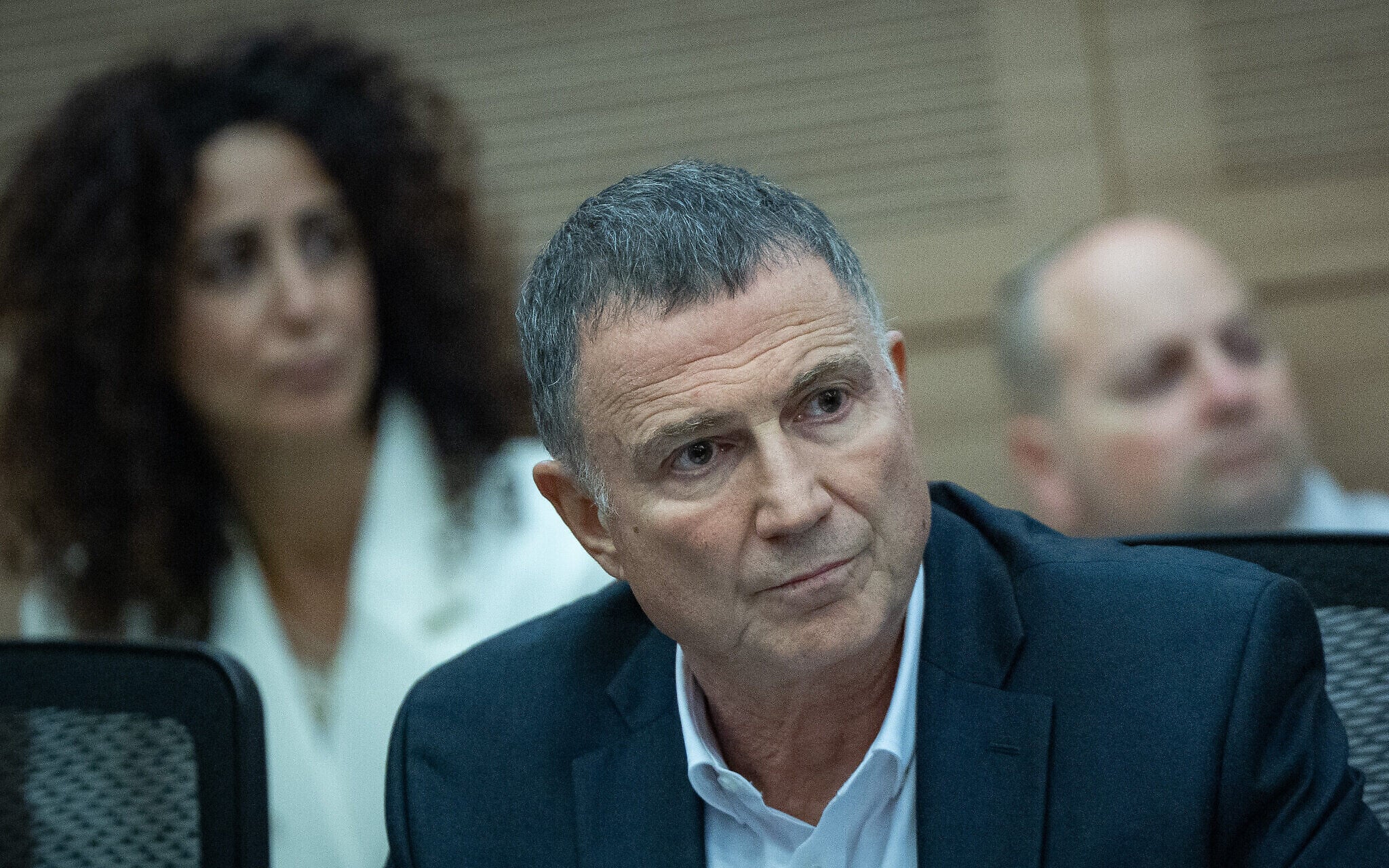
Likud MK Yuli Edelstein attends a Foreign Affairs and Defense Committee meeting at the Knesset, in Jerusalem, December 2, 2025. (Yonatan Sindel/Flash90)
Also on Tuesday, critics of the bill failed to amend the bill’s introduction, which lists its objectives, during a debate in committee.
The bill states that its goal is to “regulate the status of full-time yeshiva students while recognizing the importance of Torah study.” However, while it asserts that it aims to “reduce inequality in conscription for regular military service, including through the integration of members of the Haredi public into civil-security service,” it also states that full-time yeshiva students who do not engage in any other vocation can be granted annual deferments from enlistment.
It is up to lawmakers to decide which purposes listed have priority, or if all will be given equal weight, committee legal adviser Miri Frenkel Shor stated, who insisted that she had not yet given her final opinion on the bill despite reports that she is against it.
Committee chairman Boaz Bismuth (Likud) ended the discussion without any changes to the text, despite appeals from opposition lawmakers. He has previously stated that he intends to pass the bill during December, which would leave little time for substantive revisions.
Addressing the committee, Yesh Atid MK Moshe Tur-Paz insisted that the bill’s language should be amended to emphasize the value of “military service and civilian service, all while recognizing the importance of Torah study” in order to “address the issue of inequality.”
Separately, United Torah Judaism MK Ya’akov Asher slammed a recent Finance Ministry report that argued that the government’s bill regulating ultra-Orthodox conscription will not lead to an increase in enlistment, and could instead reduce the number of Haredim who join the military, in an address to the committee.

UTJ MK Ya’akov Asher attends a Foreign Affairs and Defense Committee meeting at the Knesset, in Jerusalem, December 2, 2025. (Yonatan Sindel/Flash90)
Asher, who represents the Haredi party’s Degel HaTorah faction, said that while some of the report’s arguments are based on the treasury’s area of expertise — the economy — “the conclusions it draws about the social and security aspects are not exactly professional.”
“When the treasury determines that sanctions will not encourage Haredi youth to enlist, or that the law will not solve the manpower situation in the IDF, it is basically making a psychosocial forecast outside its area of expertise. Assessments of community behavior, social pressure, or personal choices of young people are not budget formulas that can be calculated, and therefore have lower reliability,” he said, slamming opposition lawmakers for taking the ministry’s analysis at face value.