

Listen to this article
Estimated 5 minutes
The audio version of this article is generated by text-to-speech, a technology based on artificial intelligence.
You better watch out, you better not cry. You better not post decidedly unfestive signage along a parade route, I’m telling you why: Because people will call the police.
Well, maybe it’s not as catchy as the original, but that’s what happened in Brantford, Ont., last weekend during the city’s annual Santa Claus parade.
Brantford police confirmed with CBC News that they received calls from upset residents, as well as online and in-person complaints, after someone in a house along the parade route posted anti-Santa signs in its windows.
Brantford is about 100 kilometres southwest of Toronto. The daytime parade on Saturday attracted about 30,000 onlookers, according to the Brantford Expositor.
According to multiple social media posts that claim to show the house, the colourful signs said (and children, avert your eyes): “Santa is fake,” “Santa isn’t real,” “Your parents are Santa” and “Your family buys your presents.”
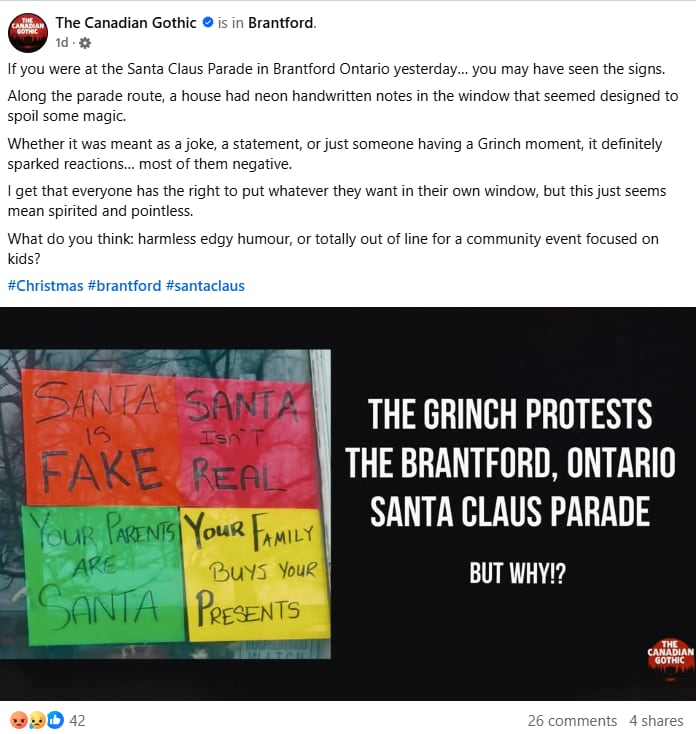 A Facebook post by The Canadian Gothic podcast from Nov. 30, 2025, claims to show a house in Brantford, Ont. (The Canadian Gothic/Facebook)
They’ve since been removed, according to police.
“An officer spoke with the individual responsible and the signs have since been removed,” Robin Matthews-Osmond, corporate communications manager for the Brantford Police Service, told CBC News in an online statement.
“While it isn’t illegal to be a ‘Grinch,’ we do encourage everyone to embrace the spirit of the season and help foster a positive, welcoming community, especially during events like the Santa Claus Parade,” she said.
Matthews-Osmond confirmed the signs weren’t illegal because of free speech laws and the fact that they were on private property.
WATCH | A Charlie Brown Christmas turns 60:
Throwback: Good grief! A Charlie Brown Christmas turns 60
A Charlie Brown Christmas is turning 60 this December.The staple TV special featuring the cast of Peanuts has been adapted into a stage play, and its iconic Christmas tree is even sold in stores, but did you know that at one point, a Canadian company helped turn it into an app?
‘Absolutely disgusting’
Online reaction to the signage was swift and merciless, with people calling it “mean-spirited” and “absolutely disgusting.”
“You don’t get to crush someone’s spirit or ruin something for someone else just because you don’t like something,” someone commented on a Facebook post by The Canadian Gothic podcast.
“How miserable do you have to be to actively try to ruin someone’s childhood?” wrote someone on an Instagram post by the Canadian lifestyle network 6ixBuzzTV.
But as appalled by some people may be, it’s not a criminal act or a hate crime to tell kids Santa isn’t real, said Michael Geist, the Canada Research Chair in internet and e-commerce law at the University of Ottawa’s faculty of law.
“I don’t think it’s unlawful either, though perhaps a municipal bylaw against a disturbance might be applied in a given circumstance,” Geist told CBC News.
“But even then, it would be subject to challenge on Charter grounds protecting freedom of expression.”
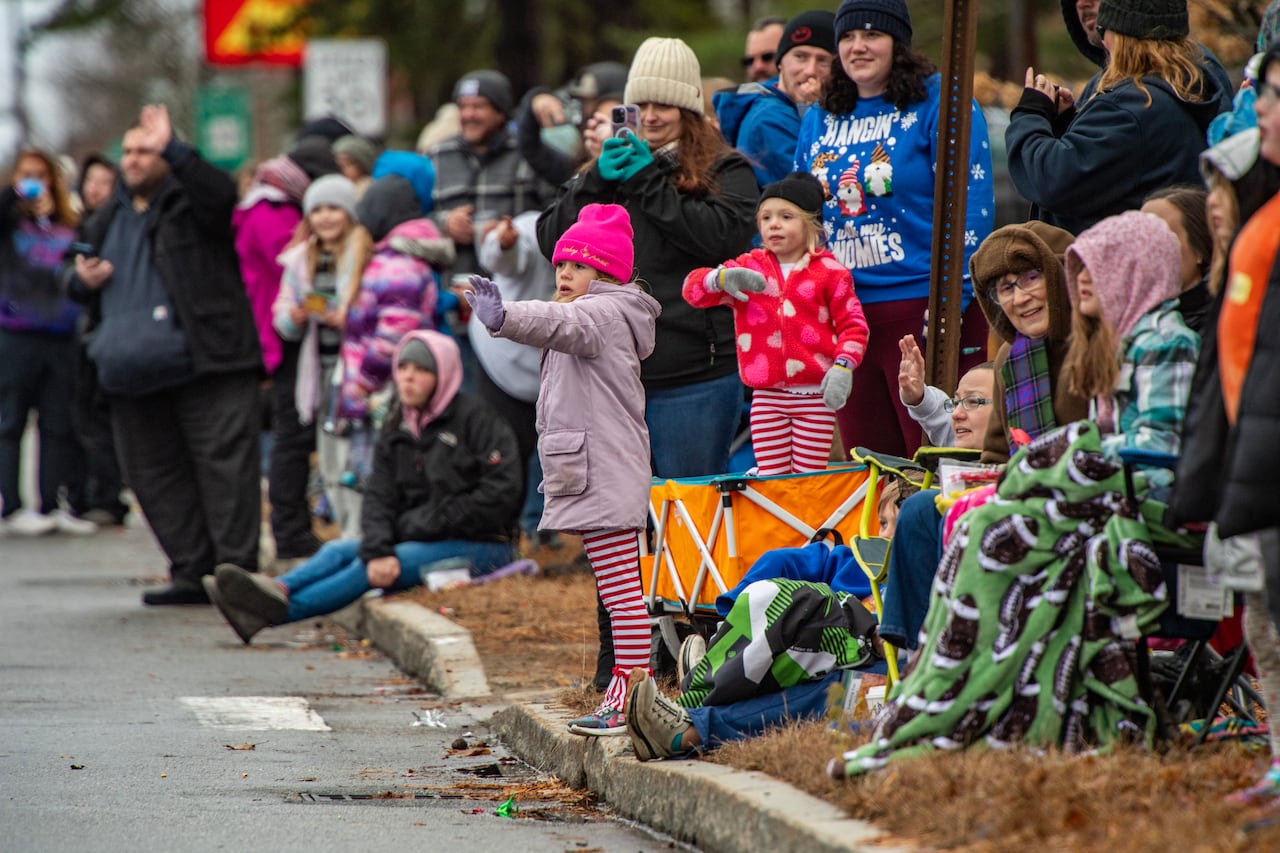 Children look up to Santa Claus as he goes by during the Christmas parade in Concord, N.H., on Nov. 23, 2024. (Joseph Prezioso/AFP/Getty Images)
There are limits to freedom of expression, but it’s a very high bar, said James Turk, director of the Centre for Free Expression at Toronto Metropolitan University. You can’t use or threaten the use of violence, for instance, harass someone or use hate speech, Turk told CBC News.
“There’s a lot of expression that people dislike, but we don’t deal with it by making it illegal,” he said.
“If someone’s going to be a Grinch at Christmas and put up signs like that, what will happen is what happened: someone will go talk to that person and they’ll take it down.”
A short history of Santa spoilers
That said, there have been cases where people were arrested while trying to spoil Santa.
In 2018, police in Texas arrested a 31-year-old man who told kids Santa wasn’t real outside a church that was hosting a breakfast with Santa event. Police said the man, who was protesting with two others, refused to leave and continued to cause a disturbance so he was charged with criminal trespass, according to The Associated Press.
In Kingston, Ont., police charged a man who was allegedly telling children Santa Claus did not exist during the city’s annual Santa Claus parade in 2012.
He was reportedly walking up and down the street telling kids his beliefs until his arrest.
Kingston Police confirmed with CBC News that the man was charged and convicted of causing a disturbance and breach of probation.
Then there’s Richard Dildy, a Toronto man who was arrested in 1979 after protesting inside and outside the Eaton Centre, shouting to holiday shoppers that Santa isn’t real, according to Toronto Today.
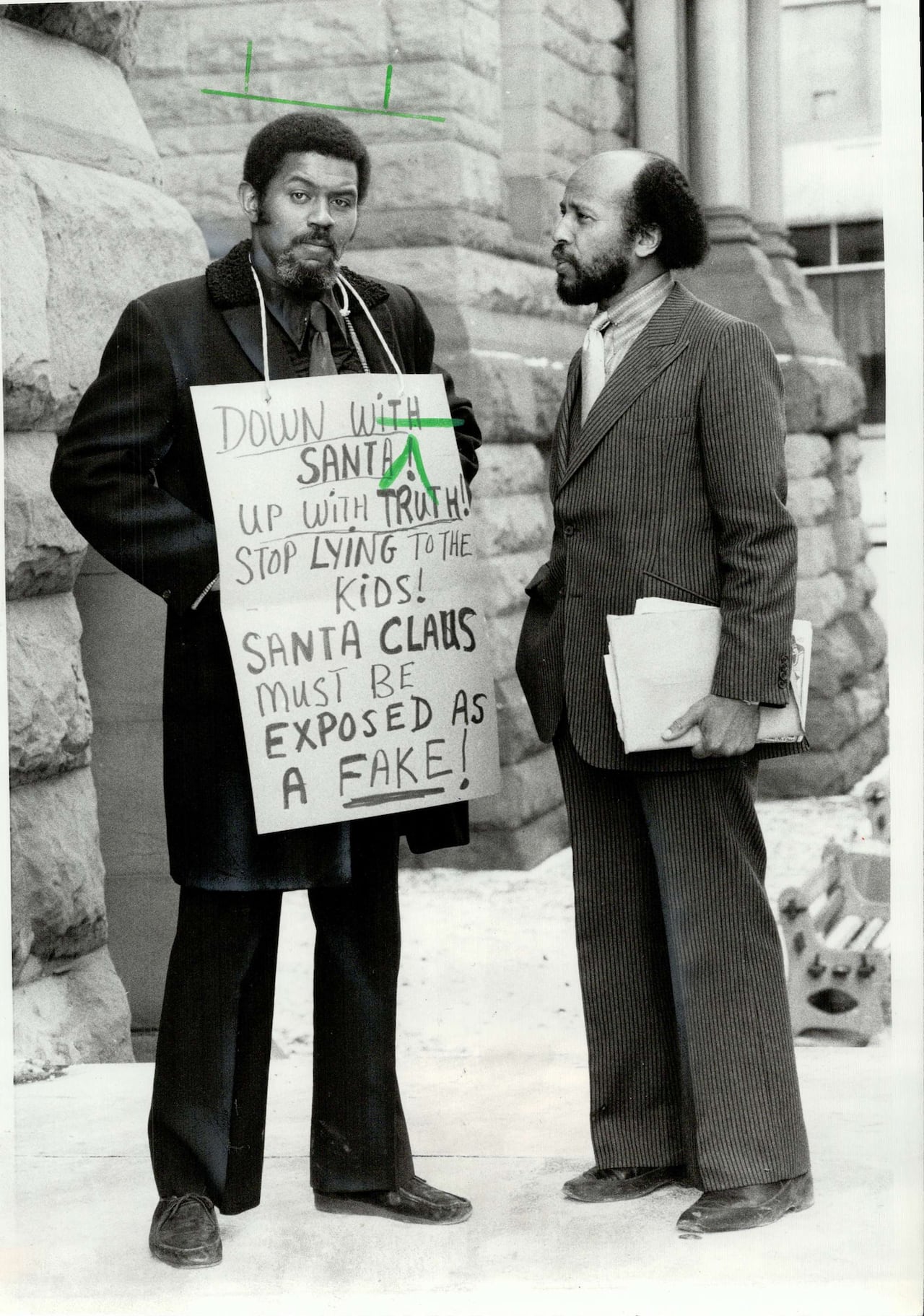 Richard Dildy wears a sign that says Santa Claus must be exposed in Toronto on Nov. 3, 1980. (Erin Combs/Toronto Star/Getty Images)
Dildy was arrested again during Toronto’s 1980 Santa Claus Parade for shouting, “There is no Santa Claus,” the publication said. He was given a $50 fine.
As Turk points out, none of these individuals was arrested for what they said about Santa, but for the circumstances: trespassing, mischief or causing a disturbance.
“Our courts really see the value of freedom of expression and so are very reluctant to have that right restricted,” he said.
LISTEN | Where is the line with freedom of expression?:
50:01Where is the line with free expression in Canada?
The suspension of a U.S. late-night host has reignited debate on both sides of the border about where free speech ends and harm begins. In Canada, conversations around book bans, anti-hate laws, campus protests, and online speech are forcing us to ask tough questions: what can you say, and when does it cross the line?
On this episode of Just Asking, we take your questions about freedom of expression with Hasan Alam, President of the B.C. Civil Liberties Association and a labour and human rights lawyer, and Ira Wells, President of PEN Canada, Academic Programs Director at Victoria College at the University of Toronto, and author of On Book Banning.