
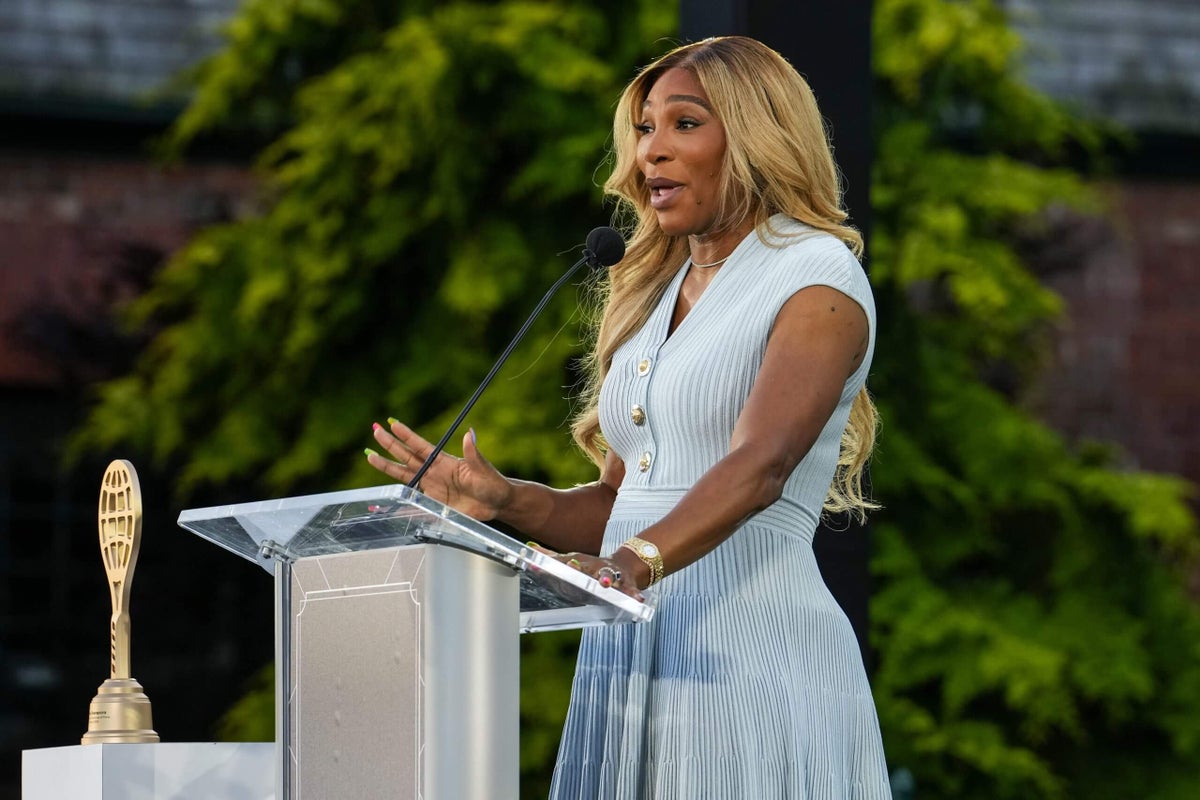
Serena Williams, the greatest women’s tennis player of all time, has taken a required step toward a sensational return to professional tennis.
The 23-time Grand Slam champion, who last played in 2022 and avoided using the word “retirement” in announcing her “evolving away” from the sport, has informed the International Tennis Integrity Agency (ITIA) that she wishes to reenter the sport’s International Registered Testing Pool.
Her name appears on an updated list of players in that pool, dated October 6 this year.
“She has notified us that she wants to be reinstated into the testing pool,” Adrian Bassett, a spokesperson for the ITIA, said in a text message Tuesday.
“I do not know if this means she is coming back, or just giving herself the option. All I can say is she’s back in the pool and therefore subject to whereabouts.”
A spokesperson for Williams, 44, did not immediately respond to requests for comment.
The testing pool does not encompass every active player, even though every active player is subject to out-of-competition testing.
Instead it is mostly comprised of the top 100 men’s and women’s singles players, elite doubles and wheelchair players, and players wishing to return to competition after a long hiatus. Players in the pool have to provide their whereabouts at a given time every day of the year, and anyone who reenters has to be in the pool for six months before playing a tournament.
Officials with the WTA Tour and the United States Tennis Association, who spoke on the condition of anonymity because they were not authorized to speak on their organization’s behalf, said that they were unaware that Williams had re-entered the testing pool.
While an October reinstatement would make her eligible to play from April 2026, the mostly likely venue for Williams to return would appear to be the U.S. Open mixed doubles tournament, which has become a star-studded, two-day event open to wild-card pairings from all over the tennis galaxy. She was one of the best doubles players of the modern era too, winning 14 Grand Slam titles and three Olympic gold medals with her sister, Venus, 45, who is still competing.
Serena, though, is not known for doing anything halfway. If she does come back, there is no reason to think she would not give singles a try. Venus played several singles matches last year, beating Peyton Stearns, at the time a top-40 player about half her age, at the Citi Open in Washington, D.C. last summer.
Serena’s return timeline could also permit her to enter Wimbledon, which she won seven times.
In the past year, Serena has become an ambassador for telehealth company Ro, which sells GLP-1 weight-loss medications. Her husband, Alexis Ohanian, is an investor and is on the company’s board. Williams has been open about her own use of GLP-1s, as well as her self-consciousness about her body image earlier in her tennis career.
“It was hard because when I was playing in the beginning – the first 15 years – my body was different,” she said in an interview with Net-a-Porter’s magazine published this week.
“I had big boobs; I had a big butt. Every athlete was like super flat, super thin and beautiful, but in a different way. And I didn’t understand as an athlete how to deal with that.”
The medications, which were originally developed to treat diabetes, are not currently on the World Anti-Doping Agency (WADA) list of prohibited substances. The organization has said it is studying and monitoring the drugs, which could result in them being added to the list in the future.