
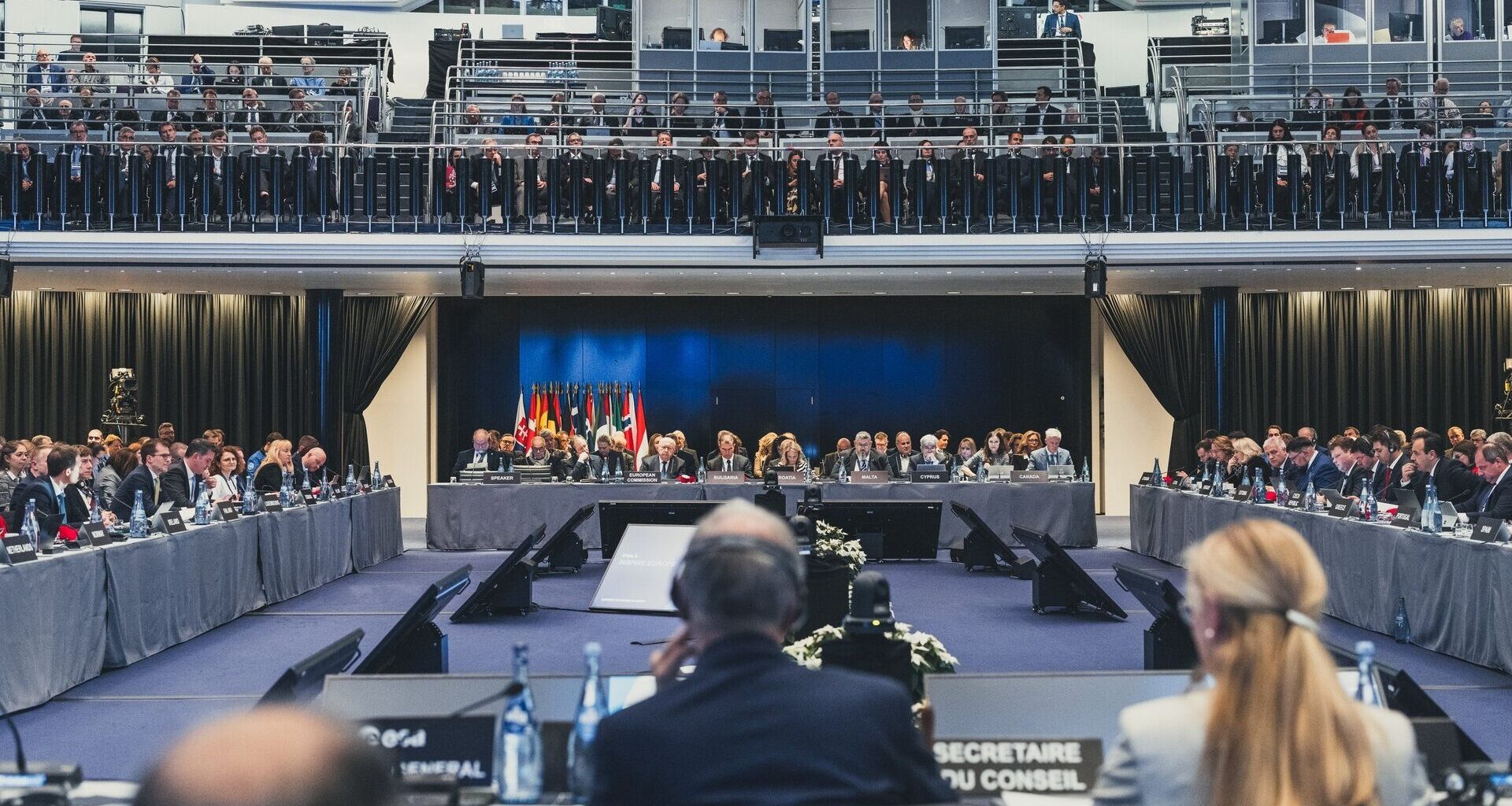
BREMEN, Germany — The European Space Agency member states have approved a record-breaking budget for the agency’s next three-year period, including an increase in funding for science exploration and dual-use technologies for security and defense.
The budget of nearly 22.1 billion Euros ($25.63 billion) was agreed upon at the European Space Agency‘s (ESA) Ministerial Council — a high-level conference of its 23 member states held every three years — which took place in Bremen, Germany from Nov. 25 to Nov. 27. The funding pledged by the member states will cover the period between 2026 and 2028 and is more than 5 billion Euros ($5.8 billion) higher than that subscribed for the previous budgetary period.
You may like
The squabble over NASA’s 2026 budget is leaving several joint science and exploration projects in uncertainty as the vision for the American space agency put forward by President Trump cuts funding for multiple international collaborations.
Despite the funding increase, ESA’s budget is still way below that of NASA. In fact, it is way below even the $18.8 billion offering proposed by the Trump administration for 2026, which presents a reduction of $6 billion compared to the 2025 budget.
Still, ESA hopes its new record-breaking budget will help Europe make important steps toward the continent’s sovereignty and autonomy in critical infrastructure including space launch systems and secure communications. These two areas have been particular pain points for Europe, which has lost its edge in rocket technology to SpaceX’s Falcon 9 and has a long way to go to catch up with the company’s Starlink internet-beaming mega-constellation. Investment into launch vehicle development makes up the highest portion of ESA’s new budget — 4.439 billion Euros ($5.15 billion) over the next three years, up 1.604 billion ($1.86 billion) compared to the triennial budget agreed in 2022.
Boost to science amid NASA chaos
Most importantly, ESA member states, for the first time in years, increased their spending on science missions, a sharp diversion from the Trump vision for NASA, which made massive sacrifices in science funding.
ESA will have 3.787 billion Euros ($4.39 billion) for its science project in the coming budgetary period, up 600 million Euros ($696 million) compared to the 2022 budget. The member states also pledged an additional 328 million Euros ($380 million) to ESA’s PRODEX program, which develops innovative science experiments and technologies.
“We have managed to come out from a relatively flat curve and we will increase [the science funding] in 2026, 2027 and 2028 by 3.5 percent per year in addition to inflation,” Aschbacher said in a press briefing. “This is a very important signal that with this budget, we can really focus on the backbone of the ESA program, which is the science program.”
Self-reliance
ESA executives hinted during the summit that the agency intends to become more self-reliant in the future. ESA has suffered painful setbacks in its international collaborations and although it still continues to seek partnerships, it will work toward securing all technologies “on the critical path” domestically, one ESA executive told Space.com on the sidelines of the conference.
You may like
The life-hunting ExoMars Rosalind Franklin rover is a prime example of such a fraught collaboration. First conceived as a partnership with NASA, Europe’s first Martian rover became a joint project with Russia in 2012 after budget cuts imposed by the Obama administration forced NASA to withdraw. Russia’s invasion of Ukraine in 2022, however, forced ESA to halt that partnership just a few months before a planned launch.
ESA member states subsequently had to invest an additional 360 million Euros ($417 million US) into the mission to build a new landing platform to replace the one made by Russia. NASA at that time stepped back in, offering to pay for a launcher and provide a few components not available in Europe. Trump’s budget proposal, however, cut that funding, leaving ESA once again in uncertainty. In the latest twist of events, Aschbacher said NASA had confirmed its commitment to the mission in a letter received on the eve of the Bremen meeting.
A further 19 science missions could be hit by the Trump-proposed budget cuts. The Laser Interferometer Space Antenna (LISA) gravitational wave observatory, the Venus orbiter EnVision and the proposed X-ray telescope New Athena all count on significant NASA contributions.
ESA’s Director of Science Carol Mundell told Space.com that ESA is working on a rescue plan for all three of those missions and estimates it would have to invest an additional 900 million Euros ($1.043 billion) over a ten-year period to get them all off the ground without NASA. That funding is not part of the latest science budget as most hope that at least some of the cancelled collaborations will be reinstated by the U.S. Senate and House of Representatives.
During its upcoming budget period, ESA wants to develop a proposal for a mission to land on the pole of Saturn’s moon Enceladus to search for life under its icy crust. That mission would launch in 2042 in order to reach Enceladus in 2053 when the positions of Saturn and Enceladus are favorable.
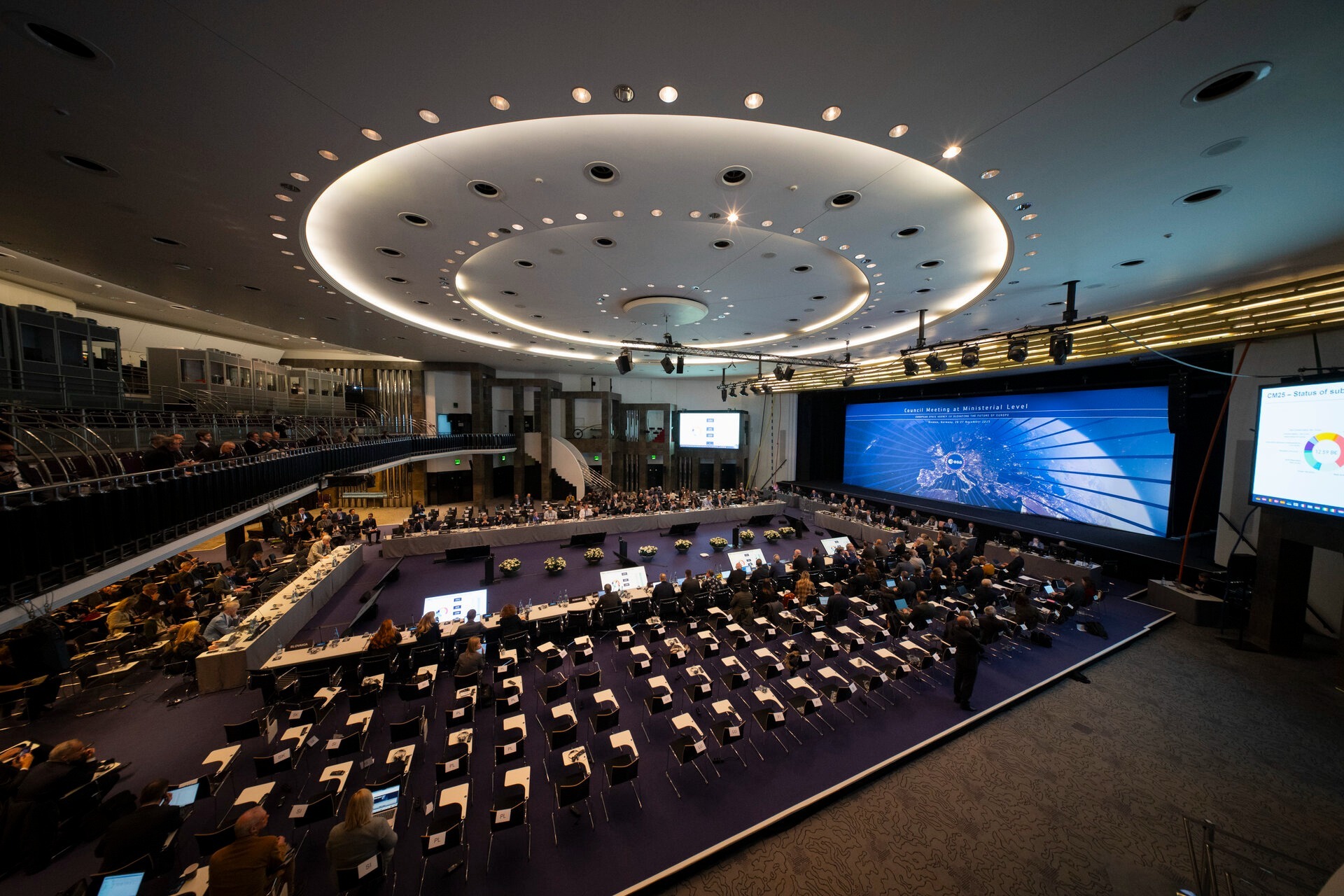
ESA’s Ministerial Council in Bremen, Germany held Nov. 25 to Nov. 27, 2025 (Image credit: ESA – S. Corvaja)New future for Orion Service Module and Earth Return Orbiter
ESA’s budget for human and robotic space exploration received only a minor boost compared to 2022 and will have just a little under 3 billion Euros ($3.5 billion) to work with in the next three years.
Most of ESA’s exploration activities, including its presence at the International Space Station, are done in cooperation with NASA. But the agency’s Director for Human and Robotic Exploration Daniel Neuenschwander told Space.com that here, too, ESA would work to strengthen its position.
“The three billion of support for exploration activities will serve to increase our own capabilities,” Neuenschwander said. “It’s very simple. If you want to be a partner sitting at the table and not to be on the menu, you need your own capabilities.”
ESA develops the service module, which provides power, propulsion and atmosphere regeneration for NASA’s Orion spacecraft, designed to take Artemis astronauts to the moon. That program, however, is another victim of Trump’s proposed NASA budget cuts. Currently, NASA expects to discontinue Orion and its launching rocket, the Space Launch System, after the Artemis 6 mission in the early 2030s and replace the combo with commercial vehicles. Neuenschwander said ESA would study options to convert the service module into a multi-purpose space tug to keep the technology in use.
The new funding will also allow ESA to repurpose the Earth Return Orbiter which was to bring back to Earth samples collected by NASA’s Perseverance Mars rover. The Mars Sample Return mission was axed by the Trump administration, and although it might be reinstated by the Congress, ESA’s plan is to use the technology for a new Mars-orbiting mission. Called ZefERO, the mission would launch in 2032, study Martian geology and atmosphere, and serve as a communication relay for rovers on the Red Planet’s surface.
The agency will also continue with the development of components of the Lunar Gateway, a space station foreseen to orbit the moon from 2027, and the lunar lander called Argonaut, designed to place around 3,300 lb (1,500 kilograms) of cargo on the moon’s surface.
At the conference, Aschbacher announced that the first European astronaut to fly to the moon with one of the future Artemis missions will be from Germany, ESA’s currently largest budget contributor.
Further programs that received significant funding increases include Earth observation, connectivity and secure communications and navigation. ESA previously announced plans to develop a low-Earth-orbit navigation constellation to serve as a back-up to Europe’s alternative to GPS — the Galileo global navigation satellite system.
The member states also approved the European Resilience from Space (ERS) program, which will include communications and Earth observation satellites serving defense-related purposes. The ERS program received $1.39 billion in funding from the member states, many of which have previously announced substantial boosts to domestic spending on space defense technologies.
The program is a response to rising tensions with Russia and Europe’s acknowledgement of its dependencies on American space defense assets. For ESA, however, ERS is a major departure from its founding document, the Convention, which explicitly states the Agency is dedicated exclusively to peaceful purposes.