
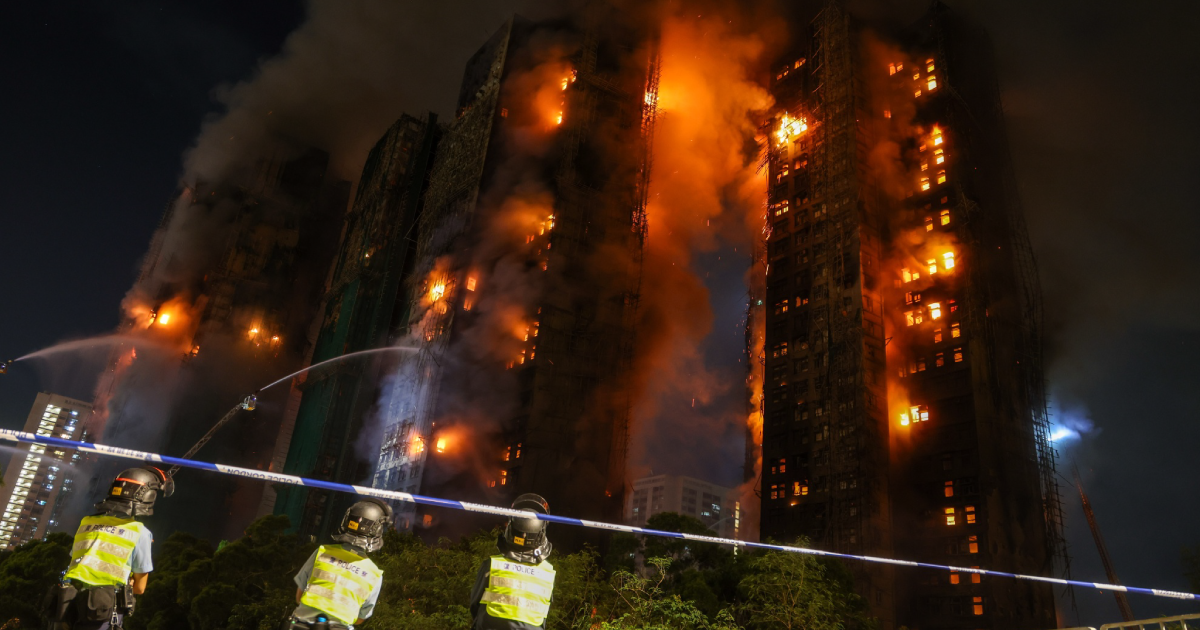
One of the towers at Wang Fuk Court in Hong Kong on Nov. 28. Photographer: Leung Man Hei/Bloomberg
Outrage over the catastrophe threatens to revive dissent that Beijing has sought to eradicate.
December 2, 2025 at 6:00 PM EST
As workers erected bamboo scaffolding around Hong Kong’s Wang Fuk Court last year, a group of residents grew alarmed about plans to put styrofoam boards over windows to protect the glass.
On a September evening in 2024, they decided to stage an experiment. With homeowners gathered in the green space under the eight towers — each 31 stories tall, housing a combined 4,600 people — the group placed a cigarette lighter under a styrofoam board. It quickly burst into flames.
Hong Kong Fire Destroys Wang Fuk Court Complex
Fire service alerted to a blaze on Nov. 26 at 2:51 p.m. HKT
Sources: CNES/Airbus; Maxar Technologies
According to several attendees, who asked not to be identified for fear of retribution, a representative of Will Power Architects Co. Ltd. — the consultancy overseeing the roughly HK$330 million ($42 million) renovation — simply brushed off their concerns, saying that styrofoam wasn’t illegal. In the following weeks, the contractor on the project — Prestige Construction & Engineering Company — installed the boards across the complex, leaving residents to live in fear they would be caught in an inferno.
“Of course I was scared, how could I not be?” said Chan Yuen Yuen, 68, who was out when the blaze began, recalling how the foam boards plunged her apartment into prolonged darkness.
Now more than 150 people are dead and executives of both companies are among about a dozen people arrested as Hong Kong races to find those accountable for the city’s deadliest fire in nearly eight decades. Authorities have blamed the styrofoam boards, substandard netting that encased the towers and inoperable fire alarms for contributing to the high death toll — all factors generating public outrage unseen since Beijing imposed a sweeping national security law in 2020.
Interviews with roughly a dozen residents and homeowners, as well as a review of project documents, show a series of missed opportunities to prevent the tragedy. They include several that have been previously unreported, such as misleading statements by the contractor and an appeal in early 2024 for the Independent Commission Against Corruption — Hong Kong’s anti-graft agency — to investigate the company. That’s on top of moves by residents to replace the homeowners’ committee that oversaw the bidding process, seek action from the Labour Department and alert local media about their concerns.
Smoke rises from the buildings at Wang Fuk Court on Nov. 27. Videographer: Lam Yik/Bloomberg
Outrage over the catastrophe now threatens to rekindle dissent the Communist Party has devoted the past six years to eradicating, with Chief Executive John Lee under pressure to deliver justice while also preventing the kind of mass street protests that erupted back in 2019. Growing calls for him to establish an independent inquiry — echoing the “five demands” that galvanized demonstrators back then — are testing the extent to which Hong Kong’s separate legal system is being transformed by Beijing’s playbook, which seeks to quell public anger without a transparent investigation.
In a briefing on Tuesday, Lee pledged to appoint an independent committee to look into the fire and to make the results public, while vowing to crack down on forces that “sabotage” social unity. Unlike a Commission of Inquiry, which under Hong Kong law has subpoena power and public hearings, an independent committee relies on voluntary participation and testimony isn’t given under oath.
How Hong Kong’s Deadly Fire Spread
Note: Distances between buildings are approximate Sources: Google Earth and local reports
“We have to expose the truth, do everyone justice and make sure the deceased can rest in peace,” Lee said, standing behind a black background and wearing a dark tie. “We should turn our anger and sorrow into the power of reform.”
In addition to at least 15 people arrested in connection with the fire, local media reported that three others have been taken in by national security police. One of them — Kenneth Cheung, a former district councilor — posted on Facebook that a “human chain” to deliver donated goods reminded him of 2019. He also amplified a post by Christopher Patten — the last governor before Britain handed Hong Kong over to China — on his decision to establish a Commission of Inquiry after a 1996 fire that killed 41 people. “A good post-disaster review is not about finding scapegoats, but about uncovering the truth,” the post said.
So far, the outrage is largely in the digital space. An Instagram page titled Tai Po Wang Fuk Court Fire Concern Group set up last week raised “four demands” for the government, including an independent inquiry and holding officials to account, before it was taken down. Online petitions amplifying those terms proliferated, with one garnering more than 10,000 signatures before being closed. Police didn’t confirm the national-security arrests in a response to questions, saying only they will take actions in accordance with the law.
Luk Yu Yeung, who lost his 71-year-old mother in the fire, posted the four demands from the petition on X on Monday, after his mother’s body was found. “These demands are actually very basic and simple,” he said by phone. “These are things they should be doing — they shouldn’t need to be told.”
“No matter how long it takes, the government owes us an answer regarding this project,” Luk added. “After all, more than 150 people burned to death. It is a true tragedy. And this was a man-made disaster, not a natural one.”
Investigation Launched Into Fatal Hong Kong Fire
Safety concerns have been raised regarding materials used by contractors
Sources: Bloomberg and local reports
Perched on Hong Kong’s northern shores beside the Tolo Harbor, Wang Fuk Court hardly stands out in a skyline dominated by towering blocks. More than a third of its inhabitants are over 65 years old, many of whom moved in when it first opened in the early 1980s, when the colonial government rolled out a series of housing projects for low-income families.
Elderly residents, particularly on the higher floors, had little time to escape after the blaze was first reported at 2:51 p.m. on a sunny afternoon last Wednesday. Authorities later said protective netting on a lower floor of one building caught fire and spread to the foam screens covering the windows, prompting a vertical column of flames to shoot up one of the towers in a so-called chimney effect. With no fire alarms sounding, residents shouted at each other to evacuate.
For many, it was already too late. Within hours, seven of the eight towers in Wang Fuk Court were ablaze. The inferno raged for nearly two days, burning victims beyond recognition in their apartments. Lee said on Tuesday that 30 people are still missing.
The fire has shone a spotlight on persistent social tensions in one of the world’s most unequal cities, where millions of people cram into tiny apartments as the government restricts land available for housing, giving local billionaire family developers outsized market power. That’s driven up property prices and squeezed together high-rises like those at Wang Fuk Court, where the towers stood as little as 7.5 meters (25 feet) apart — even less with the bamboo scaffolding, which allowed the fire to quickly jump from one building to the next.
The disaster was long in the making. Back in 2016, the government issued a mandatory inspection order for the estate in compliance with Hong Kong law, which says private buildings more than 30 years old must be checked for necessary repairs and renovated. Roughly 29,000 buildings — accounting for 60% of the city’s total — have reached that threshold, and thousands more will join over the next decade.
Like many private residential buildings in Hong Kong, Wang Fuk Court is managed by an owners’ corporation that oversees repair work. In 2019, the estate’s owners committee picked Will Power Architects to inspect the towers. The consultancy identified issues including damage to exterior walls and inadequate fire-safety measures, and prepared the project for bidding. In early 2024, Prestige Construction & Engineering won the contract over 56 other companies.
Residents Raised the Alarm Multiple Times Before Deadly Blaze
Disputes soon erupted among residents over the selection process for the contractor, with families shocked by the requirement to each pay more than HK$160,000 for the repairs — with the first installment due in a matter of weeks.
They weren’t aware at the time that the money was going to a contractor on the radar of authorities: Back in October 2023, in an interview as part of the bidding process, Prestige Construction said it had never been prosecuted by the Labor Department, which has its own division that can bring cases to court. Yet records provided by the department to Bloomberg News show Prestige Construction was in fact already being prosecuted at the time.
Then in early 2024, more than a dozen Wang Fuk Court residents went to a regional office of the Independent Commission Against Corruption to file a complaint regarding the renovation project, according to a person with knowledge of the matter. In a statement to Bloomberg News, the anti-graft body said it isn’t appropriate to comment at this stage as its investigation is ongoing.
Polystyrene pieces found on the ground at Wang Fuk Court. Photographer: Leung Man Hei/Bloomberg
The residents ultimately failed to stop the construction. By July of that year, bamboo scaffolding began to go up around the towers. Still angry about the expensive bill, homeowners convened a general meeting in September 2024 and voted to remove the management committee responsible for overseeing the bidding. Yet the contract had already been signed, leaving the new committee with no choice but to proceed.
By then, alarm over safety risks had escalated. Beyond concerns over the styrofoam boards, punctuated by the move to burn them at a public meeting, residents wrote to the Labour Department with questions over whether the protective netting wrapped around the buildings was flammable. In a statement, the department said it had inspected the estate 16 times since July last year, and found the netting’s quality certificate met official fire-retardant standards.
During those visits, Labour Department inspectors warned about fire-safety hazards and found several other violations, issuing fines as much as HK$18,000. During the final inspection on Nov. 20 — less than a week before the blaze — the department reiterated the need to adopt better fire-safety measures even though “no matters warranting prosecution were discovered,” it wrote in an email to Bloomberg News.
Students leave flowers outside Wang Fuk Court on Nov. 28. Photographer: Leung Man Hei/Bloomberg
Representatives from Will Power Architects didn’t respond to phone calls and emails seeking comment. Phone calls to the offices of Prestige Construction and Engineering went unanswered.
While the cause of the fire is still under investigation, scrutiny has focused on renovation materials.
On Monday, officials said the blaze was accelerated by cheaper, substandard scaffolding nets and foam boards. After a typhoon damaged the original netting in July, individuals under investigation bought 2,300 rolls of substandard material at HK$54 a roll, enough to cover all eight buildings, according to ICAC chief Woo Ying Ming. Another 115 rolls that met fire standards were bought at HK$100 apiece and installed at the base of the scaffolding in order to pass safety inspections, he said.
Minimum Distance Required Between High-Rise Buildings
Note: Singapore requires a minimum of 22.2 meters between tower blocks of 31 stories. Chongqing requires a minimum of 26 meters between residential buildings of 24-60 meters. Source: Government authorities
Jason Poon, chairman of CHINAT Engineering Ltd., said that while styrofoam isn’t specifically banned, Hong Kong’s building regulations make it clear the material shouldn’t be used in renovation projects.
“In the early days of my career, about two decades ago, styrofoam was still used in Hong Kong,” said Poon, who had been helping Wang Fuk Court residents raise safety concerns with the government. “But because it burns so violently, gradually no construction project dared to use it anymore. It’s a material that is widely known to be dangerous.”
The blaze at Wang Fuk Court on the night of Nov. 26. Photographer: Yik Yeung-man/Bloomberg
Known for his whistle-blowing activism in construction projects, Poon said some residents had called the Fire Services Department to express concern. But authorities later reviewed the certificates of the materials and found they met official standards, according to Poon. “The oversight is obviously lacking,” he added.
In a statement to Bloomberg, the Labour Department said the objective of its inspections was to assess whether conditions at the construction site posed any safety risk to workers. “The materials used to seal windows in residential units are generally not a priority in our inspections,” it said.
Tsui Mun Kam, chairman of the new homeowners’ committee that took over in September 2024, said he repeatedly raised concerns about the protective netting and styrofoam in weekly meetings with Will Power Architects and Prestige Construction. The companies assured him the materials were tested and reviewed, Tsui said by phone.
The Housing Bureau’s Independent Checking Unit had also dispatched inspectors multiple times a month to check on the renovation project, he added. “They can’t say they never noticed the styrofoam boards,” Tsui said.
The Housing Bureau referred Bloomberg News’ request for comment to a statement issued last week. It said the Independent Checking Unit didn’t identify “any non-compliance issues” against fire-retardant requirements in a test report on the protective nets submitted by the contractor. Officers from the unit visited Wang Fuk Court in November 2024 to oversee how the contractor conducted on-site sampling and burned the material, but no combustible feature was detected, according to the statement.
All of this will now be scrutinized by the courts. And questions will linger over how the government will hold itself to account — and what will happen if it fails to act sufficiently. In a sign that Hong Kong still retains a different system from the mainland, reporters peppered the city’s leader with questions on Tuesday — including a pointed one about whether he would resign. Lee sidestepped it, saying criminals who commit offenses should be punished.
At the same time, the push to suppress expressions of concern from the public suggests that authorities view the fallout as a serious threat to the government’s “credibility and capacity to maintain stability and good order,” said Steve Tsang, director of the SOAS China Institute in London.
At Wang Fuk Court, light is finally streaming through the windows, into homes blackened by soot and strewn with rubble. Hundreds of mourners queued over the weekend to lay flowers and pay tribute at makeshift memorials as police continued to search for remains. Around the estate, handwritten signs urged residents to stay strong. “The people of Hong Kong are with you,” one said.
Luk, the 29-year-old who lost his mother to the fire, was conflicted about the scenes of camaraderie.
“Does it always take a crisis like this to bring us together?” he said. “I don’t think anyone wants to come together like this.”
More On Bloomberg