
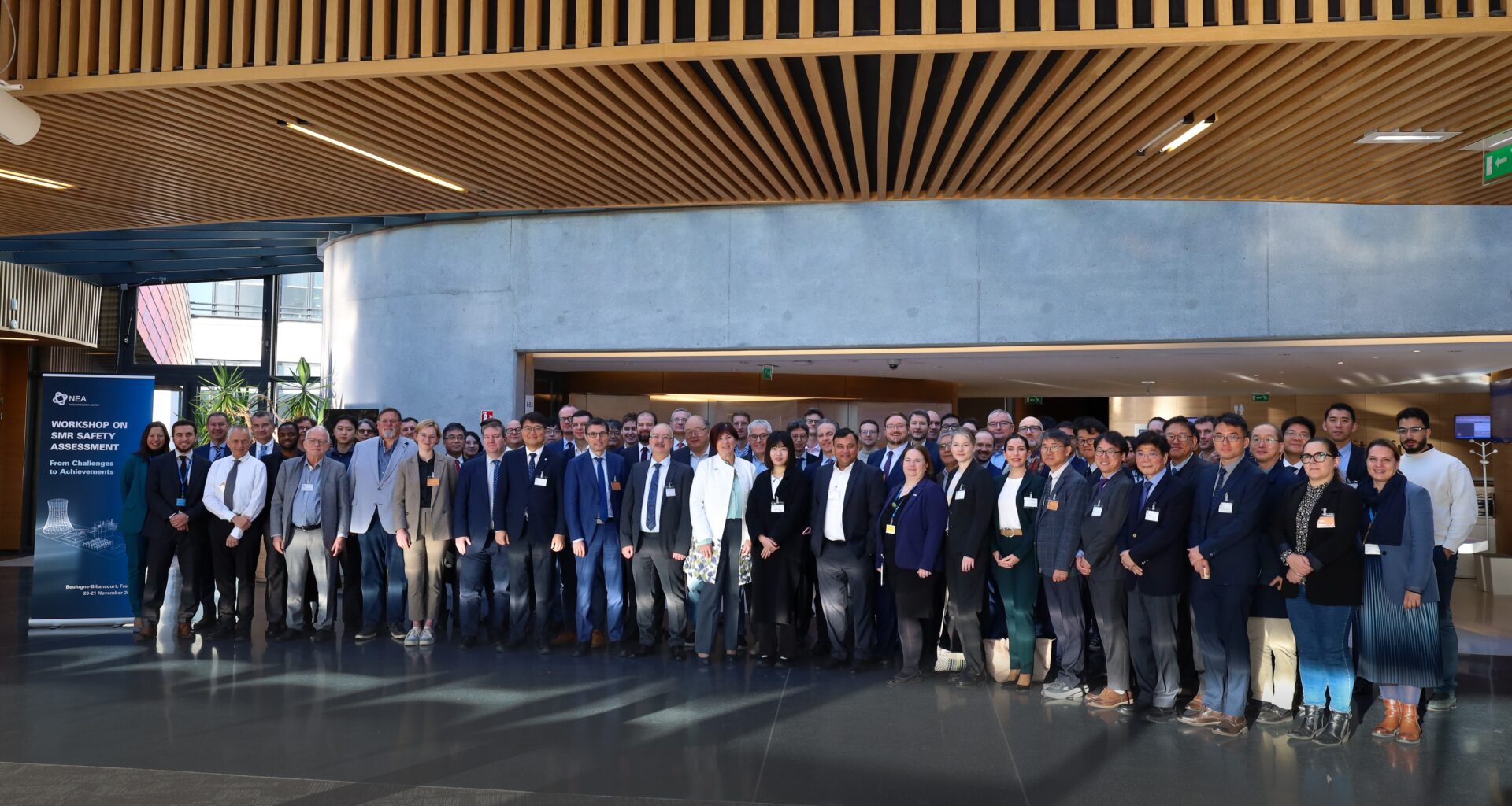
The NEA hosted the Expert Group on Small Modular Reactors (EGSMR) Workshop “SMR Safety Assessment: from Challenges to Achievements”, bringing together more than 100 participants from over 20 countries on 20-21 November 2025. The event welcomed a diverse group of professionals, including representatives from regulatory bodies, technical safety organisations, research organisations and vendors.
The aim of the workshop was to cluster recent progress on small modular reactor (SMR) safety assessment, marking two years since the publication of the CSNI Technical Opinion Paper n°21: Research Recommendations to Support the Safe Deployment of Small Modular Reactors. This gathering provided the opportunity for stakeholders to share experiences, discuss challenges, and explore solutions that advance the safety and reliability of SMR technologies. By revisiting the findings of the report, participants were able to discuss challenges ahead and identify recommendations to address them.

The workshop was opened by NEA Director-General William D. Magwood, IV, CSNI Chair and Senior Vice-President of the Korea Atomic Energy Research Institute (KAERI) Dr Ki-Yong Choi and the EGSMR Chair and technical lead for Reactor Safety from Canadian National Laboratories (CNL) Dr Andrew Morreale. Topical sessions highlighted the complexity of the evolving SMR landscape, bringing to light technical and regulatory challenges. They also emphasised the value of cross-border partnerships in tackling the complexities of these new reactor designs and deployment models. The first day concluded with keynote speeches on crosscutting safety issues. Participants discussed the unique perspectives of human factors in SMR and advanced modular reactor (AMR) projects, as well as the use of artificial intelligence (AI) in safety to enhance design, decision support, maintenance, and information management.

The second, and last, day of the workshop included breakout sessions focusing on SMR siting plans, assessing design maturity and licensing readiness, challenges for micro-reactors and the use of passive safety systems. These sessions enabled participants to engage in small groups in dynamic, interactive discussions on regulatory expectations, vendors’ approaches and research activities.
By clustering recent progress and fostering open dialogue, the event set the stage for continued effort to close knowledge gaps and strengthen regulatory alignment. As SMR projects move forward, the lessons learnt and findings from this workshop will play a vital role in shaping future activities of EGSMR to support the safe deployment of SMRs.