
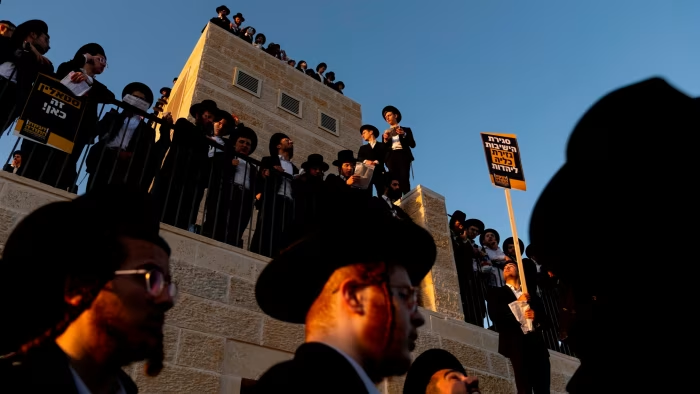
Benjamin Netanyahu faces a parliamentary revolt over a controversial bill to draft ultraorthodox young men into the military after two years of war in Gaza brought the flashpoint issue to the forefront of Israeli politics.
A bill drafted by a member of Netanyahu’s Likud party and ultraorthodox parliamentarians has this week drawn an immediate backlash from opposition lawmakers and even some from the Israeli premier’s coalition, who argue it does not go far enough to induce people to enlist.
A lack of support for the bill, which aims to fulfil requirements laid down by the supreme court, could pose a risk to Netanyahu’s governing coalition.
Under a compromise dating back to Israel’s founding in 1948, young men from the ultraorthodox community, known as Haredis, have been exempt from compulsory military service if they instead enrolled in a yeshiva, or religious school. The vast majority choose this route.
The issue — along with lavish state subsidies for the ultraorthodox community — has divided Israeli Jewish society for years, with demands growing that the Haredis do more to “share the burden” of national service. All Jewish Israeli citizens are required to serve at the age of 18, with men enlisting for roughly three years and women for two.
As the Haredi population has soared, the total number of ultraorthodox men exempted has grown to more than 80,000.
The supreme court in 2012 found the arrangement inequitable and unconstitutional, and has since issued multiple rulings — to no avail — requiring successive Israeli governments to legislate to force more Haredi men to serve. The court has not called for Haredi women to be conscripted.
After more than two years of war, the issue has gained greater public urgency. The military has said it needs thousands of additional combat personnel to secure multiple active fronts and backfill the ranks when troops have been killed or injured, with reservists increasingly being called upon to serve for hundreds of days in uniform.
Parliament’s foreign and defence committee this week began deliberating the new bill, which was drafted by committee chair Boaz Bismuth, a member of Netanyahu’s party, with heavy input from ultraorthodox parliamentarians.
Ofir Sofer, the immigration and absorption minister from the Religious Zionism party, called it a “disgrace” and said he would vote against it even if Netanyahu threatened to sack him.
“For the past two years I have tried repeatedly to appeal to the Haredi leadership. I found a deep cultural gap . . . Some spoke about the need for change, but regrettably did not give that any practical expression,” Sofer said.
 The Religious Zionism party, led by Bezalel Smotrich, issued a statement saying its MPs would ‘only vote for a bill that brings real conscription’ © Chip Somodevilla/Pool/AFP/Getty Images
At least two more parliamentarians from the party — a key member of Netanyahu’s coalition, which represents a constituency that is both religiously observant and serves in the military — said they would vote against the bill.
The party, led by far-right finance minister Bezalel Smotrich, later issued a statement saying its MPs would “only vote for a bill that brings real conscription”.
Five members of Netanyahu’s own Likud party also demanded changes and indicated they could vote against the law, as did a more extreme Haredi political faction that opposes any military service.
The incipient revolt puts into serious doubt whether Netanyahu has the votes to pass the current draft bill, known by its opponents as the “draft dodging law”, without significant changes.
Such alterations could draw opposition from the wider Haredi parties and imperil his government.
Analysts are also uncertain whether the current version of the bill, which includes lax enlistment targets for Haredi young men and delayed sanctions if those targets are not met, will pass legal muster before the supreme court.
The ultraorthodox factions nominally resigned from the governing coalition in the summer over the imposition of court-mandated subsidy cuts on its institutions and the lack of a favourable solution to the draft crisis.
But the parties, which have for years backstopped Netanyahu’s coalitions, have so far refused to take active measures to topple the government and disperse parliament.
Netanyahu has for months attempted to find a workable solution, and despite public and parliamentary anger still appears intent on pushing through the bill in the coming weeks.
He fired the previous chair of the foreign and defence committee, Yuli Edelstein, in October as he sought a less stringent version of the legislation.
Speaking at the committee hearing on Monday, Edelstein argued the current “bill’s goals might be anything, [including] apparently protecting the coalition, but it certainly was not conscription”.
“If this bill is passed, it will damage national security” since it does not address the army’s acute needs, he said.
Recommended

The committee also heard testimony from relatives of soldiers killed in action during Israel’s recent regional wars — which also included active ground campaigns in Lebanon, Syria and the occupied West Bank — and spouses of reservists who spoke of families crumbling under the pressure of months-long deployments.
Hagai Lober, whose soldier son was killed fighting in Gaza, told the committee on Monday that he voted for the current government, but slammed the bill for differentiating, as he put it, “between blood and blood”.
His children, he said, served for a combined 900 days in the reserves over the past two years. “We do it because there are not enough people. If you were born to the right sector, then your life is a lot more secure in the state of Israel,” he added.