
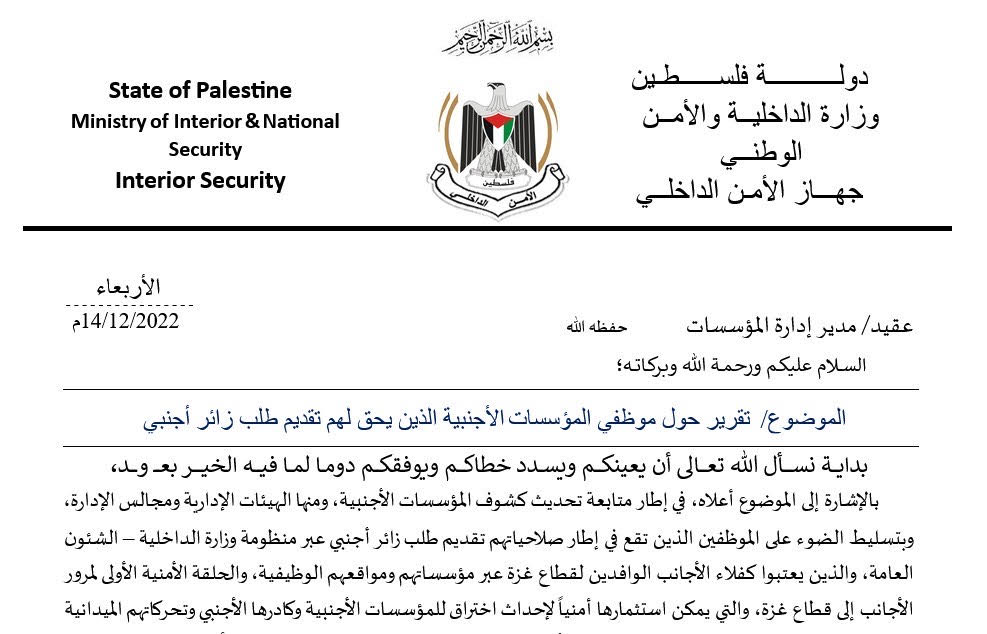
BERLIN – Internal Hamas documents seen by Euractiv reveal that the EU-designated terror group was closely monitoring international NGOs working in the Gaza Strip by requiring that trusted liaisons work with the organisations, several of which receive direct EU funding.
The documents, dated between 2018 and 2022, were found in the Gaza Strip by Israeli authorities during the war that began after Hamas led a terror attack on Israel on 7 October 2023.
The Israel Defense Forces (IDF) declassified the documents, and researchers from the Jerusalem-based institute NGO Monitor analysed digital and physical copies. The organisation later shared the documents and their findings with Euractiv.
The documents offer a unique insight into how the Interior Security Mechanism (ISM), a special unit within the Hamas Ministry of Interior, monitored and approved the projects NGOs implemented in the Gaza Strip. The files also suggest that European NGO’s, however unwittingly, were collaborating much more closely with the terror group than previously understood.
The war between Israel and Hamas has increased the need for humanitarian assistance in the territory. However, even before the most recent conflict, which paused in October following a US-brokered ceasefire, the Hamas-controlled Gaza Strip was heavily reliant on international assistance, especially from the EU.
NGO ‘guarantors
Researchers from NGO Monitor said that Hamas used so-called “guarantors,” or Gazans who serve as a point of contact between Hamas and the respective NGOs. These so-called guarantors were often given influential administrative positions within the NGOs, such as director or board chair.
While some of these individuals were members of Hamas, others are described as trusted sympathizers or as “affiliated with Hamas”. That latter term was used to refer to a member of the Italian humanitarian NGO Cesvi, which the EU has funded.
A December 2022 document lists the personal details of several guarantors, further stating that these individuals could be “exploited for security purposes in order to infiltrate foreign associations, their foreign senior personnel, and their movements.”
The extensive surveillance of the guarantors also resulted in detailed descriptions of their religious behavior, attire, internet activity, and political convictions.
The documents also revealed that Hamas had extensive knowledge of the organisations’ inner workings. In a 2020 report, Hamas authorities noted that the offices of the International Medical Corps (IMC), a global non-profit, were closed for a week because it refused to submit financial and administrative reports to Hamas. After the EU-funded NGO complied with Hamas’s orders, its offices reopened.
In a December 2022 document, Hamas authorities noted that the current IMC administrative director is a member of the terrorist group, holding the rank of captain.
The Oxfam connection
The documents also showed that Hamas sought to exploit the NGO’s work for its military activities.
In a document dated 16 June 2021, Hamas noted that the organisation Oxfam partnered with a local Hamas-linked group to implement an irrigation project for fruit trees. The terrorist group asserted that the project would aid their military objectives.
The Oxfam water project took place in a “border area and is security sensitive,” Hamas noted, adding that the fruit trees “are known to be a cover for resistance activities in border areas.
The NGO Monitor researchers said that Hamas “ensured this Oxfam project was implemented in a manner consistent with maintaining and concealing tactically advantageous positions for its forces.” The EU funded the project with 800.000 euros.
The organisations Cesvi, Oxfam, and IMC did not respond to Euractiv’s requests for comment at the time of publication.
Infiltration and control
The internal documents prove for the first time Hamas’ infiltration and control of Gaza’s humanitarian ecosystem, NGO Monitor’s Vice President Olga Deutsch told Euractiv.
Those Hamas memoranda are “detailing its formal network of monitoring, controlling, and influencing NGO activity,” Deutsch said. “Yet never once did NGOs say anything about this Hamas infiltration and repression.”
As the time for Gaza reconstruction draws closer, German MEP Niclas Herbst has called for proper vetting mechanisms for NGOs working in the Gaza Strip.
Since 2019, the EU has required that grant beneficiaries and contractors ensure that no subcontractors, participants in workshops or training, or recipients of financial support are subject to EU sanctions. That would apply to EU-designated groups such as Hamas.
“The EU Commission must finally take its own rules seriously and enforce them,” Herbst told EURACTIV. “If NGOs are not complying with EU rules regarding terror groups like Hamas, they can no longer receive EU funding.”