
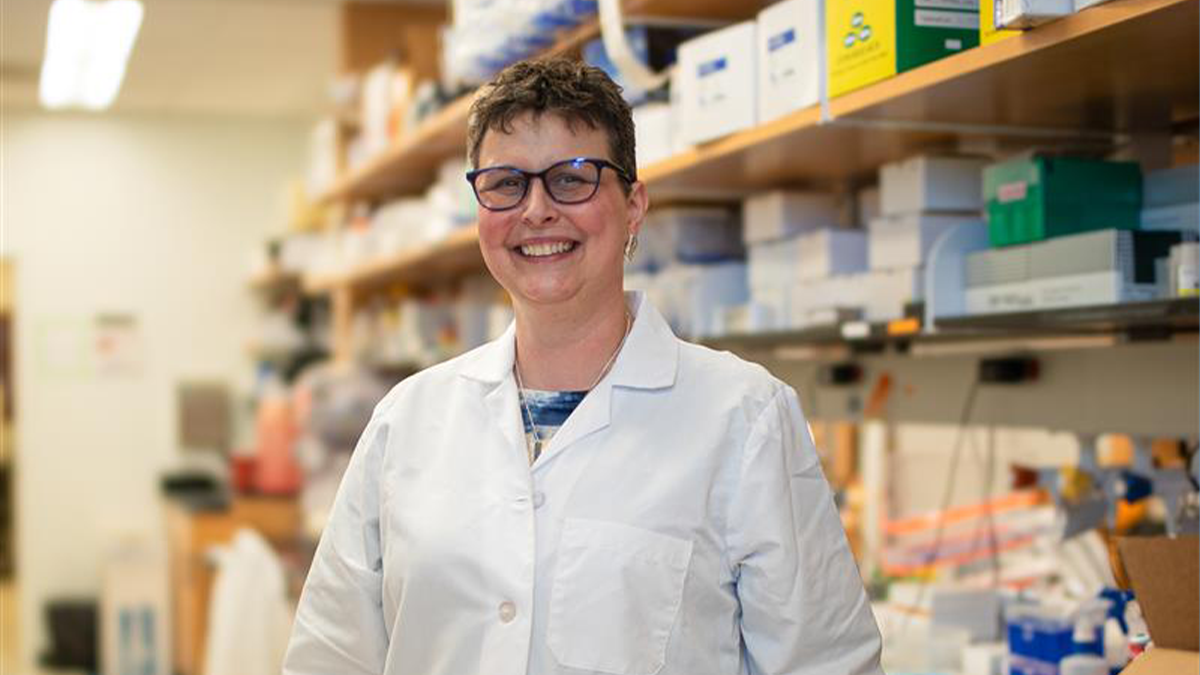
For Samantha Pattenden, cancer research has always been personal. She remembers when she was an undergraduate and her grandfather, diagnosed with colon cancer and confused about his treatment, called her for information. “These are the drugs they are giving me. What are they?” he asked her.
At the time, chemotherapy options were “really nasty, nontargeted chemo drugs,” she recalls. That conversation sparked a drive to understand how cancer drugs work, and how to make them better. Later, her own experience with battling breast cancer gave her a patient’s perspective when doing her own research.
Today, Pattenden is an associate professor in the division of chemical biology and medicinal chemistry at the UNC Eshelman School of Pharmacy. A doctoral graduate from the University of Toronto and later a postdoctoral researcher at both the Stowers Institute in Kansas City and the UNC Eshelman School of Pharmacy, she has built her lab around chromatin biology and its central role in cancer.
As Pattenden explained, her lab focuses on chromatin, the scaffold that packages DNA into a cell nucleus. For the DNA sequence to be read, the chromatin needs to be opened. Her work highlights how these accessible “openings” in chromatin often give cancer cells their identity and drive their growth.
Pattenden’s lab is tackling some of the toughest challenges in pediatric oncology in two major projects.
One project focuses on Ewing sarcoma, a bone and soft tissue cancer in children and young adults. Working with Dr. Ian Davis, chief of pediatric hematology oncology at UNC Children’s Research Institute, Pattenden’s team worked to uncover compounds that might counteract the effects of an abnormal protein. This abnormality opens chromatin in places it shouldn’t, activating gene expression programs that drive tumor growth. Her lab designed an assay to target its activity — specifically, its ability to open chromatin.
With support from the National Cancer Institute’s Experimental Therapeutics program, the team screened more than 120,000 compounds. After three years in the NExT program, and over 15 years of research at Carolina, they are now narrowing down compound candidates that might one day move to the clinic for testing.
“We’re talking about the molecular mechanism, so we’re getting right down to the cellular level,” she said. “Success for us looks like finding a new target or a new way to target a key pathway in the tumor cell.”
A second major effort is aimed at the aggressive pediatric cancers osteosarcoma, a cancer that begins in the cells that form bones, and neuroblastoma, a cancer that starts in immature nerve cells.
Whether working with pediatric oncologists, chemists or engineers, Pattenden views teamwork as essential. “I think the only way any of these projects would be possible is because of collaboration,” she said.
Ultimately, her motivation circles back to patients. Cancer is not one disease but many, each requiring new ideas and new tools.
“These diseases are so complicated. Because cancer isn’t just one thing, it’s many, many, many things, we need this kind of research,” she said. “Our goal is to ultimately find a target that we can modulate with a small molecule to specifically target the cancer so that we don’t negatively affect normal cells in the process.”